A Guide to this Blog

Showing posts with label New Mexico. Show all posts

Tuesday, September 29, 2015

New Mexico to Texas (Day 11)

Post Office Box, Roswell
I would never have imagined waking up this morning that I would shortly find myself being interviewed on a Chinese TV series about America.

Nicole and I check in to the International UFO Museum and begin a walk through each of the bays that illustrate the various perspectives of what happened in Roswell, 1947. The first thing I will say is, standing in the museum, reading all of these eyewitness accounts from U.S. soldiers and Roswell residents, that it's pretty hard to refute that something very sketchy happened here in 1947. Especially creepy is the transcript from an unaired radio interview that shows the discoverer of the crashed ship talking about the non-human bodies found there. 

Museum from outside.
Every month they clear this board so the next month's visitors can mark where they've come from.
I'm not saying that it was definitely an alien ship that crashed here, but I challenge anyone to come to this museum and walk away believing the official story of a weather balloon crashing. 

Crash!
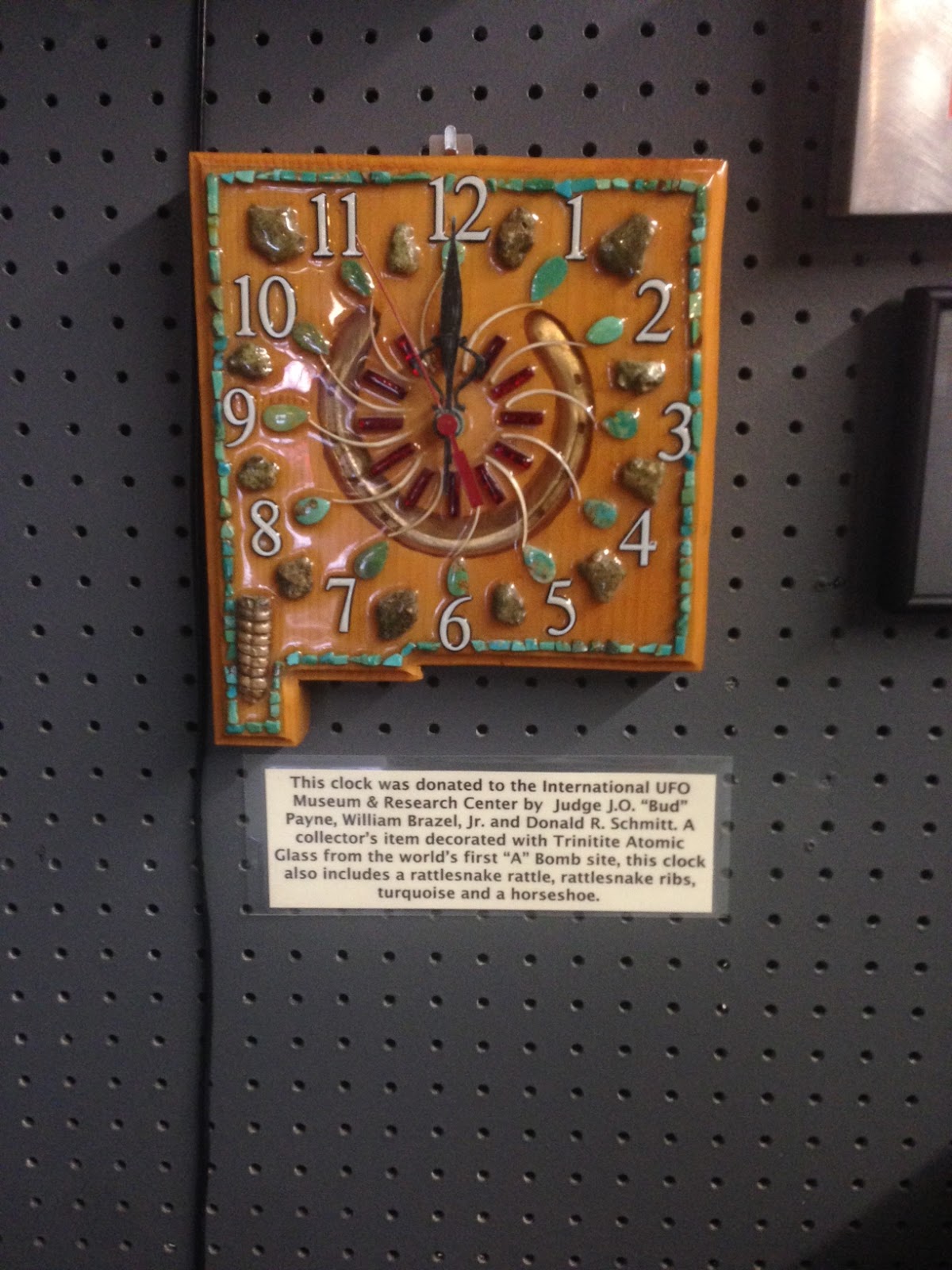
This clock is made from rattlesnake bones, turquoise, and glass created in the desert sand by atomic bomb testing.
We've come to give your town meaning!
About halfway through our tour, I notice a Chinese film crew moving about the museum from the opposite direction. I take a few sneaky snaps and then think nothing more of it.

An American couple come over to me and ask if I can take their picture in front of the big flying saucer in the centre of the museum. As always in these situations, I defer to Nicole and her superior photography skills. The American couple then introduce themselves as Gary and Michelle. Gary is an astronomer who has travelled all the way here in his RV from New Jersey in just three days. 

Then, BAM. The producer of the Chinese TV show comes over and asks if they can interview all four of us for their documentary series. 

TV crew in action
So there we are, standing on either side of a presenter as he speaks very fast in a language none of us understand. The producer then translates for us. They want to know if we've seen any UFOs. Gary launches into several stories regarding UFOs that he has sighted in his time as an astronomer. Nicole and I, struggling to think of anything that would be relevant, talk about the weird lighthouse we saw back in Area 51. They seem very interested but Gary is easily the star of the show, his emphatic anecdotes about UFOs draw their attention further and they speak to him at great length. 

Nicole and I try to edge away from the interview, sensing (and hoping) that we're no longer required. 

But the producer pulls us back in! I think she just likes the look of having four of us standing in front of the camera. The presenter shakes each of our hands and says "Oh my god" in English when Gary gives him what must be quite a firm handshake. The Chinese presenter strikes a big muscly pose after the handshake to illustrate the strength of it, but Nicole suspects he might be mimicking our ballooning American waistlines. Either way, it's a very surreal situation.  

Gary talks to us some more after the TV crew move on. He tells us that he and his girlfriend are headed to Chaco Canyon next and up through the Extra-Terrestrial Highway. It's like they're doing our journey in reverse. We bid them farewell and continue our look around the museum.

Gary and Michelle are in the middle. The lady on the left is Tammy Fang, a local guide for the Chinese TV crew, and on the far right is her husband.
Artist's representation of U.S. soldiers discovering a Nazi flying saucer in WWII.
Props from the film Roswell
The UFO museum is obviously the only real reason that tourists come to Roswell. It's a busy place, and the displays are impressive and legitimately interesting. And, much to my amusement, every time the sceptic in me voices a thought, Nicole touches her ear and listens to an imaginary transmission before telling me in an official voice that I have to leave. 

By the time we get out of the museum it's midday and we decide to divert a little ways south to see one more attraction in New Mexico before we move on to the next state; the Living Desert Zoo and Gardens in Carlsbad. 

Another fun store in Roswell is Nifty 50s, which is easily sighted from the road when you notice this car.
Nifty 50s in Roswell
Great photo op inside the store.
Friendly staff too!
Living Desert Zoo and Gardens entrance just outside Carlsbad.
It's a fairly short drive of about an hour, and the zoo is really well set out. Being Tuesday, we almost have the place to ourselves, so it's nice to stroll through the zoo's replications of the various habitats from the Chihuahuan Desert. The gardens are beautiful, and we see tiny lizards run across our path into the cacti. Better yet is when we suddenly freeze at the realisation that the large bugs buzzing nearby are hummingbirds. I had no idea they were that small! 

The zoo features a walk-in aviary where you can watch roadrunners as they dart back and forth with their heads held low.
The Javelina is also known as the Collared Peccary and is found throughout south-western America. Although they look a lot like pigs, they are actually only distantly related.
Inside the nocturnal house with forced facial expression.
Finally got to see a Gila Monster. It was surprisingly animated, and kept opening its mouth while slinking around its enclosure. The Gila Monster is one of only two venomous lizards in the world.
These Prairie Dogs were rad too. They can live in colonies of up to 1000 individuals. The zoo's group is a rather conservative 30 or so individuals.
The zoo also has some Pronghorns. This skull illustrates how the Pronghorn differs from deer and antelopes. Its antlers are made of bone and have a sheath that can be shed. The Pronghorn is the only living remnant of an ancient and otherwise extinct family of hoofed animals.
The zoo feels like a real desert at several points, especially as we bake in the very real heat. Nicole is more than ready to beat a quick retreat to the air conditioning of the car once we're done.

We don't really have a set destination today so we decide to just head east and get as close to Dallas as we can before it gets dark. As we drive through Carlsbad, Nicole keeps the car stationary well after a light has turned green. I notice that she's admiring her new turquoise bracelet from the Zuni Reservation. I subtly remind her to drive on before the car behinds us gets friendly with his horn.

The offending piece.
The drive to Texas is a lonely one. I get a little nervous after a while that we might run out of gas... the roads we've picked don't seem to go through any towns. Slowly but surely, the farmlands around us segue into oil fields - self-operating machinery dots the landscape around us and the air has a dirty haze to it. 

I feel tense for a while that we aren't going to make it to a gas station but don't let on to Nicole that I'm worried. After nearly 2 hours of driving through the big, industrialised nowhere of south-eastern New Mexico, we arrive at the town of Eunice. After such a hazy, eerie trip through the scattered oil fields, Eunice feels like the ends of the earth to me. We fill up on gas and drive on towards Texas. Before we leave I notice a kid playing with a large pile of sand-like dirt outside an abandoned store. I think to myself, that's nice - that kid is making sand castles. However, my opinion changes when he ducks behind the huge dirt pile and then re-emerges with a big earthy clump that he throws at the traffic just behind us. Boredom breeds brats.

Day 11, State 6
Oil fields
The view west, behind us
America - land of capitalism and long signs without adequate spacing.
For one last time we time travel into another time zone as we finally reach the state line for Texas, losing an hour as the sun sets behind us. The oil fields intensify as we drive past Andrews and Odessa, and I notice one that has been set alight in the distance - a huge plume of bright orange flame visible on the horizon. I wonder why it's been lit, if it's an accident or something they do on purpose, and it's something I don't think I'll ever know. That makes me a bit sad.

Nicole had this spud for dinner from McAlister's Deli. She tells me it was good.
Around 7:30 pm we reach the city of Midlands and work our way through three hotel receptions before finding one that's A) available, and B) cheap enough to cater to our Australian dollar.

Monday, September 28, 2015

Albuquerque to Roswell (Day 10)

Welcome to Roswell
In a stunning snap of coincidence, we wake up in eager anticipation of NASA's news conference about the Mars discovery and it's the same day we're planning on going to Roswell, the New Mexico town famous for its own dalliances with space lore. 

Unfortunately the NASA press conference isn't until around 11 AM and we won't have WIFI access until tonight, so we spend most of the morning speculating as to what it could be. Is it aliens? Water? Aliens that live in water?

The walk up Boca Negra Canyon
Before heading down south towards Roswell we drive about 10 miles out of Albuquerque to see the Petroglyph National Monument at Boca Negra Canyon (Spanish for 'Black Mouth'). It's not far from the city and it's still temperate enough for a nice hike. The petroglyphs are markings made by the local Pueblo peoples about 700 years ago, and they can be found on the sides of large black rocks that are scattered all over steep volcanic hillside in this area. 

One of many hundred petroglyphs in the area
As we start hiking up the chaotic pathway we see an older couple coming down towards us, the woman in a NASA T-shirt and the man dressed more formally. They stop to try and take a selfie and Nicole offers to take the photo for them. The man asks us where we're from and they tell us that they work for NASA as scientists.

"We're pretty excited about that Mars announcement", I say, hoping for some information. 

The couple look a bit sheepish, and the man says that he's meant to be at the conference right now but that he and his wife were unable to make it back in time from their trip.

"Do you know what it is?" Nicole blurts out eagerly.

The man has an easygoing smile, "I have my suspicions... I think they've found permanent water".

We chat a little more and the woman gives us a NASA pin each. It's forty minutes before the announcement so we feel pretty special now that we know what the news will probably be. Nicole is really chuffed.

This snapshot of our GPS shows you what roads are sometimes like in America's big cities. Look at that craziness! And this was in Albuquerque, where the highways aren't nearly as stressful as somewhere like L.A. or San Francisco.
Afterwards we start our trip south and take another diversion when we see signs for Wildlife West Zoo. It turns out not to be a real zoo but a wildlife sanctuary for injured and illegally domesticated animals. The lady inside asks us if we've been touring along old Route 66. We haven't, but this explains why this animal park is so quiet and run down. Route 66 was once clearly a thriving tourist route but has now been reduced to hundreds of struggling or closed-down attractions - Wildlife West amongst them.

Wildlife West Zoo
Donated carving outside of Wildlife West Zoo

The lady thanks us for our interest and gives us a bit of background on the refuge. The sanctuary was built with labour  from youth programs, is staffed by volunteers, and is entirely non-profit. This is pretty cool.

We see only one other group of people the whole time we're there. All of the animals are local - Horned Owls, various other birds of prey, some rare Mexican Wolves, Coyotes, Deer, and a rather sleepy Black Bear. I feel sad for a lot of them... not because they're in captivity, but because nearly all of them are incapable of living in the wild due to the influence of humans. A lot of the birds were injured by cars, and some were kept as pets and then released. Unfortunately, once an animal has become 'imprinted' on humans it is no longer able to survive in the wild; unable to hunt food with the same ferocity, and no longer afraid enough of humans to safely avoid them.

Crested Caracaras, a kind of bird of prey that prefer to mostly stick to the ground. These two are named Max and Polly and were illegally kept as pets. As you can see, they are very inquisitive and not at all afraid of humans.
At one point we get hopelessly lost in the animal park, walking up and down dirt trails that lead nowhere - losing all sense of direction. Luckily, Nicole leads us back and then we come to standstill as something yellow, white and black coils across our path. I creep forward a little and take some photos from a safe distance as the snake crosses to some bushes on the other side.

As you can see, this snake was at least a metre long. I think it was a Painted Desert Glossy Snake.
A brief highlight of the park (for me) is finally getting to see a Pronghorn Antelope. This animal is sometimes mistakenly identified as the only North American antelope but it's not actually an antelope at all. It's a unique prairie-dwelling relative of both deer and antelope, and is actually the fastest animal in the Americas - able to reach up to 60 km an hour and sustain such a high speed for even longer than a cheetah.

This bus is part of the wildlife sanctuary.
The drive south to Roswell is fairly uneventful after this point. We hope to stop in Encino (definitely not the one from the movie) for gas but this little place is nearly a ghost town. We see boarded-up houses, a burnt-out motel, gutted gas stations and a tiny house with a huge sign that proclaims 'El Bandido' in big scratchy hand-painted letters.

This gas station sink symbolises the decay of non-freeway America
This little abandoned diner from south of Albuquerque does too.
The huge open spaces and dusty, abandoned buildings throughout America are a little haunting after a while.

Ah yes, finally! Look at that stereotypical diner.
From the outside
A few miles down the road from Encino we reach Vaughn, a more sustained little town with at least two staffed gas stations and a single diner. The diner is really cool, a nicely furbished restaurant in that kitschy '50s roadside Americana style that we'd been looking for. The staff and food are both great, and the diner gleams from outside like some kind of futuristic space ship.

The temperature continues to rise quite unreasonably as we head south, hitting the 90s. Nicole pumps the air conditioner in our car so high that her right arm becomes intensely cold from the vent next to the steering wheel. She pushes it up against my face and it's so cold that it feels like chicken loaf from the deli. Gross.

Around 5 pm we pull into Roswell.

Street art on store wall in Roswell.
Roswell is not what we expect it to be. It's fairly large and there is little to initially indicate its fame as the alleged 1947 crash site for an alien ship. We expected alien paraphernalia everywhere and the sort of '50s/'60s Americana retro nostalgia that populates the televised version of small town America. Instead, the first few miles of the city are pretty standard and boring - the same 30 fast food restaurants, Walmart, military academy, etc.

Store window in Roswell.
I like the store hours on the sign.
Little green footprints on the pavement in the UFO quarter of Roswell.
Black light display inside one of the alien stores.
I remain optimistic as we drive on but Nicole is disappointed. I hope that the International UFO Museum perks her up some but it's closed by the time we get there. This end of town seems to be the 'UFO/Alien' quarter though, and there are a few alien-centric curio stores still open (see pics above). Most of these stores are filled with daggy T-shirts and a few Roswell-related knick-knacks, and - if I'm honest - the flavour is more distinctively tacky than kitsch.  Then again, kookiness and sophistication have never gone hand in hand.

I had Asado from a Mexican restaurant called Tia Juana. It was a great dish, big thumbs up from me!
We'll head back to the UFO Museum tomorrow morning.

Sunday, September 27, 2015

New Mexico and Zuni Reservation (Day 9)

Zuni Sun Face, a representation of the Sun-Father, one of the three main deities in Zuni religion
The first thing I notice about New Mexico in comparison to Arizona is that there are a few more trees around. Granted, they are fairly small trees, but it's not quite the same flat, sage brush desert that we've grown accustomed to over the last couple of days. You also know that you're closer to Mexico when you see three guys slouched in the tray of a pick-up truck on a highway.

The road to Albuquerque is a straightforward interstate freeway that would take about 2 hours to drive along from Gallup, but that sounded boring so we decide to head a little further south to take the old highway, Route 53, which has more historical significance. Whilst this way is still modern enough to drive along in comfort, it actually has roots that reach back into the 16th century and earlier as a exploratory trail for the Spanish.

Display in a local museum depicting the arrival of the Spanish and their Catholic missionaries.

There is a heavy Spanish influence throughout New Mexico, something seen in the presence of Catholic missions hidden all the way out here in the pinon-juniper woodlands and desert. Our trip along Route 53 takes us through three layers of history - the most recent is the American history of the area, which dates back to 1848 (when America won the territory after the American-Mexican War). Prior to this is the Spanish history, when Nuevo Mexico was a province of New Spain. And before this is the indigenous history - of the Pueblo peoples (the Zuni and the Hopi), and the nomadic Apache and Navajo tribes.

Unlike the nomadic tribes of Native Americans, the Zuni and Hopi are settler peoples who built pueblos (cities). These mud and stone-brick buildings can be found all over America's South-West, some of which date back to the 13th century.

Zuni hornos. These are outdoor ovens that can be seen in the backyard of nearly every Zuni home.

So we head a little further out of the way so that we can visit the Zuni Reservation, and drive through the shadow of their sacred Corn Mountain, a huge rocky outcrop that towers over the township and the flat lands that stretch beyond.

Our drive is a little confused at first; we reach the Zuni Information Centre and find it closed. A gas station attendant a few doors down, Charles, is a great help to us in checking the car over to make sure we haven't run it into the ground yet, and he spurs us on by telling us of the beauty of his culture and the reservation. He encourages us to keep driving on.

The township is quiet, and many of the stores have shut down. Photography permits are needed if we want to take photos of the restricted area of the town so we simply drive around a bit and observe the mud-brick buildings along the tight-knit network of dirt roads. The Zuni Reservation is the site of the largest of New Mexico's pueblos, but we are only able to see it from a distance at the bottom of a walled off hill within the community.

'The Turquoise Village', a jewellery store in the Zuni Reservation

A visit to one of the town's only open stores reveals that the tourist aspect of the town is well in decline. The owner of this business is philosophical and honest, explaining that the tastes of American tourists have changed in more recent times. In the 1990s, Zuni tourism was thriving and you could hire a guide to take you into the pueblo. Today, there just aren't enough visitors to support such an industry.

It's a real shame. Not because this means we can't go into the pueblo but because it means the people here have become financially isolated from the rest of the country. Haven't the Zuni been through enough? Not only did they have to survive American colonisation, before that they faced the full zeal and fervour of the Spanish - who came to the area to conquer and convert the Pueblan peoples to Catholicism whilst searching for the fabled Seven Cities of Gold.

Continuing on towards Albuquerque, we leave the reservation and re-enter American New Mexico - a territory marked by scarecrows in cornfields and late 19th century-styled cottages. We stop in the town of Ramah, where we don't see a single person. We get out to take a look at the local museum and Nicole shrieks as a cloud of locusts erupt around her. She quickly returns to the car after we realise the museum is closed.

Museum in Ramah
By this point it's nearly 3 pm so we stop for lunch at a remote Navajo diner called La Tinaja. The menu is predominantly Mexican food, something I've been waiting for. The restaurant's host, Teresa, unabashedly tells us that the salsa comes from a bottle, but that it's also "the best bottled salsa you can buy". The food is great, exactly what we needed, but Teresa's service is the best thing about the place. She tells us about the local area and gives us a lollipop each for being good customers. 

La Tinaja Restaurant
Taquitos and green chili.
Teresa and her perfectly preserved cash register
Eating Mexican food reminds me how much I've missed fruit and vegetables. Getting fruit is really hard in America! Just this morning I was over the moon that our hotel offered apples for breakfast. Then I bit into one and had to chuck it away. Apples shouldn't be spongey.

El Morro
Next stop is El Morro, another towering sandstone outcrop in the flat wilderness. This one has particular significance as a symbol of the layers of history in the area. As El Morro is also home to shaded pool of fresh water, it has been a stopover point for nearly every group in the area for at least a thousand years or more. The proof of this can be found in the form of inscribed graffiti all along the bottom of the sandstone outcrop. 

Peachy Breckinridge was an American who helped lead 25 camels across New Mexico in 1857. It was hoped that this expedition would prove that camels could be useful to the U.S. Army but then the American Civil War broke out, and Breckinridge died 4 years after he made this inscription while fighting in Virginia.
Don Juan de Onate made this inscription in 1605 (a full fifteen years before any English settlers had landed in America). Onate was the Spanish Governor of Nuevo Mexico.
Petroglyphs made by tribal people before European settlement.
It's a pleasant walk, and the inscriptions are a fascinating insight into hundreds of years of history in the wider area.

Home along the roadside in Acoma.
One more stop we take before we reach our destination is a trip into the Acoma Reservation. This diversion is taken on a whim and turns out to be the real highlight of the day. The car winds its way through hillsides covered in traditional stone and mud-brick buildings that are still inhabited, and a rather peaceful drive along a 16 mile road leads us to 'Sky City', an area named for a very special pueblo perched upon a mesa out in the desert. 

View of Acoma Sky City from afar. Note the road leading towards it.
Why is it so special? The pueblo is one of the oldest (if not the oldest) continuously inhabited places in the United States. It has been estimated that tribal people have lived in this pueblo for nearly 2000 years. Travel up into the pueblo is, of course, forbidden to tourists, but a view is allowed from just below the clifftop. 

Closest photo I could get whilst remaining respectful. Click to enlarge so you can see the pueblo on top of the mesa. If you look up 'Acoma Pueblo' on wikipedia you can see some fantastic aerial shots.
The view into this area, and the pueblo itself, feels and looks like a whole other country.

I know I've said things like this on my blog before, but it's truly awe-inspiring.

The tamale is a staple of Mexican cuisine that I have not been able to find in any Mexican restaurants in Australia. This picture shows the one I had for dinner tonight. A tamale is a mixture of ground corn and other fillings cooked within a cornhusk. It is delicious and quite filling!
Another hour or so of driving brings us to Albuquerque, the capital of New Mexico. May told us that it's "the gem of the desert", named for the huge mass of sparkling lights that are visible as you approach it, but as it's still daylight it takes a little while for us to realise why it has this name. It looks like quite a big city but it turns out to be a lot easier to navigate than San Francisco.