This blog post offers an overview of the Prescribed Texts for the Advanced English 'Craft of Writing' module. In the study of this module, teachers are required to teach TWO of the Prescribed Texts. There aren't any prescribed editions for these texts, which means that they don't have to be sourced from particular anthologies or websites (NOTE: There are multiple versions of some texts, such as Tennyson's poem 'The Lady of Shallot', but the ISBNs used in the
support document can be used as an indicator for the version that NESA likely used to establish the Prescriptions)
Special thanks to Kira Bryant for supplying me with the majority of these texts! I highly recommend her excellent twitter feed: @tirisays
Prose Fiction Options
With a higher expectation that Advanced English students will be prepared to read more (not always true, I know, but it's something to aim for), there is a wider selection of prose texts here than what is found in the Standard 'Craft of Writing' list. Of the 7 texts, two are novellas, one is an extremely long short story that may as well be a novella, and the other four are short stories. The stats for this section are as follows:
- 2 female authors, 4 male ones.
- 2 stories from the same author in one case.
- The 2 novellas are both from authors who have been dead for 100 years or so, whereas all the short stories are by living authors.
- 2 of the authors are Australian (one lived in London for a time, the other is of Vietnamese heritage), 1 is American, 1 is a Jewish-German writer from what was known at the time as Bohemia (now the Czech Republic), 1 is an Indian-born Canadian, and 1 is an Irish-born New Yorker.
 |
| Due to it's short length, Kate Chopin's novella is often packaged alongside some of her short stories. |
The Awakening by Kate Chopin
What is it: Edna is a disatisfied wife living in late 19th century Louisiana who begins to explore a dalliance with a younger man named Robert. As Edna moves into a greater state of self-actualisation she also starts exercising an increasing sense of independence - something that, in the context of America's turn-of-the-century South, is quite scandalous for a married woman.
Scope for Study / Verdict: My first exposure to this early feminist text was through the excellent HBO TV series Treme, in which John Goodman's literature professor poignantly recommends it to his students. In terms of reading, it's short in comparison to the other novels that Advanced students might be required to read, but also much longer than the majority of texts listed in Module C. I found it a little bit a slog at times due to my waning level of interest, however, I can appreciate the text's significance as a precursor to the modernist literature of the 20th century and as a proto-feminist tragedy steeped in metaphorical allusions to subversive sexuality. Context is key in this piece and will need to be explicitly taught in regards to the nuances of 19th century high society, the specific creole vernacular of New Orleans, and the casual racism that sees one character often referred to only as 'the quadroon'.
Page Count: 116 pages.
Source: As it was published in 1899, Kate Chopin's novel is well outside of the statute of limitation on copyright, and can therefore be found for free online in its entirety. One such link can be easily found via a Google search
here. You can also buy relatively inexpensive paper copies from various publishers.
 |
| Harrower worked as a reviewer for the Sydney Morning Herald in the 1960s. She published four books but retired from writing altogether in 1977 after finishing (and suppressing) her fifth novel. In 2014 she was finally persuaded to allow this 'lost' novel, In Certain Circles, to be released. |
'The Fun of the Fair' by Elizabeth Harrower
What is it: Janet, ten years old and resentful of being dragged along to a fun fair by her Uncle Hector, finds herself separated from her family and watching a sideshow featuring a giant and a dwarf. The depressing sideshow disturbs and awakens the young protagonist, with Janet experiencing a sense of adolescent anagnorisis.
Scope for Study / Verdict: Harrower's story is at once accessible and enigmatic, pulling focus in on the ten year old protagonist as third-person narrator. Students can gauge the story's effectiveness by examining the way Harrower both orients the reader and subverts expectations by not orienting the reader. Other features that will bear examination include Harrower's establishing and maintenance of setting, and the emotional journey taken by Janet (culminating in the mysterious ending).
Page Count: 14 pages.
Source: Elizabeth Harrower is an Australian author of international renown, and this particular short story can be found in her 2015 anthology A Few Days in the Country.
Metamorphosis by Franz Kafka
What is it: Gregor Samsa, a travelling salesman, wakes up one morning to find that he has transformed into a 'monstrous verminous bug'. His family reacts in horror, attempting to feed him, and Gregor gradually loses his humanity and becomes more bug-like.
Scope for Study / Verdict: As difficult and alienating as the content can be, I love
Metamorphosis and am very intrigued by the idea of teaching it. Students can be introduced to concepts and techniques such as: the idea of a text being 'Kafkaesque', the use and impact of visceral language, the challenges of translating a German text into English (see
this article for further discussion), symbolism and allegory, and the syntactical wonders of anacoluthon. Kafka's infamous and absurdly disgusting tale of early 20th century dehumanisation will provoke discussion if nothing else!
Page Count: Approximately 60 pages, depending on the edition.
Source: Published in 1915,
Metamorphosis can be found
online for free at Project Gutenberg. The author, Franz Kafka, was a German-speaking Jew who lived in Bohemia (the western part of the Czech region). He did not find fame during his lifetime, nor did he particular want it. He died at the age of 40 in 1924 from starvation after his throat closed up as a symptom of tuberculosis.
'Love and Honour and Pity and Pride and Compassion and Sacrifice' by Nam Le
What is it: Nam Le reflects on the processes and purposes of writing short fiction via the persona's involvement in an Iowa-based writing workshop; a semi-fictionalised account that intertwines with the author's Vietnamese-Australian father coming to visit in America. The complex and troubled relationship between the protagonist and his father gradually takes centrestage as the author wrestles with the implications of writing an 'ethnic' story about his own cultural past.
Scope for Study / Verdict: There's a lot of subtle undertones to this story of a father, a son, writing, cultural values, and the Vietnam War. It's a story that could be easily read by Standard students, but its placement in the Advanced English 'Craft of Writing' module cannily requires a deeper and more complex understanding of Nam Le's themes. In the case of 'Love and Honour and Pity and Pride and Compassion and Sacrifice' it will be the Advanced student's tolerance for ambiguity that sets them apart from their peers, particularly in regards to their ability to provide an independent reading of the ending and the discussion-provoking motif, "He had destroyed himself... in my name".
Page Count: 10 pages.
Source: Nam Le is a Vietnamese-Australian author who won an array of prizes for his short story collection
The Boat, published in 2008, in which 'Love and Honour...' is featured.
 |
| Fun Activity: do a Google image search on Colum McCann and count how many different images of him feature a loose, thin scarf worn in the above manner. |
'Thirteen Ways of Looking' by Colum McCann
What is it: A retired New York judge, infirm and reflective, is murdered one day after lunch with his son at a restaurant. Between the protagonist's perspective leading up to the event, the detectives investigating the murder, and the examination of available CCTV footage, McCann dissects the incident into 13 separate parts.
Scope for Study: As a teacher tackling the Craft of Writing with a class of students, it would be tempting to avoid this text simply due to it's length (it's listed as short fiction within the module but it's probably more accurate to describe it as a novella). Taking his cue from the poem 'Thirteen Ways of Looking at a Blackbird' (also featured in this module), Colum McCann gleefully attempts to hold down the English language as it squirms chaotically in his fist like a fragmentary cluster of multiplying worms. The inventiveness featured in the judge's stream-of-consciousness-like narration leaves a lot of scope for discussion and analysis - in terms of structure, style, intertextuality, characterisation, narrative voice, and reflexivity.
Page Count: 142 pages.
Source: 'Thirteen Ways of Looking' is the lead story in the 4-story collection Thirteen Ways of Looking by New York-dwelling Irish expat Colum McCann. This anthology was published in 2015.
'What Time Is It Now, Where You Are?' by Colum McCann
What is it: A writer muses on a short story he has been engaged to write about New Year's Eve. He settles on the conceit of a 26 year old marine stationed on her own in the Afghan night, and the phone-call she will make home to America to talk to her teenage son. Two stories unfold in communion with one another - the author arriving at decisions on what to write and why, and the marine preparing herself for her New Year's Eve phone-call. It's the same reflexivity alluded to in McCann's 'Thirteen Ways of Looking', only this time it's an explicit part of the story.
Scope for Study / Verdict: McCann's story is very much an exercise in metatextuality - he renders himself as a third person narrator, musing on the process of creating a short story, and tells the story within this framing device. The beauty of this is that it allows the author to describe the why and the how of each element of his story, and students will be able to essentially 'watch' the writer build a story from scratch - for example, the narrator's explanation of the characters' ages in part 6 of the story and why these are important in regards to the shape and intent of his story. This can be discussed in class in terms of why each minute detail of a story needs to be justified and used to a particular end.
Page Count: 12 pages.
Source: As per 'Thirteen Ways...', this short story is also featured in McCann's anthology Thirteen Ways of Looking, published in 2015.
'The Ghost of Firozsha Baag' by Rohinton Mistry
What is it: Jaakaylee is an old maid working for a well-off Parsi family in the Mumbai apartment building Firozsha Baag. Her job is mainly to make curry for her employers, however, the routine of her life becomes disrupted when a 'bhoot' (ghost) begins visiting her every night. When she tries to tell the other apartment residents their response is to make fun of her, which leaves her to try and figure out how to deal with the ghost on her own.
Scope for Study / Verdict: From the opening paragraphs, with the use of words like 'ayah' and 'bhoot', Mistry's short story has a strong sense of its Indian setting. This provides scope to ask students to consider how we deal with regional lexical items that are unfamiliar to us when we read. Other things to look at include the author's ellipsing of conjunctions and prepositions to establish character voice, and the way Mistry weaves characterisation, backstory, and plot together to explore themes of belief, respect, and social standing.
Page Count: 18 pages.
Source: Rohinton Mistry was born in Mumbai, India (then known as Bombay) and emigrated to Canada in his 20s to study English and Philosophy. The short story featured here is one of 11 tales set in the same fictional apartment complex, all of which can be found in Tales from Firozsha Baag, published in 1987 (Mistry's first novel).
Nonfiction Options
There are four options: three female writers, one male. Two are British, one is Australian, and one is American.
'How to Marry Your Daughters' by Helen Garner
What is it: In her reading of Jane Austen's Pride and Prejudice, Garner gains a new appreciation for the heroine's young sister, Lydia, the 'slack moll' who disrupts the plot and provides 'grit in the engine of the marriage plot'. This essay outlines Garner's reading of the classic novel and her interpretation of the events therein.
Scope for Study / Verdict: Garner is essentially modelling the process of critical engagement, exemplified in a beautifully understated fashion by the line "I sharpened a pencil and sat down at the kitchen table". This is followed up by such gems as 'Lydia Bennet, at sixteen, is a piece of trash' - a highly individualistic positioning that demonstrates the bravery and joy of an intelligent reviewer formulating an opinion on the page.
Page Count: 7 pages.
Source: This piece can be found in Everywhere I Look, Helen Garner's 2016 collection of non-fiction.
'Eight Days in a Corset' by Siri Hustvedt
What is it: Hustvedt recounts her time spent working on a film with a 19th century setting, and discusses the corset she had to wear as part of her role. Rather than tell the story of wearing this corset for the eight days of filming she instead ruminates on the idea of clothes and what they signify in our consciousness and culture.
Scope for Study / Verdict: The crux of Hustvedt's article is the idea of representation. She looks at the corset in both personal and socio-cultural terms, with attention paid to everything that it could possibly symbolise within these realms. Her confessional and candid tone illuminates the human condition in surprising ways whilst remaining tightly focused on this much-maligned and fetishised item of clothing. The assignment of this text to an Advanced English class will be partially reliant on the maturity of said students in discussing adult concepts in regards to the depth of thinking, feeling, and experience that the author brings to the topic.
Page Count: 8 pages.
Source: Hustvedt is an American novelist and poet educated in Norway, is best known for the novel What I Loved. This fashion-themed article can be found in A Plea for Eros, an essay collection published in 2006.
'Politics and the English Language' by George Orwell
What is it / Verdict: Orwell unleashes his inner pedant and goes full throttle in attacking what he perceives to be the biggest sins in mismanaging the English language when writing, deconstructing the common issues in political writing and issuing advice to those seeking to write clearly.
Scope for Study: In one sense, this essay invites the reader to look at some of the most common and overlooked mistakes used in writing, however, in another sense the teacher may wish to get the student to critique Orwell himself. I found this piece to be an incredibly dry and persnickety excursion into Orwell's own personal grammatical dislikes, and students should probably be encouraged to engage with it by decoding it in parts rather than aiming for complete comprehension. Despite its deficiencies, the piece does include some really quotable sections, such as "The enemy of clear writing is insincerity" and "Our civilisation is decadent and our language must inevitably share in the general collapse". The rules at the end of the piece will also be useful.
Pages: 10 pages.
Source: First published in the 1946 journal Horizon. This essay can be readily found online or in the Penguin Modern Classics anthology Essays by George Orwell.
'That Crafty Feeling' by Zadie Smith
What is it: Via lecture, Smith outlines her ten rules for writing, carefully pointing out the subjectivity and self-consciousness of her approach, and ensuring that the audience is aware of the key differences between a writer's arbitrary ten rules and an academic's. The piece is easily-read and relatively straightforward (perhaps owing to its origin as a spoken piece) but also illuminating in giving insight into what an established and critically appraised author really thinks about their own writing.
Scope for Study / Verdict: Here's the metatextual piece for this module. In this article, Smith discusses her own personal approach to the craft of writing, and as such it becomes perfect fodder for both looking at the rubric for this part of the syllabus and looking at how a writer disseminates ideas in relation to this. Things to consider include: the distance between author and reader becoming lessened somewhat by Smith's candid tone and low modality, and the author's concept of the relationship between rhetoric and truth as being mutually exclusive motives in and of themselves. Students might also like to consider some of the meta-language used here, such as whether they're a micro-manager or a macro-planner of their own writing when composing text.
Pages: 8 pages.
Source: This piece of writing started out as a lecture that Smith delivered to students as part of a Columbia University writing program in 2008. An author-edited transcript can be found in Changing My Mind: Occasional Essays, published in 2011. Zadie Smith is a British writing professor who came to fame with the 2000 novel White Teeth.
Speech Options
There are three speech options. Two are delivered by females and one by a male; two are Australian (one of whom, Pearson, is the sole Indigenous figure on this Prescriptions List) and the other is Canadian.
'Spotty-Handed Villainesses' by Margaret Atwood
What is it: Atwood examines some of the key facets in creating a novel and the practical demands of this. After laying this thesis out, she then examines the process of writing from a feminist perspective, focusing on the roles and lack of diversity amongst female characters, and the true meaning of an egalitarian approach to characterisation - repositioning the audience to appreciate the great unsung female villains of literature as feminist icons.
Scope for Study / Verdict: A provocative, highly intertextual and erudite speech that should prompt a range of conversations for teachers and students. References for further exploration include the 'Angel/Whore' dichotomy and Atwood's interest (as a novelist) in 'spots', the way Atwood uses and deconstructs idioms and clichés (EG. 'Flogging a dead horse') to manipulate tone and distance in relation to her audience, and Atwood's discussion of what a novel isn't. The author also builds beautifully on the contrast between the Shakespearean characters of Ophelia and Lady Macbeth (which is a bit of a shame for us teachers as Hamlet is no longer available as an Advanced English text).
Page Count: 8 pages.
Source: NESA have provided a copy of
the transcript on their website. Atwood delivered this speech several times circa 1994, and it has featured as a part of the English syllabus at various points from at least earlier than 2009. The transcript originated on Atwood's (now defunct) website 'O. W. Toad'.
 |
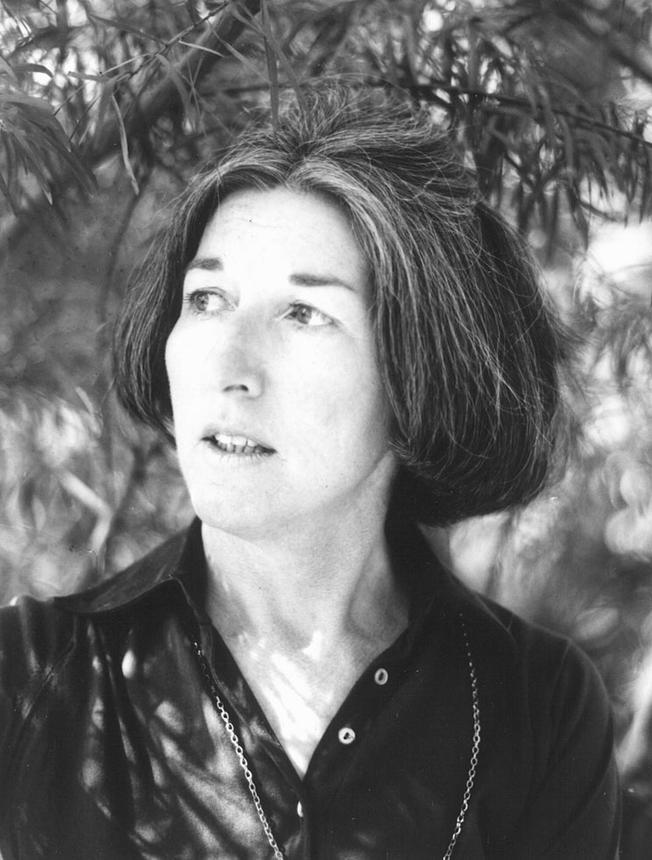
| Brooks, pictured in her own garden. |
'A Home in Fiction' by Geraldine Brooks
What is it: Brooks describes her development from journalist to novelist, and the ways in which the tools of her trade have informed her writing of historical fiction, and the ongoing search for meaning that drives her.
Scope for Study / Verdict: 'A Home in Fiction' is a highly metaphorical speech that lays out the English language like a nation, and describes the language of mathematics as a comparable realm of passion. Brooks ascribes to both disciplines the quest for truth, and gradually builds up a picture for the reader of her own relationship with the writing of fiction. The speech is very accessible and contains a multitude of highly quotable lines.
Page Count: 8 pages.
Source: A transcript of this speech can be found
on NESA's site. Brooks, an Australian novelist, broadcast this lecture in 2011 as part of the Boyer Lectures on 'The Idea of Home'.
 |
| Noel Pearson delivering his eulogy for Gough Whitlam |
'Eulogy for Gough Whitlam' by Noel Pearson
What is it: Beyond a eulogy for one who has just passed, Noel Pearson's powerful speech frames the death of Whitlam within a much wider discourse, as befitting Australia's most controversial Prime Minister. Pearson deals with themes relating to political legacy, the rights of Australia's Indigenous peoples, and the subtext of white privilege.
Scope for Study / Verdict: Through Noel Pearson's crisp and articulate rhetoric students should be able to engage with concepts of partisanship (or non-partisanship), intertextual motifs, the power of rhetoric itself, and the ongoing battlefield of political reform. In both the Advanced and the Standard collection of texts for the Craft of Writing it is easily the political eulogies that I would most like to engage my students with, being that they are so rich in rhetorical device in their interrelated dance between politics and vocabulary.
Page Count: 4 pages
Source: Noel Pearson is one of this country's most respected Aboriginal rights activists. He is also a lawyer and academic, and founded the Cape York Institute for Policy and Leadership. The transcript of the prescribed eulogy was reprinted in the Sydney Morning Herald on November 5th, 2014. It can be found online
here.
Poetry / Performance Poetry Options
There are five poetry options in the Prescriptions List. Three are male, one is female, one is non-binary; three of the poets are now deceased; two are Australian (one of whom was born in Singapore), two are British, and the other is an American.
'Stamp Collecting' by Boey Kim Cheng
What is it: The persona muses on the demise of the British colony of 'Malaya', his place of birth, and the stamp that bears its name. He explores the meaning behind the stamp, what it meant to him as a child, and the past it represents. Eventually he comes to see it as a token of his personal history that can be passed on to his daughter.
Scope for Study / Verdict: Students can use this poem to examine the way that the writer explores notions of identity, place, belonging, displacement, history, and symbolism. To what extent can a piece of poetry be viewed as the construction of a persona vs. a representation of the author's identity? Where are the lines between these two viewpoints blurred in 'Stamp Collecting'? In extrapolating these questions into an exploration of the craft of writing, students might also be asked to create their own piece of writing that uses an object from their past as a symbol of identity and legacy.
Length: 3 stanzas.
Source: 'Stamp Collecting' is a poem by the Singaporean-Australian poet Boey Kim Cheng, who is currently an Associate Professor at the Nanyang Technological University in Singapore. It can be found online
here, and in the 2013 anthology
Contemporary Asian Australian Poets (ISBN: 9781921450655). This particular poem was first published in 2008.
'Father and Child' by Gwen Harwood
What is it: This two-part poem 'blows up' two moments divided by a great many years, expanding on each in meaningful detail to examine the relationship between father and child. The first part concerns a child forced to use a gun to put a bird out of its wounded misery, and the second is a walk in which the child-now-adult reflects on the father's advanced age and his diminishment in the face of his impending demise.
Scope for Study / Verdict: The clarity of imagery and the deafening contrast between these two memorable visions of death will make suitable impact on the student (and teacher), and should prompt discussion on the themes of mortality and loss of innocence. Each part of the poem can be analysed on its own terms (with differences in pacing, allusion, and symbolism) despite the thematic webbing and perspective that ties them together.
Length: 3 pages; a poem in two parts.
Source: This diptych poem can currently be found in Gwen Harwood's 2001 volume of Selected Poems. From what I can gather (information online is scant in regards to which original volumes contained which specific poems), the first half of Father of Child may have first been published on its own in 1973. Garwood passed away in 1995 and was an Australian poet also known for her work in writing text for opera.
'Thirteen Ways of Looking at a Blackbird' by Wallace Stevens
What is it: Just as it says on the tin, Stevens comes at the humble blackbird in 13 different ways - describing environments, perspectives, moments in time, and feelings associated with the presence of this bird in his home state of Connecticut.
Scope for Study / Verdict: With its neatly partitioned sections, Thirteen Ways of Looking at a Blackbird initially seems to lend itself to easy digestion. On closer inspection though, Stevens seeks to break the idea of an overarching narrative and subverts the reader's expectations in terms of linking the sections through any unifying theme other than the mention of blackbirds. Students should instead be asked to consider what Stevens describes as 'the sensations' that are evoked throughout the poem, the unusual haiku-influenced structure employed to draw the reader's attention to each carefully-chosen detail, and the genre of modernism as a lens through which to examine the poem's wider context.
Length: 13 stanzas, ranging from 2 to 6 lines each.
Source: First published in 1917 as part of Others: An Anthology of the New Verse, a poetry collection edited by Alfred Kreymborg. More currently it can be found in the 2011 anthology Selected Poems by Wallace Stevens. The poet was a Pulitzer Prize winner and one of the most respected modernist poets of his age.
'The Lady of Shallot' by Alfred, Lord Tennyson
What is it: The Lady of Shallot is little known by the people around her; she sits in a tower on an island and has been cursed in some way. The poem describes her mystique, her solitary life, her impression of Sir Lancelot as he rides past her on horseback in his armour, and her tragic and enigmatic attempt to reach him by boat.
Scope for Study / Verdict: This epic poem in four parts is ripe for analysis in relation to the Craft of Writing, with room for close examination of the language used in constructing a narrative steeped in myth. For example, the repeated 5th and 9th lines of each stanza provide scope for students to examine the changing meaning of these words in relation to the context provided by each stanza, and Tennyson's use of rhythm and imagery evokes the romance of Sir Lancelot's passing of the Lady in her tower. The poem's place in the wider 19th century context will also allow students (and teachers) to further explore symbolism and intertextuality - in terms of the poem as a precursor to Victorian ideals of sexual repression, its role in making Arthurian myth popular again within the British psyche, and the many works of art inspired by the mysterious Lady who sits quietly in her castle.
Length: 19 stanzas, each one in 9 lines.
Source: The English poet Alfred, Lord Tennyson, was '
Poet Laureate' during much of Queen Victoria's reign.
The Lady of Shallot was initially published in 1833 as a 20 stanza poem, however, the more preferred version is from 1842 and has 19 stanzas. It can be found online, for free, in many places due to being well outside of the period of time allocated for copyright.
 |
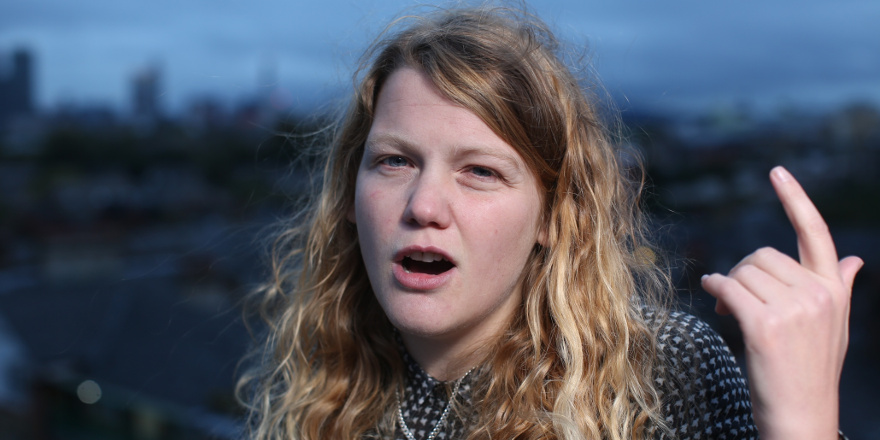
| Tempest is a cockney performance artist who has released three spoken-word albums |
'Picture a Vacuum', performance by Kae Tempest
What is it: The poet sermonises on a perspective of the wider universe, switching from first to second person to explore the relationship between the human and the cosmos. Some interpretations have taken an abstract approach of applying this piece to the metaphysical, whereas others have more literally identified Tempest's narrative as reflecting the perspective of someone who has taken a mind-altering drug, like LSD.
Scope for Study / Verdict: I can appreciate the inclusion of multimodal texts in the syllabus, and there is a definite need for more curriculum and resources that address the way that separate modes of communication can work together (in this case it would be Tempest's delivery of words in conjunction with the live incidental music that accompanies it). Having said that though, I can't help but feel that this piece sticks out sorely amongst so many other pieces that are focused wholly on the craft of writing in a more traditional sense. The idea of exploring multimodality needs to be distinct and not tokenistic, rather than a footnote at the end of each Craft of Writing Prescription List. There's a sense here that Tempest is either likely to be ignored by teachers or that their piece will stretch the scope of the module far beyond what the rest of the texts set out to do. Tempest's performance poetry would be better served (and of better service) within a module or unit that explores the underrepresented area of multimodality, specifically in the analysis and crafting of multimodal texts.
Length: Roughly 3 minutes.
Source: Kae Tempest is a South East London-born poet who started out at open mic nights performing slam poetry. 'Picture a Vacuum' features on the 2016 album
Let Them Eat Chaos. A video of the performance can be found
here.