A Guide to this Blog

Showing posts with label Animals. Show all posts

Saturday, February 26, 2022

Making Stronger Arguments (Stage 4)

Two years ago I had a Year 8 class who were doing a unit of work on Conservation. The framework was all about endangered animals and themes of sustainability (Cross-Curriculum Priorities ahoy!), with the driving English focus being 'Text Types'*. It was basically an opportunity to teach a range of writing modes that didn't fit elsewhere in our Year 8 curriculum - early forays into discursive writing (IE. Feature articles), poetry, a range of informational texts, and persuasive writing. 

(* I put 'Text Types' in inverted commas as I prefer to use the term 'genre'. The above are all different genres of writing. But more on that another time.)

Today I'll show you an idea for a lesson that I wrote later in my spare time. It marries together two of my favourite things - the mechanics of persuasive writing and Marsupial Moles. 

Now, I know what you're thinking... Why haven't these two things been put together before? My answer to this is - I don't know, I was just as baffled as you are as they seem such an obvious pairing. But, as they say, "there's no opportunity quite as golden as a Marsupial Mole" (okay, no one says this, but they definitely should).

Incidentally, this lesson would come after introducing what a Marsupial Mole is. I would do this in a separate lesson that looks at the differences in perspective between European and Aboriginal viewpoints of this amazing and seldom-seen creature. If you haven't heard of the Marsupial Mole, here's the crib notes:

  • It's not a mole. It's a marsupial creature that lives in Central Australia - it's closest relative is the Bilby. 
  • It basically has no eyes and doesn't need them - it spends the majority of its time swimming through sand under the surface of the desert.
  • The Marsupial Mole has only been photographed a handful of times and Australian scientists have no idea how many of them are even in existence. 

Okay, now that's out of the way - here's what I would do with a class.

Firstly, we would look at four ways in which writers attempt to craft stronger arguments when writing persuasively. I picked just four so it would suit a mixed ability class and I don't want to overwhelm students. I want them to be able to identify what these things are so they could start experimenting in their own writing. Here are the techniques:

  1. Synonyms
  2. High Modality
  3. Second Person Language
  4. Rhetorical Questions
Notes on this can be found here - Making Stronger Arguments.

Students would then use these notes while reading two persuasive pieces about the Marsupial Mole and annotating them accordingly. This can be done individually or as a whole class activity, depending on the class. I would then project the pieces onto the board and read through them while making notes / highlighting certain sections with contributions from the students. The students would then copy the annotations onto their own copies. 


Things we would annotate:
  • A text chain showing different terms for the Marsupial Mole (this allowed students to see how synonyms were used).
  • Examples of second person language.
  • Rhetorical questions and why they were asked.
  • Modal terms - this involved comparing the two pieces to identify which one had higher modality.
At the end, I would then asked the students to identify which of the two pieces was more persuasive and why (the pieces differ in quality quite deliberately for this reason; they provide set standards for the students to work off). Students would then write their justification for which one is more persuasive using the metalanguage they've now learned.

In terms of backward mapping skills from Year 12 to 7, this services the need for students to build their familiarity with persuasive writing (think Craft of Writing in Year 12). It also works to support the NAPLAN writing task for Year 7 and 9 - which can be either persuasive or imaginative. 

Disclaimer: All the above resources have been created specifically for this blog in my own spare time.

Tuesday, February 11, 2020

Literacy and the Orca

Screenshot from the documentary Blackfish
Prospective English teachers (student teachers at university) are often told that the English method can be applied to every kind of text. One of the few parts of the senior syllabus that pays lip service to this is the Craft of Writing module in Year 12, in which informative texts are mentioned as one of the genres of writing that students will explore. Strangely though, despite this being mentioned in the module descriptor, there are no informative texts in the Module C prescriptions list nor is it expected for students to interact or engage with informative texts in the HSC Examination.

So why is it there?

If we consider that the HSC Examination implies the endpoint of what a student is expected to learn (in my mind it's the only truly summative assessment in the entire course of a student's primary and secondary schooling) then the logic follows that the curriculum for each stage should be backward-mapped from here. Yes, we don't asses informative texts in the HSC Examination, but the inclusion of this idea in the module descriptor is intended to support the literacy of our students. 

There is no specific Literacy subject in Stage 6 yet literacy is an integral part of our learning. The public is fixated on it, the government is fixated on it, and the media is fixated on it. We have NAPLAN and Minimum HSC Standards and PAT Testing but all of these things exist outside of the KLAs. We're often told that literacy should be taught in all subjects (and to some degree it is) but it often falls onto the shoulders of the English subject to show leadership in relation to it because reading and writing is our area. And it is - inescapably - embedded into the content dot points of our syllabus outcomes in ways that it isn't for other KLAs. 

The point I'm making here is that we should be building the understanding of our students in regard to reading informative texts because it's a key part of literacy. Having a sophisticated understanding of informative texts and how they work isn't going to be assessed directly in the HSC Examinations but it will be assessed indirectly in the sense that this kind of understanding is of invaluable benefit to students when they undertake a range of examinations across a range of KLAs. 

Where the Orcas Come In
In Year 10 at my school we have a unit of work called 'Charity and Change' that focuses on students identifying a charitable cause and pitching their own charity for a fictional sum of funding. In preparation for their project on this, the students are currently undertaking a case study on the documentary Blackfish and the issues it examines in relating to Orca captivity. In order to contextualise this it's necessary for students to have an understanding of what Orcas are and what their historical relationship with humans has been. 

In a sociology subject it would be fine to just have students examine the information directly, however, in English it becomes harder to link something as straightforward as this to the outcomes for Stage 5, especially if you've already created an assessment task that's tied into particular outcomes (in this case, EN5-1A, EN5-2A and EN5-8D). In order to make good use of a context lesson like this it can become a case of combing through the English syllabus content dot points in order to find windows into the requisite skills that will assist students in reading this genre of text.

So, before I get to the reading skills, I wanted to first have an information sheet supports the watching of Blackfish by covering the following content:
  • What an Orca is and how it operates in the wild
  • What makes them 'special' in terms of their intelligence
  • The relationship between Orcas and the Yuin Aboriginal people of the South-East Australian coast
  • The broader relationship between Orcas and human societies
  • The current ecological status of Orcas 
All of this is included in this sheet: Orca Information

Then in terms of the skills that students would be using to read the text this is where the English outcomes needed to come in. I ended up finding the following content dot points to support this:
  • EN5-2A: use comprehension strategies to compare and contrast information within and between texts, identifying and analysing embedded perspectives, and evaluating supporting evidence
  • EN5-8D: examine how language is used to express contemporary cultural issues
  • EN5-8D: explain and analyse cultural assumptions in texts, including texts by and about Aboriginal Australians
These have been used to construct some questions that will scaffold students in gaining a greater awareness of the processes we employ when reading informative texts. These questions should redirect student focus into using particular reading skills, such as:
  • The strategies used to comprehend informative texts - such as the conventions used to structure said texts
  • The ability to recognise perspectives
  • Identifying where evidence has been used to support an argument or point
  • Looking more closely at word choices and why they've been made
  • Examining the Aboriginal perspective and contrasting attitudes that relate to it
A sheet of these questions can be found here: Orca Questions

The questions are broken up paragraph by paragraph so students don't get lost in the text. As 'whole text' comprehension isn't one of the skills being taught here it therefore becomes a waste of time not to direct student attention to specific parts of the text.

Happy reading!

Some Further Reading:
Eden: Paradise and Purgatory by the Sea - my visit to the Eden Killer Whale Museum 
Killer Whales Learn to Speak Dolphin - an interesting article on the concept of dolphin 'accents' and 'dialects' 
Defenders of Wildlife: Orca - a site with a lot of information about a specific Orca population 
The History of Whaling in Twofold Bay - the curious story of 'Old Tom', the Orca that worked alongside human whalers in Eden and Boydtown

Sunday, January 6, 2019

Dipping Our Toes into Victoria

Lockhart - the water tower in the background has recently been painted to depict some of the local birdlife.
Hello reader! Just thought I'd jot down my journeys this weekend for posterity.

Nicole and I came down to Wagga Wagga a couple of days ago so we could visit my brother in Lockhart. It's a short trip, just a few days, and I type this blog entry from the desk in our hotel room. We've been trying to get away somewhere for a little while but our last stretch of time off together was just spent at home due to some impending renovation costs. As it's (roughly) the Christmas season and my brother has just had his birthday it was nice to be able to come down to the Riverina and say hello to him, his wife, and my niece. 

But I tell you what - the first day driving down here was like riding in a space capsule that was orbiting closer and closer to the sun. The 45 degree heat was our third passenger in the car; constantly turning our air conditioner down, pushing my face directly into the hot window, and wringing every inch of sweat out of my forehead. We pumped the hotel's air conditioning all night and managed to get our bedroom down to a cool 30+ degrees.

While we were visiting the Lockhart Bartolos, my brother Jon suggested checking out Beechworth on our day of travelling. We were looking for somewhere new to go so we ducked down over the Murray River for the day and visited the historic Victorian town on his recommendation. 

Looking down the main street of Beechworth
Turns out Beechworth is a bit of a Ned Kelly spot owing to his incarceration in Beechworth Gaol. As you walk through the town's sandstone district and past the tourist shops it becomes evident that there are rusty steel effigies of the proto-hipster bushranger everywhere. The visiting tourists are an odd mix of upwardly mobile senior citizens who are drawn to the boutique stores, foreign visitors hoping to see some history, and foul-mouthed singlet-wearers who idolise Australia's most famous criminal. It was quite a vibrant scene.

A tree on the main street
Centre of town
We overheard someone talking about how great Beechworth Bakery is so we decided to go there for lunch. The place was absolutely packed; just a mess of queues crisscrossing everywhere and eight staff members behind the counter who all coincidentally had apparently just started working there that day. Well, I don't really know that, but it seems to be the most reasonable explanation for their lack of service skills. 

As I lined up I listened to two British tourists behind me as they read the menu. One explained to the other what kind of pies they have:

"What's the Australian pie?" the older one asks.
"Bacon, cheese, and egg. Do you want that one?" says the other.
His friend replies with a horrified, "Good lord, no!"

I tried not to laugh too loud.

When I got to the front I worked my way through the menu until the lady behind the counter and I could reach an agreement that my item of choice was available for purchase (some things on the menu were crossed out due to being out of stock, and some things on the menu weren't crossed out but also were out of stock). I got halfway through asking for a pepper steak pie when a customer came back and complained that her pepper steak pies had chicken in them. The lady behind the counter took them, looked carefully at their crust, and confirmed with the kitchen that some pies had been filled with the wrong recipe. This meant that, when I received my pie, said staff member stuck her finger under the lid of the pie in front of me and lifted it up to check what was inside it. 

So, yeah, that was a fun adventure. 

Beechworth Honey Shop
This pipe sucks bees in so they can create honey inside the store. This is easily my favourite thing about the store and I'd love to see more shops incorporate living animals in this way.
We kept exploring the rest of the town, visited the Beechworth Honey Shop, found a pretty cool secondhand bookstore inside an old church building. Nicole then did some preliminary research using the Information Centre (she loves Information Centres) and decided we could go visit the Yeddonba Aboriginal Cultural Site just a little ways to the north, so off we headed.

Bookstore in foreground
Visiting Yeddonba involved driving into Chiltern National Park via a series of dirt roads that spiralled further and further off the highway. The Yeddonba site is located in the middle of a semi-circular walking track that winds up into a rocky hillside that overlooks the box-ironbark forest. Once we found it via car the walk itself took only about 45 minutes.

Yeddonba is considered sacred to several local Aboriginal peoples, with the Dhudhuroa, Pangerang, Minjambuta and Jaitmathang all living in its vicinity prior to European invasion. There are several Aboriginal-authored signs around the track that explain the cultural significance of the local hillside caves and the rock art that can be seen here. 

The drive in. Not the worst dirt road we've unexpectedly found ourselves on!
View from the petroglyphs down into the national park. A beautiful spot - photo doesn't do it justice.
The rock art is quite impressive. Over time it has faded quite a bit but in the daylight it can still be seen clearly enough. The most interesting aspect is the depiction of a Thylacine, an animal that has been extinct on mainland Australia for at least 1000 years. The dating of these particular petroglyphs is estimated to be between 2000 and 10 000 years of age. 

There's something awe-inspiring about looking at artwork that has sat largely undisturbed on an ancient rock-face for an amount of time that dwarfs most of Western recorded history. In this one image of a Thylacine, without any need for scientifically-verified fossil records, we have proof that this marsupial lived on Australia's mainland. I try to imagine what the Chiltern forest was like before the Europeans arrived but pull up short of a reasonable replication - the history is too remote, too distant. All I have is this fading painting and a kind of Gothic solitude interrupted only by birdsong.

Despite my sense of isolation, or perhaps because of it, I feel immensely grateful that the Aboriginal elders of this area have allowed for visitors to share in experiencing it.

Other Australian Travels
North Coast NSW - Byron Bay, Nimbin
The Sapphire Coast 1, The Sapphire Coast 2 - Green Cape, Boydtown, Eden
The Snowy Mountains - Tumut, Adaminaby, Cooma, Candelo

Saturday, September 15, 2018

English Textual Concepts: Point of View


In my teaching adventures last year I had the privilege to teach a Year 8 class with additional learning needs and I can say (and have probably already said on this blog before) that it was one of the most rewarding teaching/learning experiences I've had so far in my career. Teaching such a diverse range of little people helped me re-frame a lot of teaching strategies in a way that would make them more accessible and inclusive for those with learning difficulties. At this point I had already been experimenting with integrating the English Textual Concepts into my programming for a few years and the resources below represent one of these forays in relation to the aforementioned Year 8 class. 

For some additional context: the English Textual Concepts have been in development for quite some time. When I first heard about them at the 2014 ETA Conference they were referred to as the 'English Concept Continuum' and after this it popped up in various English-related professional learning scenarios and I kind of made it my mission to attend as much of PD sessions as possible. These days it is now being taught at Western Sydney University and is endorsed by the Department of Education as an invaluable resource for English programming - it isn't a mandatory part of being an English teacher but it's certainly a helpful one! When I get stuck in the formative stages of programming I find it's useful to have a squizz at the Textual Concepts and locate a concept that might work as a way to pull everything together.

So, anyway, I wanted to teach Point of View to my Year 8 class because I'd noted some of the students struggling to comprehend how writers establish a relationship between narrator and audience. Here's what the framework says in regards to teaching this particular concept to Stage 4:

Point of View - Stage 4
Students understand that choice of point of view shapes the meanings, the values and the effect of the text.

Students learn that
  • a narrator can tell a story, comment on a story or break out from the story to address the responder, directly
  • point of view is a device for persuading 
  • point of view directs the responder to the values in the text
The Qinling Panda, with its brown fur, is one of the most endangered mammals in the world
Animal Conservation
At the start of 2017 the unit my school was teaching Year 8 focused on endangered animals and text types, which works well with Point of View if you want to look at how different text types utilise first, second and third person for particular effect. Anyway, here's a breakdown of the lesson:
  1. Start the PowerPoint Presentation on Point of View. On the second slide brainstorm with students the language used for first, second and third person (IE. 'I, 'Me', 'Myself' for first person; 'You', 'Your', 'You're' for second person; 'He', 'She', Proper Nouns', 'His, etc. for third person). This explicitly identifies and classifies the sort of language the students will be looking for in the next part of the lesson.
  2. Students are then shown three pieces of writing about the American Bison in the PowerPoint Presentation; hand out these extracts as a separate sheet and have them highlight the language that differentiates the pieces as first, second and third person.
  3. On the 6th slide students are asked to consider the implications of how point of view affects the relationship between writer and responder. Think about: the first person text could be either non-fiction or fiction, however, the third person feels more resolutely like fiction and the second person example moves into a different realm altogether (it can be seen as an instructional text of some kind, perhaps even a travel guide). The questions build upwards ala Bloom's Taxonomy, starting with the 'what' questions before asking students to engage with some basic evaluation (which version appeals the most and why?)
  4. The last slide gives students a first person piece of writing that they must rewrite as third person. It's a fairly straightforward activity that allows a struggling class a reasonable degree of success. The scaffolding of analysis before this final activity should also prepare students to discuss their piece of writing afterwards in relation to the way shifting point of view can help the responder to see the content of the text in new ways.
Sometimes I think we (the teacher) underestimate the value of explicitly teaching what we might take as obvious - there are some students who come to high school with a very real need for continued support in developing key comprehension skills that some students can already access unconsciously. In any event, it certainly doesn't hurt to let students achieve success in regards to exploring Point of View before moving forward to more advanced English processes.

Monday, July 16, 2018

To the North

I can write on this blog in a lot of detail sometimes, especially if I'm writing about resources or syllabus stuff that connects with teaching. Sometimes when I write along these lines I'll avoid using first person language and it can establish a more formal tone, which makes me sound (or feel) more confident about what I'm saying.

Other times I like to incorporate some anecdotes from my teaching and this only really works if I slip away from third person and take a more relaxed approach.

If I decide to write about my travels then first person is the only real way to do this properly, and I can feel less self-conscious about the travel writing because I know that my audience for these particular blog posts is smaller and more intimate (I generally don't post links to my travel posts on teaching networks because there usually isn't any relevance and, therefore, these particular posts have a readership about 10% the size of my teaching posts).

In the last two months my posting on this blog has stalled.

I'd like to write from the heart for this post. I feel self-conscious about this because I like to maintain a certain degree of metaphorical distance between myself and the audience when I write, however, I just can't write this particular entry in any other way because it's much more personal than usual.

My wife, Nicole, has asked me several times in the last few days if I will blog about our current travels and I had to tell her that I just wasn't sure. We didn't have wifi for the last couple of days so that helped me just not think about it but I knew, at heart, that I was avoiding writing because everything in my life is so bound up with recent personal events right now and it was all too hard.

A month ago my wife gave birth to a little girl that we named Elouise 'Split-Pea' Bartolo. It was too early for our daughter to survive and we lost her. It hurt, and it hurts still. I almost lost Nicole too... she had to have surgery after she delivered the baby herself and her recovery was physically difficult and required three blood transfusions. I... still don't really have the words. It was hard. It still is.

In the last two weeks we both re-integrated into our workplaces after a lengthy absence. Getting back into the routine at work wasn't so difficult after a few days, I found I could do a lot of things through compartmentalising. But coming home each day was like coming home to meet my grief again; it waited for me in the car, in the house. It waits for me anytime I let my mind sit still. Sometimes I write poetry, or I journal, and writing can be sort of therapeutic.

I've always written better than I speak. You can't see the awkward pauses this way, nor do I fill the silence with words that don't really matter. But I haven't been writing as much lately because it's like wrestling with the grief directly and that can be exhausting.

Anyway.

Four days ago Nicole and I packed the car and we struck out north, away from our jobs and away from our home. We've always loved travelling together and I was eager to navigate into this space again to see if it still existed after everything that has just happened. We decided that our journey would focus on finding as many 'big things' as we could and I joked, upon arriving in Taree to see the Big Oyster, that it was fitting we would travel so far to see something so mediocre considering that whatever we do right now would feel mediocre no matter what.

Nicole laughed at that. I love her for sharing my ambivalence in regards to personal pain; we can laugh at the little things while experiencing our pain. We do this while fighting sometimes too - we'll be right in the thick of an argument and one of us will make a ridiculous joke about it. We laugh in these situations and then continue our fight. I like the idea of that - the acceptance that you can be more than one thing at any given time. You know that phrase, "If you don't laugh, you'll cry"? I've always preferred to think of it as non-binary. Imagine each person is really Schroedinger's Cat in the box and that, until you open them up, they're simultaneously laughing and crying.

Owing to the emotional mess that I'm still wading through, I don't think I can take a linear approach to this holiday and recount everything in order. It feels like too much, and I think the facile nature of this approach would scoop out what little life is left within me. Joke.

Anyway.

Here is a collection of pictures that Nicole and I took, and the stories that go with them:

View from the bridge in Bellingen. I remember this bridge from my teen years, when we would visit my Aunty Jan's farm on the river. It's a very picturesque spot.
Usually I'll be driving and then I see some street art and I'll double-back to get a photo. This usually leads to some confusion and frustration on Nicole's part because I don't always get around to explaining what I'm doing until we've pulled up and I've jumped out to get a photo. This pic was taken in Bellingen.
Nimbin is something else. The whole town smells of marijuana, and Nicole and I entered it via the carpark into this little area where a tin shed proclaims itself as a place to procure "Medical Cannabis". Not gonna lie, I felt a bit confronted by the casual pot smoking everywhere - and we got offered marijuana at least four times in the short time we were there. We declined and settled for some pizza in a nice Italian place down the road instead. I'd never felt so bourgeois.
I love this sign. Nimbin shop fronts are a whole bunch of hilarious - keeping the town's unique hippy roots alive.
Growing up, Mum would take us to visit her sister, my Aunty Lynette, in Warragamba. Aunty Lynette and Uncle Phil moved to Glenreagh in the '90s and it was nice to finally take Nicole up the coast to see them and their amazing collection of historical curios. Uncle Phil has a fantastic museum in his backyard.Seen above is a collection of antique stove plates.
One of the more unique items in Uncle Phil's museum is this old American school desk with moveable parchment. The desk opens up and you wind a lever to show a variety of different teaching materials.
Preserved microbat. Aunty Lynette and Uncle Phil have preserved and restored a variety of dead animals they've found in their explorations.
Uncle Phil's bottle collection is quite amazing, and showcases Australia's convict history. Aunty Lynette has a great love of owls and Tawny Frogmouths, and I remember this stuffed Frogmouth very well from my childhood visits to her house. Nice to see it's still on the perch, so to speak.
The Scottish town of MacLean is situated near the southernmost part of NSW's sugar cane fields. Along the horizon you can see the fields burning and it's quite pretty if you happen to see it at sunset. Driving alongside the cane fields is always interesting too as you can see kites and kestrels hovering overhead while they hunt.
Glenreagh made a bid for fame with their own 'big thing' - the Big Dingo - but it doesn't show up on many lists of Australia's Big Things. Time to rectify this, Australia. Glenreagh is a quiet country town about 30-40 minutes outside of Coffs Harbour. Russell Crowe lives there and his massive house, property and tennis court all stand out like a sore thumb alongside his more modest neighbours.
In Lake Cathie you can see the Big Lawn Bowl. It doesn't draw the same sort of crowd as the Big Banana but it's moderately large size puts it on the list all the same.
I guess, technically, this is a small whale as real whales are bigger. It was parked in someone's front yard so we had to get our pictures really quickly.
The Big Prawn in Ballina was recently saved by the local Bunnings, who also added a tail. It's never looked better... but at the end of the day it's also just a massive crustacean in a carpark and none of the locals seem to pay it any attention. I think a plaque would at least be nice.
Byron Bay is a nice place but the buskers get a bit annoying when you a crowd gathers on the sidewalk and you just want to get through so you can eat some tacos.
There are 3 Big Pineapples in Australia. This little Big Pineapple is the lesser known of them, and can be found in the carpark of a service station in Ballina.
The Big Rock Service Station is looking worse for wear these days. It started life as a replica of Uluru built for Leyland Bros. World in 1990 and later became known as the 'Ayers Rock Road House'. Disappointingly, there's a still a sign up that calls it 'Ayers Rock'. I'd normally put this down as an oversight but the huge collection of golliwogs inside makes me think there might be a bit of a racist undercurrent at work. If anyone wants to own an obsolete tourist attraction that needs a few thousand dollars worth of restoration then I am pleased to announce that the owners are currently accepting offers for purchase.
Macadamia Castle near Lennox Head has wisely opted not to create a Big Macadamia (one already exists up in Queensland) and have instead decided, bizarrely, to use a medieval theme to draw customers in. I know when I think of the Australian-native delicacy known as the macadamia nut I find it difficult to separate them from the European middle ages, and it's great to see this tourist attraction making a real connection with that heritage via this giant knight.
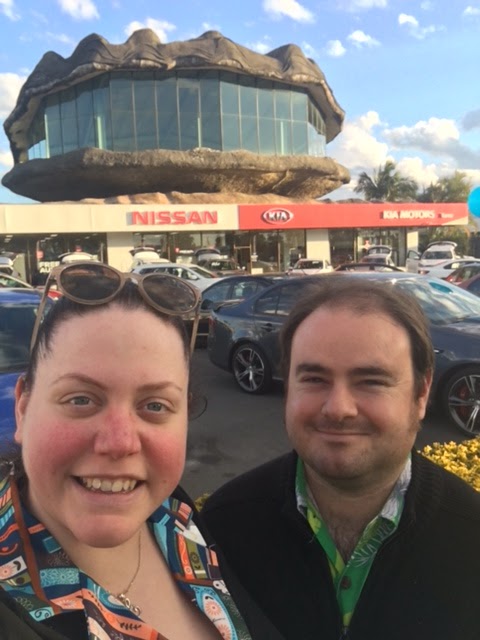
This car dealership keeps Taree's dream of a Big Oyster tourist attraction alive. It was hoped that the Big Oyster would become an attraction comparable to Goulburn's Big Merino, or the Big Banana in Coffs Harbour, but this business venture was a failure and it became known by locals as the 'Big Mistake'
The Big Axe in Kew was rebuilt only in the last few years. The original one fell foul of white ants.
Wingham Brush Forest is one of the world's few lowland subtropical rainforests. It's hard to capture the scale of the huge Moreton Bay figs that have helped make the forest so famous. Visitors to the forest must stick to a walkway otherwise they  could be injured by the giant stinging trees, which are also found everywhere in this habitat. Strangler figs and recent drought have led to the death of several of the forest's biggest trees, which now lay collapsed and rotting like huge fallen dinosaurs.
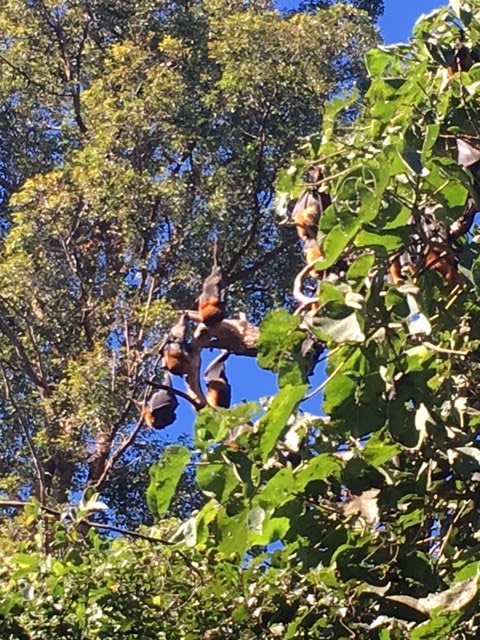
The other most famous aspect of Wingham Brush Forest is the huge colony of Grey-Headed Flying Foxes who have lived here since before European settlement (the word 'Wingham' is an anglicised version of the local Biripi word 'Wingan', which means 'where bats come to drink'). There are approximately 40 000 of this vulnerable species of bat living in the forest and all you have to do is look up to see hundreds upon hundreds of them roosting above. Even while 'sleeping' the sound is deafening; they screech and chatter like chimpanzees and can be seen scrapping with one another for the best positions. Every minute or so you'll hear their heavy wings flapping overhead and a shadow will pass over you and it's like being in the pterodactyl aviary from Jurassic Park III.
I wasn't aware that Nicole was taking this photo until the last minute. I don't know how it happened but somehow we managed to walk through the forest for half an hour without any bats pooping on us.
In Wingham forest we also saw Brush Turkeys, King Parrots, and some fruit doves.
On the way up to Byron we stopped at the lighthouse in Woolgoolga. As we watched the water Nicole spotted a Humpback Whale and its calf migrating north. In this picture you can see the whale engaging in a behaviour known as 'pec slapping', where it repeatedly splashes the water with its pectoral (side) fin. It's believed that this is part of the courtship signals that Humpback Whales use, which makes sense as this is the time of year that these whales travel north for breeding. 
We had to stop for a while when travelling back out of Bellingen because this young cow had somehow gotten out of its paddock and was frolicking about on the side of the road. Some rangers were attempting to round him up but he wasn't having a bar of it.
This active lighthouse in Port Stephens used to be a WWII base and continues to function as a point of action for local rescue operations.
Pelicans. I can stop and watch animals for hours.
Nicole was eyeing off this glass seagull in Port Stephens and decided not to buy it. The whole way home she kept mentioning it, and even suggested we go back to get it after we'd been driving for an hour. When we got home it magically appeared on the coffee table and Nicole told me it had followed us home. I laughed so hard.

Wednesday, April 18, 2018

Island by the City: Manly Quarantine Station and the North Head

Over the last few days I've been at the Quarantine Station at Sydney Harbour's North Head, writing and workshopping poetry as part of a writer's retreat run by the indefatigable Kerri-Jane Burke. The station (styled as 'Q-Station' by the organisations that maintain and staff the area) occupies a unique position in Australia's landscape as a heritage-listed historical site situated within the confines of Sydney Harbour National Park. The Quarantine Station itself operated for 150 years until 1984 and is now known as a hotspot for ghost tours and historical preservation, and provides the perfect backdrop for creative observation.

What struck me most about this location was the extreme contrast between the surrounding harbour, with all its buildings and skyscrapers and landmarks crowded along the coastline, and this little three-point-odd square kilometre pocket of history and nature. Between the colonial huts, unmarked one-way roads, and general hilliness and isolation, the Q Station feels like a self-sufficient island. There's something incredible and mildly shocking about standing on an incline, staring out across the water at the city lights with that distinctive Centrepoint skyline, and being surrounded by dense foliage that shelters a Ringtail Possum with a joey on its back just a few centimetres from my arm. 

Here are some pics and observations from the last few days:

The Boiler Room
In the background you can see a big smoke stack chimney; this is 'the Boiler Room', the upmarket restaurant situated within the Quarantine Station. Businesses such as this help to supplement the funding of the heritage site (which goes beyond the remit of National Parks NSW). Many of the buildings in this area date from the 1830s, and the Boiler Room is situated near the wharf where ships would unload their passengers for quarantine purposes. Across it's 150 years some 500+ people died here, which actually isn't that much when you consider that the site serviced 13 000 arrivals in its time of operation.


Engravings
The rocks near the wharf are covered in hastily-made engravings representing the years of arrivals at the Quarantine Station, and indicate the vast array of ships and cultures that passed through here. The RMS Lusitania mentioned above isn't the same one from WWI, it's an earlier ship that the later one was named after. Note also the flag scratched in by some early Japanese arrivals. The rocks also feature inscriptions from Arabic and Chinese passengers who alighted here in the 19th and early 20th centuries, and are a wonderful insight into the early beginnings of Australia's multiculturalism.


Shower Block
Pictured above are the First Class shower blocks (you can tell that they're first class because the dividers go all the way up rather than to waist height). Upon arrival the passengers would be told to remove all items and clothes, wash themselves in carbolic acid whilst being watched by quarantine staff, and then come back to clothes that had been blasted-free of assumed diseases. Prior to this shower system (implemented circa the late 19th century) the arrivals would watch all their possessions get put to the flame on the beach. 


Sterilisation
By most accounts, the process of sterilisation at the Quarantine Station was imprecise in the early 19th century due to the pervading belief in the miasma theory. Later in its history, in the Victorian and Edwardian eras, there were these huge lockable vaults where everything was railroaded in and exposed to extreme steaming. Clothes would survive but imagine the effect on cardboard-lined suitcases and books...


Hospital
What you see above are the actual beds used in the early 1900s, which have been preserved in the Quarantine Station Hospital at North Head. Circa 1918, these beds were home to many returned WWI soldiers suffering from Spanish Influenza.  Other common diseases of the time were Scarlet Fever, Typhus, and Smallpox.


Graveyard
There are three graveyards at the Quarantine Station, only one of which still retains its headstones. The above image shows the location of the one of the cemeteries that no longer has markers for the graves.


Third Cemetery 
These gravestones are found on the other side of the Head and contain those who passed away at the Quarantine Station during the turn of the century and earlier. It's a very quiet spot, and there is still a lot of archaeological work being done here to establish identities for the worn-away sandstone headstones. Perhaps the most striking aspect of the cemetery is the way it looks over the harbour and the Pacific from its serene vantage point.

The Funicular Stairway
I had a hard time with these stairs due to their length and height. I don't deal with heights very well so I found it much easier to do these stairs at nighttime rather than in the day when I could see between each step. These stairs sit in place of the steep railway that used to transport items from the wharf to the other buildings.


Wildlife
The most surprising aspect of this little national park is the prevalence of native wildlife in such close proximity to the city. Ringtail Possums run along the length of the Funicular Stairway's rails, fearless in regards to the human foot traffic alongside them. We also saw this Echidna nuzzling about in the dirt on our way back to our cottage one night - it seemed completely unperturbed by my presence as I crouched down next to it and at one point it looked up at me with its little beaky nose before returning to its antwork. 


Bandicoots
North Head is home to an endangered population of Long-nosed Bandicoots. I've driven through this area before and registered their presence, hoped to see them one day, and was happy to return to Manly in the hope that I might see one. They emerge at night and the area is apparently full of them. On the first night I was here I stepped out of the restaurant to get some air and looked down to see the little guy above inquisitively weave between my feet in his search for food. I watched as he systematically investigated each table and chair before disappearing into a nearby kitchen door! One of the pictures above also shows the little pockets they dig everywhere in their search for worms. 

Programme
As you can see, the days were spent doing a variety of activities relating to poetry. The poet and writer Kirly Saunders from Red Room Poetry visited on the Tuesday to talk over a few techniques and strategies she likes to use, and we workshopped some great ideas while exploring The Disappearing, one of the creative apps pioneered by Red Room Poetry. 

Anyway, it was a fantastic opportunity to work with other writing English teachers, share valuable feedback, and just have a space where I could write and experiment with different styles.