A Guide to this Blog

Showing posts with label Whales. Show all posts

Monday, July 16, 2018

To the North

I can write on this blog in a lot of detail sometimes, especially if I'm writing about resources or syllabus stuff that connects with teaching. Sometimes when I write along these lines I'll avoid using first person language and it can establish a more formal tone, which makes me sound (or feel) more confident about what I'm saying.

Other times I like to incorporate some anecdotes from my teaching and this only really works if I slip away from third person and take a more relaxed approach.

If I decide to write about my travels then first person is the only real way to do this properly, and I can feel less self-conscious about the travel writing because I know that my audience for these particular blog posts is smaller and more intimate (I generally don't post links to my travel posts on teaching networks because there usually isn't any relevance and, therefore, these particular posts have a readership about 10% the size of my teaching posts).

In the last two months my posting on this blog has stalled.

I'd like to write from the heart for this post. I feel self-conscious about this because I like to maintain a certain degree of metaphorical distance between myself and the audience when I write, however, I just can't write this particular entry in any other way because it's much more personal than usual.

My wife, Nicole, has asked me several times in the last few days if I will blog about our current travels and I had to tell her that I just wasn't sure. We didn't have wifi for the last couple of days so that helped me just not think about it but I knew, at heart, that I was avoiding writing because everything in my life is so bound up with recent personal events right now and it was all too hard.

A month ago my wife gave birth to a little girl that we named Elouise 'Split-Pea' Bartolo. It was too early for our daughter to survive and we lost her. It hurt, and it hurts still. I almost lost Nicole too... she had to have surgery after she delivered the baby herself and her recovery was physically difficult and required three blood transfusions. I... still don't really have the words. It was hard. It still is.

In the last two weeks we both re-integrated into our workplaces after a lengthy absence. Getting back into the routine at work wasn't so difficult after a few days, I found I could do a lot of things through compartmentalising. But coming home each day was like coming home to meet my grief again; it waited for me in the car, in the house. It waits for me anytime I let my mind sit still. Sometimes I write poetry, or I journal, and writing can be sort of therapeutic.

I've always written better than I speak. You can't see the awkward pauses this way, nor do I fill the silence with words that don't really matter. But I haven't been writing as much lately because it's like wrestling with the grief directly and that can be exhausting.

Anyway.

Four days ago Nicole and I packed the car and we struck out north, away from our jobs and away from our home. We've always loved travelling together and I was eager to navigate into this space again to see if it still existed after everything that has just happened. We decided that our journey would focus on finding as many 'big things' as we could and I joked, upon arriving in Taree to see the Big Oyster, that it was fitting we would travel so far to see something so mediocre considering that whatever we do right now would feel mediocre no matter what.

Nicole laughed at that. I love her for sharing my ambivalence in regards to personal pain; we can laugh at the little things while experiencing our pain. We do this while fighting sometimes too - we'll be right in the thick of an argument and one of us will make a ridiculous joke about it. We laugh in these situations and then continue our fight. I like the idea of that - the acceptance that you can be more than one thing at any given time. You know that phrase, "If you don't laugh, you'll cry"? I've always preferred to think of it as non-binary. Imagine each person is really Schroedinger's Cat in the box and that, until you open them up, they're simultaneously laughing and crying.

Owing to the emotional mess that I'm still wading through, I don't think I can take a linear approach to this holiday and recount everything in order. It feels like too much, and I think the facile nature of this approach would scoop out what little life is left within me. Joke.

Anyway.

Here is a collection of pictures that Nicole and I took, and the stories that go with them:

View from the bridge in Bellingen. I remember this bridge from my teen years, when we would visit my Aunty Jan's farm on the river. It's a very picturesque spot.
Usually I'll be driving and then I see some street art and I'll double-back to get a photo. This usually leads to some confusion and frustration on Nicole's part because I don't always get around to explaining what I'm doing until we've pulled up and I've jumped out to get a photo. This pic was taken in Bellingen.
Nimbin is something else. The whole town smells of marijuana, and Nicole and I entered it via the carpark into this little area where a tin shed proclaims itself as a place to procure "Medical Cannabis". Not gonna lie, I felt a bit confronted by the casual pot smoking everywhere - and we got offered marijuana at least four times in the short time we were there. We declined and settled for some pizza in a nice Italian place down the road instead. I'd never felt so bourgeois.
I love this sign. Nimbin shop fronts are a whole bunch of hilarious - keeping the town's unique hippy roots alive.
Growing up, Mum would take us to visit her sister, my Aunty Lynette, in Warragamba. Aunty Lynette and Uncle Phil moved to Glenreagh in the '90s and it was nice to finally take Nicole up the coast to see them and their amazing collection of historical curios. Uncle Phil has a fantastic museum in his backyard.Seen above is a collection of antique stove plates.
One of the more unique items in Uncle Phil's museum is this old American school desk with moveable parchment. The desk opens up and you wind a lever to show a variety of different teaching materials.
Preserved microbat. Aunty Lynette and Uncle Phil have preserved and restored a variety of dead animals they've found in their explorations.
Uncle Phil's bottle collection is quite amazing, and showcases Australia's convict history. Aunty Lynette has a great love of owls and Tawny Frogmouths, and I remember this stuffed Frogmouth very well from my childhood visits to her house. Nice to see it's still on the perch, so to speak.
The Scottish town of MacLean is situated near the southernmost part of NSW's sugar cane fields. Along the horizon you can see the fields burning and it's quite pretty if you happen to see it at sunset. Driving alongside the cane fields is always interesting too as you can see kites and kestrels hovering overhead while they hunt.
Glenreagh made a bid for fame with their own 'big thing' - the Big Dingo - but it doesn't show up on many lists of Australia's Big Things. Time to rectify this, Australia. Glenreagh is a quiet country town about 30-40 minutes outside of Coffs Harbour. Russell Crowe lives there and his massive house, property and tennis court all stand out like a sore thumb alongside his more modest neighbours.
In Lake Cathie you can see the Big Lawn Bowl. It doesn't draw the same sort of crowd as the Big Banana but it's moderately large size puts it on the list all the same.
I guess, technically, this is a small whale as real whales are bigger. It was parked in someone's front yard so we had to get our pictures really quickly.
The Big Prawn in Ballina was recently saved by the local Bunnings, who also added a tail. It's never looked better... but at the end of the day it's also just a massive crustacean in a carpark and none of the locals seem to pay it any attention. I think a plaque would at least be nice.
Byron Bay is a nice place but the buskers get a bit annoying when you a crowd gathers on the sidewalk and you just want to get through so you can eat some tacos.
There are 3 Big Pineapples in Australia. This little Big Pineapple is the lesser known of them, and can be found in the carpark of a service station in Ballina.
The Big Rock Service Station is looking worse for wear these days. It started life as a replica of Uluru built for Leyland Bros. World in 1990 and later became known as the 'Ayers Rock Road House'. Disappointingly, there's a still a sign up that calls it 'Ayers Rock'. I'd normally put this down as an oversight but the huge collection of golliwogs inside makes me think there might be a bit of a racist undercurrent at work. If anyone wants to own an obsolete tourist attraction that needs a few thousand dollars worth of restoration then I am pleased to announce that the owners are currently accepting offers for purchase.
Macadamia Castle near Lennox Head has wisely opted not to create a Big Macadamia (one already exists up in Queensland) and have instead decided, bizarrely, to use a medieval theme to draw customers in. I know when I think of the Australian-native delicacy known as the macadamia nut I find it difficult to separate them from the European middle ages, and it's great to see this tourist attraction making a real connection with that heritage via this giant knight.
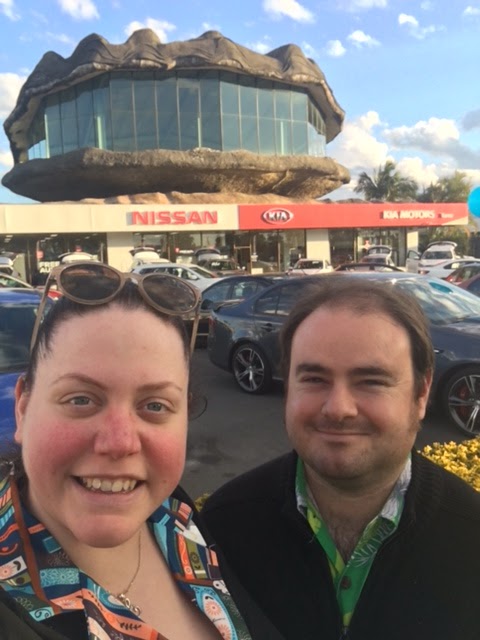
This car dealership keeps Taree's dream of a Big Oyster tourist attraction alive. It was hoped that the Big Oyster would become an attraction comparable to Goulburn's Big Merino, or the Big Banana in Coffs Harbour, but this business venture was a failure and it became known by locals as the 'Big Mistake'
The Big Axe in Kew was rebuilt only in the last few years. The original one fell foul of white ants.
Wingham Brush Forest is one of the world's few lowland subtropical rainforests. It's hard to capture the scale of the huge Moreton Bay figs that have helped make the forest so famous. Visitors to the forest must stick to a walkway otherwise they  could be injured by the giant stinging trees, which are also found everywhere in this habitat. Strangler figs and recent drought have led to the death of several of the forest's biggest trees, which now lay collapsed and rotting like huge fallen dinosaurs.
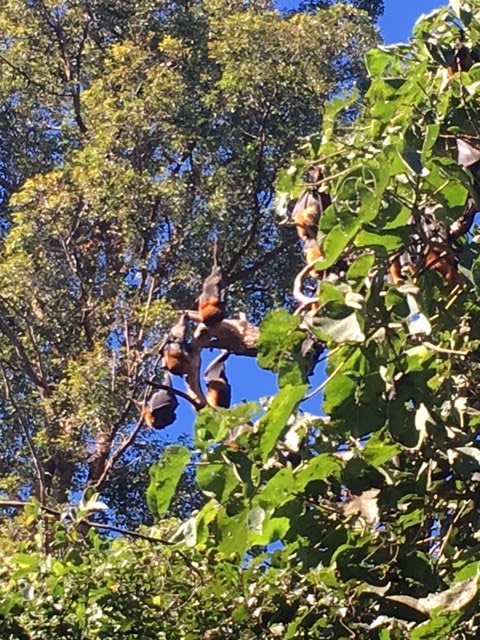
The other most famous aspect of Wingham Brush Forest is the huge colony of Grey-Headed Flying Foxes who have lived here since before European settlement (the word 'Wingham' is an anglicised version of the local Biripi word 'Wingan', which means 'where bats come to drink'). There are approximately 40 000 of this vulnerable species of bat living in the forest and all you have to do is look up to see hundreds upon hundreds of them roosting above. Even while 'sleeping' the sound is deafening; they screech and chatter like chimpanzees and can be seen scrapping with one another for the best positions. Every minute or so you'll hear their heavy wings flapping overhead and a shadow will pass over you and it's like being in the pterodactyl aviary from Jurassic Park III.
I wasn't aware that Nicole was taking this photo until the last minute. I don't know how it happened but somehow we managed to walk through the forest for half an hour without any bats pooping on us.
In Wingham forest we also saw Brush Turkeys, King Parrots, and some fruit doves.
On the way up to Byron we stopped at the lighthouse in Woolgoolga. As we watched the water Nicole spotted a Humpback Whale and its calf migrating north. In this picture you can see the whale engaging in a behaviour known as 'pec slapping', where it repeatedly splashes the water with its pectoral (side) fin. It's believed that this is part of the courtship signals that Humpback Whales use, which makes sense as this is the time of year that these whales travel north for breeding. 
We had to stop for a while when travelling back out of Bellingen because this young cow had somehow gotten out of its paddock and was frolicking about on the side of the road. Some rangers were attempting to round him up but he wasn't having a bar of it.
This active lighthouse in Port Stephens used to be a WWII base and continues to function as a point of action for local rescue operations.
Pelicans. I can stop and watch animals for hours.
Nicole was eyeing off this glass seagull in Port Stephens and decided not to buy it. The whole way home she kept mentioning it, and even suggested we go back to get it after we'd been driving for an hour. When we got home it magically appeared on the coffee table and Nicole told me it had followed us home. I laughed so hard.

Wednesday, January 17, 2018

Eden: Paradise and Purgatory by the Sea


Eden perches with some degree of isolation on a clifftop, surveying a wide open expanse of ocean with a sense of ambiguity not often felt in country communities. In the 21st century Eden is known as a perfect whale-watching spot, however, it's history is also firmly entrenched in a dark whaling mythology that is so unique that the town dare not ignore it. 

Nicole and I came here because I was drawn to the bizarre story of Eden's whaling industry. We booked a room at the other end of Twofold Bay in 'Boydtown', not realising that this building - the Seahorse Inn - had its own strange past as well. 


My first stop in Eden was the above memorial to those from the town who died in service to Australia during our 20th century wars. In travelling across Australia the one thing I've noticed that consistently appears in rural and coastal communities is some kind of ANZAC memorial, evidence of a shared cultural identity that goes beyond our media. Eden's pristine monument to the soldiers sits high up on the town's summit near its churches.  

I took this photograph because it mentions the little-spoken about Malayan War. I can't recall seeing many war monuments that make reference to this conflict and our country's involvement in it.


Mary MacKillop Hall was once a schoolhouse that was built following the death of MacKillop's mother, Flora MacKillop. Saint Mary visited the schoolhouse twice, in 1899 and 1901, out of appreciation for the care that the town of Eden demonstrated in recovering her mother's body after she was lost at sea. 

Flora MacKillop was one of 71 lives infamously lost during the wreck of the Ly-ee-Moon, a former opium transport steamship from China that broke up during a storm off nearby Green Cape in 1886.


The inside of the Hall remains a shrine to Mary MacKillop, who was canonised by the Catholic Church as Australia's first (and so far only) saint in 2010. Catholic-Australians make the pilgrimage here to pay their respects. I know this is true because I saw some.


The view outside of Mary MacKillop Hall is quite breathtaking.


The Eden Killer Whale Museum is one of the main attractions in Eden and features two storeys of whaling-related local history. While Nicole and I visited we saw at least 50 other people in there, making this one of the busiest 'local history' museums I have ever seen.  


The centrepiece of the museum is 'Old Tom', the alpha Killer Whale who assisted Eden whalers in their brutal hunting of baleen whale species (predominantly Southern Right and Humpback Whales, and the occasional Blue Whale) in the early 20th century. The local narrative is one of Old Tom and a pod of five other Killer Whales attaching themselves to Eden's whaling families to help them kill the bigger whales. The story says that these Orcas would round up and harry the larger baleen whales into range of the harpoons. The bigger whales would then be killed by the humans and left to Old Tom and his pod, who would rip off the whale's lips and tongue and take them deep under the surface for feasting upon (these organs are huge and are all the Killer Whales were interested in). Such was Old Tom's eagerness and intelligence that he would swim into Twofold Bay to meet the humans early in the morning and grab the ropes of their boats, dragging them out to where the baleen whales could be found.

It's the only known case of Killer Whales working with humans in this way. In 1930, Old Tom was found dead and floating in the bay - he had apparently come in to Twofold Bay to die near the human community there. His massive 7 metre-long skeleton was salvaged and preserved, and the Killer Whale Museum grew around him as the whaling industry in Eden disappeared. He remains as a terrifying ode to a dark past, the teeth on one side of his skull filed down from the wear of the rope he would grasp between his jaws.


Nicole was less interested in the museum than I was.


There is a section of the museum dedicated to Eden's original inhabitants, the Thaua people, however, I couldn't help but think a bigger acknowledgement of their history could have been made. The reason behind the extraordinary behaviour of the Killer Whales of this area is most likely tied to the Thaua, who had a special relationship with the Killer Whales that stretched back thousands of years. In the Thaua language these animals were referred to as 'beowas', which translates as 'brothers'. All of the whaling families in Eden 'employed' local Aboriginal men to work their boats in the 19th and 20th centuries.


Scrimshaw is the art of engraving objects out of ivory or whale bone. The ornate figures above demonstrate the intricacy of this disturbing art.

The parking demarcations outside of the Killer Whale Museum demonstrate the town's maritime heritage in a fun way. 


Further out of Eden, The Blue Wren Cafe sources the vast majority of its food onsite, demonstrating the 'slow food' ethos associated with lessening one's carbon footprint. This cafe is part of Potoroo Palace, an animal sanctuary located a few kilometres north of Pambula. The park is predominantly known for its care and healing of rescued Australian animals, and for a potoroo-breeding program that supplies these little macropods to wildlife parks all around the country.


This is Trevor, a rescued Brush Tail Possum who is quite happy to move around in the day if there's weetbix and carrot in it for him.

The sanctuary has a collection of Emus that have been raised from chicks. They are currently 4 years old and some of them have had to be separated because they've taken to fighting each other. The picture above shows two Emus that kept running over to the fence to kick at the bird on the other side. The solitary Emu on the right was nonchalant and calm the whole time, pretending that he wasn't fazed by the aggression of the two bullies.


Nicole and I also ducked up to Bega to check out the cheese factory. The upper floor of the Bega Heritage Centre featured a range of dairy-related historical paraphernalia and an animatronic cow that just shook loudly rather than actually moving.  

There was also this weird eight-legged cow. The cheese of the future? I'm thinking this genetically-modified monstrosity could be called 'the Bovine Centipede'.


I have to say that I wasn't completely sold on the Bega cheese experience. It's not like they have an amazingly large range - they know what they do well and they've stuck to it, growing a nationally-recognised brand and no doubt boosting the economy of the surrounding town - but I'm just not a huge fan of their cheese. That said, they did have some canned cheese that they use for international export, which was mildly interesting. 


Another view of Twofold Bay. Note the mountains and forest in the distance - this area is not very densely populated at all. 


The pictures above show Seahorse Inn, our accommodation. This elaborate castle-like building was constructed in 1843 just a few kilometres south of Eden in 'Boydtown'. It was envisioned by British stockbroker Benjamin Boyd as the first part of a whole new town and business empire, which he dreamt would become the future capital of the New South Wales colony. He built the Seahorse Inn, a nearby church (which burned down 50 years later in a bushfire) and a privately-owned lighthouse a few more kilometres south (modestly called 'Boyd Tower'). 


To get to Boyd Tower you need to drive another twenty minutes south and then access the coastline via an unsealed road. From here it's a short walk out onto the escarpment. On our way out we saw a shy and diminutive Swamp Wallaby watching us from between two trees; evidence of how forgotten this part of the world seems. As we got closer to the end of the bluff we spotted the tower rising up out of the bushland like some ancient, half-hidden ruin. 

Boyd wanted his tower to serve as a lighthouse, but the government wouldn't sign off on its use so it became a lookout to assist in spotting whales for the local whaling industry.  

Like the Seahorse Inn and much else of the would-be capital city, Boyd's Tower was built from an expensive form of sandstone that was brought all the way down from Sydney rather than sourced more locally. Boyd also resorted to using slave labour via the highly dubious practise of 'blackbirding', in which Islanders were kidnapped and brought to Australia as indentured workers. Despite his ambition and apparent ruthlessness, Boyd's empire collapsed in financial ruin and failure before he could attract settlers. By the late 1840s he had run off to California to try and make his fortune in the great American gold rush. 

The tower remains as a sign of his folly.

Ironically though, just a few hundred metres from the Seahorse Inn, a collection of 15 upmarket coastal houses have sprung up in a little estate that started just a year ago. It's taken nearly 180 years but it looks like Boydtown is finally happening for real, complete with the name of the entrepreneur still attached.

Eden has a population of just over 3000 people and it's busiest time of year is the end of winter when whales can be regularly seen. The town has a siren that it sounds whenever these mighty creatures are spotted so that any locals or visitors can quickly get to a lookout or the beach. It's a curiously benign industry for a place that once teamed up with one of nature's most notorious predators to drive some of the world's biggest animals to the brink of extinction, and the community's rich history of ambition, shipwrecks, and whaling makes it a uniquely intriguing and vaguely macabre destination for the curious.