A Guide to this Blog

Showing posts with label San Cristobal de las Casas. Show all posts

Monday, January 23, 2017

San Cristobal de las Casas and Chiapis del Corzo (Day 17 - 14/1/14)


Chiapis del Corzo
The hostel manager, Ricardo, is a fine and jovial fellow who speaks to us in English and has plenty of suggestions for us to check out while we're in town. We mention our day trip to Sumidero Canyon and he emphatically and endearingly tells us to put sunscreen on our faces. He also admonishingly warns me off eating any more dodgy-looking local food, "You must be careful!". I heed his calls but it doesn't stop me from piling the spicy green habanero sauce on my breakfast of tacos de canasta.

The poverty of the indigenous peoples in this state, Chiapis, continues to unsettle us. Even in thick traffic on major roads, Maya children in ripped clothes will come begging at car windows. Our Mexican tour guide for the day, Eduardo, waggles his finger at them as if they are cheeky ruffians. That they may be, but it's hard for an outsider to not perceive a class system at work.

The drive to Sumidero Canyon is all picturesque forest and mountain cornfields. We ascend up into the cloud forest, fog clinging to the road so thickly that it's impossible to see the cars in front of us. Over and over we see the same sign telling drivers to overtake. There's no overtaking lane anyway, but Mexicans are so notorious for ignoring road rules and basic safety that they still need to be told in certain situations, "Okay guys, we know you normally ignore the rules, but on this particular road we are really being serious - do not drive into oncoming traffic!"

Note the people standing in the back of the ute in front.
Our driver still overtakes.

And despite this sign all the drivers on the road continue to do the same. Many times, Eduardo overtakes on mountaintop corners in fog-blind situations, maintaining his cheerful and carefree disposition. I would worry about the huge ringworm-like cracks in his windscreen but nearly every Mexican taxi and van we have gotten into has had these.

Here are some guidelines for driving in Mexico based on what I have noticed the local drivers do:
  1. The indicator does not exist.
  2. Oncoming traffic will stop to let you overtake anywhere up to 3 vehicles.
  3. If you need to stop somewhere, even on a busy highway or one-way street, just do it and put your hazard lights on. Others drivers will wait or go around you.
  4. If you need to go down a one-way street in the wrong direction, just reverse down it. 
  5. Seatbelts do not exist. Sometimes literally.
On today's bus ride I ask the Duck if she has her seatbelt on.
"Yep," she smiles.
I feel around her middle, "No. You don't".
"...My Mexican seatbelt!" she laughs. 

Before we go to Sumidero Canyon our tour takes a previously unmentioned detour and stops at the city of Chiapis del Corzo. Eduardo doesn't speak English but one of the other tourists tells us we've been given an hour to look at the markets. I kind of begrudge this stop a little. I don't know anything about this place so I feel like I have no context for exploration. A nerdy gripe, I know, but hey, that's me. I want to use a toilet but the first two I try won't give me change for a 100 peso note, and this annoys me (specifically, my bladder). A lot of Mexican public toilets require payment to get in - a great system that prevents a lot of vandalism.


I'm not sure exactly what this procession was about.

Police man just standing around with his gun.


We talk to an Israeli tourist from our bus while we wait for our time in Chiapis del Corzo to end. He tells us he is 37 days into a 50 day tour of Central America and that he is ready to go home. To fill in the remaining time of his tour he has started taking salsa lessons and, aside from almost demonstrating some dance moves to us, this is the only time he doesn't seem bored out of his brain.

Trying to make conversation, I recommend that he takes a trip to Oaxaca to help fill in the remaining days and he sceptically asks what's worth seeing there. Both myself and the Duck start telling him about the Zapotec ruins but he cuts us off, "I've already seen three ruins. They are all the same". Conversation pretty much grinds to a halt after this. I think I hate backpackers.

Sumidero Canyon
Our tour of Sumidero Canyon is a two hour boat trip through the guts of a massive canyon via river. I'm a little surprised that they insist we wear lifejackets, this being Mexico, although my surprise diminishes when the boat driver allows passengers to take the jackets off while they pose precariously on the prow of the boat for photos (and in crocodile-infested waters!) The colony of vultures along the shoreline at this point seems ominous. The boat gets up really close to the riverbank and the birds act as if we aren't even there. A crocodile stirs from the muddy edge and slides down the bank as we take pictures, disappearing underneath our boat when we get too close. As this happens, the idiot in a cowboy hat who's been standing up every time we see something noteworthy lets out a hysterical scream. It would have been a satisfying moment if he didn't continue to irritate us for the rest of the trip: refusing to tip the boat operator, refusing to help us hold up the tarp when we all started getting rained on, shooting me dirty looks when I would then deliberately drop said tarp in front of his camera, and rudely tossing his lifejacket onto the ground rather than hand it back to the waiting attendant. What a great guy.


This little shrine was carved into the side of the cliff face of the canyon, called Cueva de Colores. There's a religious statue in the alcove - the Virgin of Guadalope.
In some points the river is quite polluted.
An American Crocodile
This was as far as the boat took us. This is the Chicoasen Dam, the massive statue is called 'State to the Workers at Chicoasen Dam'.
Black Vultures
On return to San Cristobal de las Casas the Duck and I continue to sightsee. We check out the Museum of Amber (which is in a partially restored convent) and the Museum of Historical Curiosities (which is hidden above a restaurant). The latter of these is a real non-event. The clerk downstairs indicates that we can go up and see it but the room is pitch black. We begin to look around with our mobile phone torches and by the time someone appears to turn the lights on for us we've finished looking at the single room full of early telephone and telegram devices.

Inside the Museum of Amber


The courtyard outside the Museum of Amber
In our wandering through the city we spy a church high up at the top of the city and remember Ricardo's recommendation that we check it out. After a long walk up through the hilly streets and laneways we come to the bottom of a long flight of steep steps that lead up to the church. The view from the top shows you the whole city; its labyrinthine network of laneways and multitude of colour-coded churches. 

Ironically, after climbing these mountainous steps, we notice that there is a small ramp into the church for wheelchair access. I am baffled as to the real purpose of the ramp; as I look back down the stairs at the old woman hobbling and wheezing her way to the top it doesn't seem like a place with easy access for the disabled.


Friday, January 20, 2017

San Cristobal de las Casas (Day 16 - 13/1/14)

San Cristobal is a mountain city of churches and revolutionary fervour.

In San Cristobal, every street was tiny, painted, cobbled. It was my favourite place in Mexico.

No sleep was gotten! All the Mexicans flipped their seats back as soon as they got on the bus, crushing our legs. Duck politely asked the women in front to move her seat forward a bit but she just shrugged and slammed it back further. The bus driver's solution was to banish us to the back, next to the stinky toilet. I reckon I got a solid hour's shut-eye.

Despite not having any record of our reservation, our hostel lets us check in early. This just about sums up Mexico - often disorganised and chaotic, but also flexible. The hostel is called Axkhan Arte Hotel, owing to the many works of art that adorn its walls. Many of these artworks reflect the injustices visited upon the Mayas over the last few centuries, a display of conscience that sits in stark contrast to the apathy of Alejandro and Mexico City several hundred kilometres away.

Axkhan Arte Hostel
Our room. Note the exhausted Duck in the background.
San Cristobal is in Mexico's southernmost state, Chiapis, and is home to the Lacondan people - a group of Mayas that managed to evade subjugation at the hands of the Spanish, and still live on the outskirts of town. Even though they achieved the rarity of 'freedom', there is still evidence of the generational poverty that shackles them. On our travels through the San Cristobal markets the Duck is continuously pestered by a Maya woman and her many children. One boy follows us for a while, almost crying to try and get a sale. Whilst their desperation is undeniably depressing, the tenacity of this woman is impressive - she has one child strapped to her back while she casually breastfeeds another from the front. It's a little confronting but you have to develop a harder shell to pass through these markets, and we decide to limit our time there so it doesn't colour our whole perspective of the much larger township.

Our third sighted roofdog.
San Cristobal de las Casas is a really beautiful town. Cradled between mountains and flanked by a rare cloud rainforest (which we were unable to see due to the trail being closed on Mondays), the town is a huge lattice of cobbled one-way laneways. Nearly all of the buildings have terracotta roofs and they're all painted bright colours of varying shades. Cabs race down the laneways, navigating the narrow one-way streets with assured experience, and we often have to jump up on the just-as-narrow walkways to avoid them.


A lot of today is spent just wandering around. We get lost at first but I don't really mind because it's such a picturesque place. A stray dog, jet black and bright-eyed, follows us a while. Sometimes it overtakes but keeps close, so the Duck has us follow it. We trail the happy canine through various streets blindly for a while but eventually decide to grab a taxi to somewhere central just to get our bearings. We visit the zocalo and look at various jewellery shops that specialise in amber. The state of Chiapis is the only source of amber in all of Mexico, and this amber is 25-30 million years old and found 40-80 metres deep underground. We also see a whole host of brightly-painted churches and spy some nifty anti-capitalist graffiti near the Maya Na Bolom Cultural Centre. The graffiti reflects the city's recent history as a rallying point for the Zapatistas, a civil resistance group who represent the rights of the indigenous people in Chiapis. Their mark is all over the city, in the street art, in the pro-Maya pride of the locals, and in shops that sell rebel-based paraphernalia. 


Nearly all of the street art and graffiti is either pro-Maya, or anti-Western, and usually quite beautiful
In an extension of this, the Na Bolom Cultural Centre represents the life's work of two European intellectuals who wanted to preserve the life of the local Lacondan people. It's quiet, and peaceful, but it's hard to overlook the human bones on display among other cultural items. I'm not saying these bones are 'bad'... they just stand out as a real point of difference to a Westerner like myself, and, even with its pro-Maya stance, it's hard to know if they are displayed with the consent of the local indigenous peoples or not.

The chapel inside the Na Bolom centre
A Maya doll
The inherent horror isn't just restrained to the Mayas. The Spanish ancestry of the Mexicans is hardly the cleanest history, though it's reassuring to see a bit more revisionism in San Cristobal in comparison to the latest Eurocentrism in Mexico City (a place of conquest built on the bones of allegedly Satanic savages). Catholicism in Mexico is brutal... the iconography inside the huge beautiful churches verges on the outright violent. And there's something confronting about sightseeing in one of these churches to see the poor local woman weeping loudly on her knees in front of the altar. It's something really alien to an Australian like myself, to see a true believer begging so openly and unashamedly, reduced to her faith in religion to save her from hard, real world problems. Christianity is different here in Mexico - people actually believe in God. I know I come off as cynical and generalising, but many of the God-believing Christians I know don't even go to church, so it would be unthinkable for them to prostate themselves in front of God so unselfconsciously. I'm confronted by this local woman's grief, but I also admire it a little bit, even with my own lack of belief.


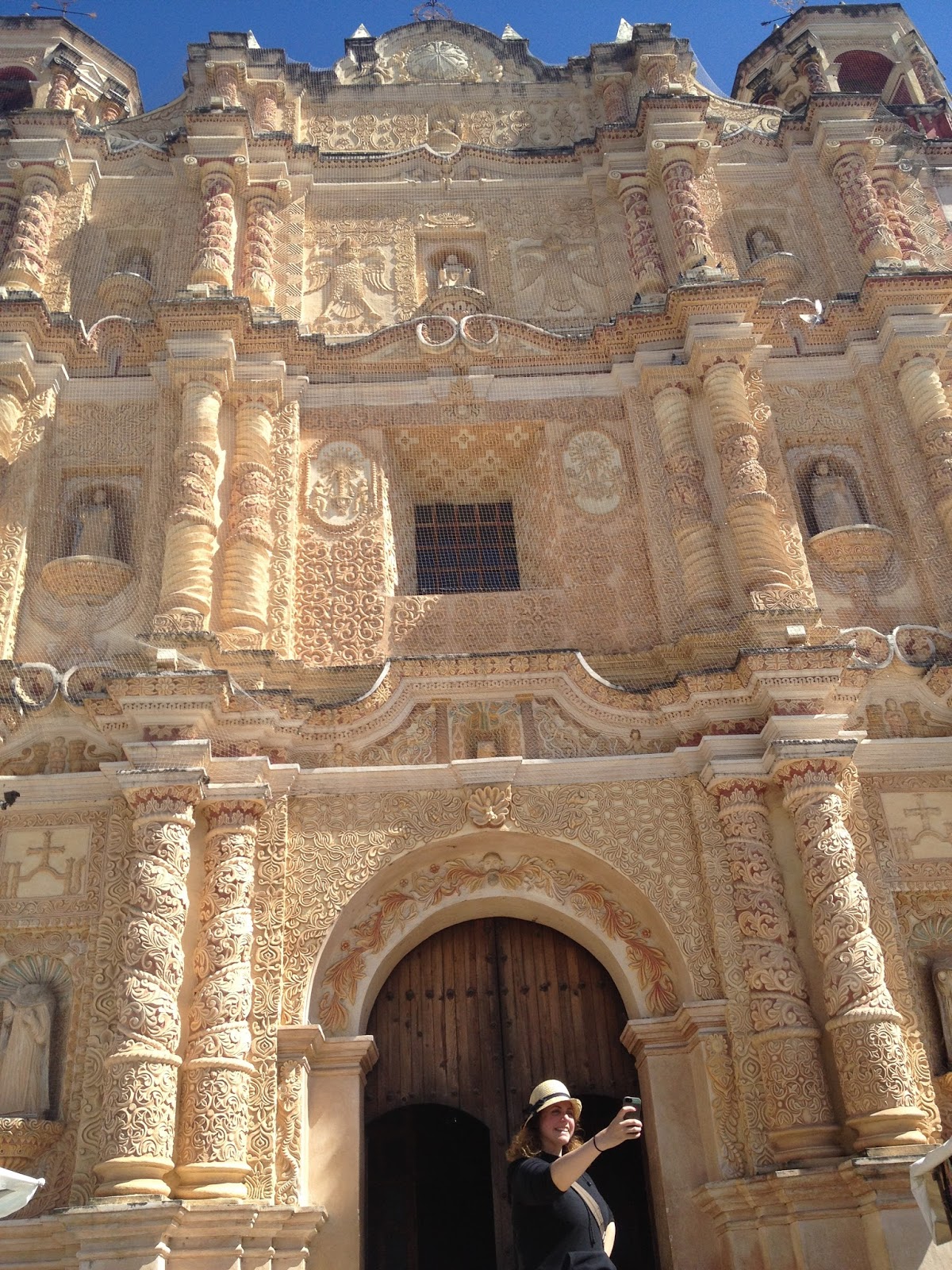
Nearly every corner has a church, each one beautifully crafted and brightly coloured.
Later, the Duck and I decide to have dinner at the hostel, and the old language problem rears its head again. We order something simple from the menu but here are certain ingredients missing from the kitchen. Duck modifies her order but it still doesn't work. The language barrier breaks down communication between ourselves and the waiter so he leads me to a computer and we begin conversing with Google translator. The wonders of modern technology!

The Museum of Amber
San Cristobal Zocalo
 

Zapatista art.