A Guide to this Blog

Showing posts with label Soviet Union. Show all posts

Sunday, October 28, 2018

Texts and Human Experiences: Orwell, Stalin, and the History Paradox


I forgot how much fun teaching Nineteen Eighty-Four was. Perhaps that's a paradoxical statement, considering the miserable nature of the text and the misery-inducing state it can inspire in the reader (Orwell's masterpiece is more likely appreciated than 'enjoyed'). That said, paradox works here due to the text's inclusion as part of the Year 12 HSC Common Module Texts and Human Experiences, in which readers gain insight into 'anomalies, paradoxes and inconsistencies in human behaviour'. I can see that Nineteen Eighty-Four isn't a joyful book and yet... I enjoy teaching it so much!

There's a certain comorbidity between the Advanced English and Extension History courses in that both involve interrogating the text to identify degrees of subjectivity. If you're lucky enough to have students who do both courses you'll notice their growing aptitude in relation to this. In regards to Nineteen Eighty-Four there's also a lot to be gained from students who do the Modern History course with all its political -isms. One key concept from Orwell's text that benefits from this increased historical understanding is the idea of a palimpsest.

The palimpsest is an ancient or medieval manuscript page that has been 'cleaned' of its original text and re-used. There's nothing sinister about this; in pre-Gutenberg times parchment was invaluable and hard to come by so repurposing was par for the course. In Winston Smith's world, however, Orwell uses the term to refer to the Party's habit of literally re-writing historical and journalistic documents. Smith's occupation is to locate any documents that contain information the Party has decided no longer fits with their official history and then rewrite them to fit with the new 'facts'.

Orwell was inspired by real practices in the Soviet Union during the 1930s. Every time Stalin 'purged' an offending member from his Party and made them 'disappear' an order would go out to schools to have the students paste new text into their textbooks over the old information, essentially rendering the figure a non-person; someone who never existed. Stalin's comfort with rewriting history can also be observed in the doctored photographs from this era, whereby purged members were painted out of the pictures as if they were never there. 

Activity
My friend Kira told me that she likes to start her students off in studying Nineteen Eighty-Four by imposing an Orwellian atmosphere on the classroom with a series of strict rules designed to get them thinking about totalitarianism. It can be hard for us, having grown up with relatively high levels of privilege, to understand what it might have been like to live in the kind of nightmarish government-controlled state that Orwell describes. I wanted to do something like this and help students get their heads around the palimpsests that Winston is tasked to make throughout the course of the novel.

I don't know how else to relay this other than just describe what I did. So here it is:
  • I wordlessly stopped the students at the door. This was automatically different for them because I've never been one for making kids line up outside the classroom. I usually say hello to them too but this time I just held my hand up and went back into the room for a bit as I wanted to heighten their anxiety a little.
  • I drew up a table on the board, like this:

  • Then I beckoned the students in and told them to place all their bags at the front of the room, and that there was to be no talking or communication. I also had a cardboard box with 'Phone Haven' written on the front and told them to place their phones into it for their 'safekeeping'. The students were very confused by this point and my straight face and lack of eye contact seemed to prevent any discussion around what was going on.
  • I then dictated the following:
Year 12 HSC Advanced English is a very intense subject and requires concentration and consistent engagement. In order to foster a better working arrangement it has been decreed that you can now call your teacher by his first name within the confines of this class room. There will also be a rotating roster in which one of you must walk the room every four minutes and check that everyone is OnTask. Infractions or OffTask behaviour will be reported to the teacher immediately.
  • Students then copied the table into their books, with four student names placed into the roster.
  • I then gave them this context sheet to work on and had Student A start their rounds, checking that each person was doing their work. I asked Student A quietly (the room was so silent that everyone could hear me still) to report back on who was working well and who wasn't. 
  • Student B had to report to me on who they thought was enjoying the activity the most and who wasn't. 
  • At this point I was admittedly getting a little bored, so I gave Student C a ruler and asked them to make sure that everyone's things were at least 5cm from the edge of the table.
  • Student D was told to make each individual student raise their index finger on their non-dominant hand and count slowly to five. There wasn't any relevance to this, I just wanted to emphasise how arbitrary the rules were.  
  • This is where the palimpsest comes in. I looked at the roster on the board and decided which student had complied least willingly. To be truthful, all of the students had gone along with the activity with surprisingly little complaining, so I just randomly picked Student A. I told him that he hadn't done a very good job and that he was to stand outside the classroom. I then removed his name from the roster on the board, replaced it with another student's name, told this new student in front of everyone that they had done a good job as the first monitor, and then provided the whole class with paper, glue and scissors.
  • I told them that they needed to change the roster in their books to reflect what was on the board. That this had always been the roster. Furthermore, I was to only be referred to as 'Sir' and not my first name and that the text in their book should reflect this. Students wrote out this new information and pasted it over the 'offending' parts of the dictated text. 
All in all, this took about 30-40 minutes. I couldn't help but laugh by the end of it, having kept a straight face for so long, and the students were relieved for the spell to be broken. This Advanced English class had only had me for a teacher for 1 lesson before this (I didn't have them for their Preliminary HSC) so a few were seriously worried that this would be how the class was like from now on!


We discussed the purpose of the activity, what a palimpsest was, and some of the students who'd already read to the end of the book told me that they'd cottoned on partway through. I have some of Stalin's doctored photographs on the back wall so we looked at those and spoke about Stalin's sinister censorship practices in the Soviet Union and how this would have influenced Orwell.

This links back really well to the rubric's mention of 'paradoxes in human behaviour', after all, what greater paradox could there be than history itself being rewritten? If history is meant to be true then how can it be changed? And yet, it happens all the time.

Saturday, February 24, 2018

Categorising Heroes: Literacy, the Soviet Union, and Differentiation in the Modern Classroom

The Khirgiz, once part of the Soviet Union, are still renowned for practising the ancient art of Eagle-hunting
A key part of early literacy for children is the development of a schema or model for understanding the world around them. We construct meaning by ordering new experiences and words into our own self-constructed epistemologies, and we can decode the unfamiliar with increasing confidence as a result. In simpler terms, a child's extending of vocabulary is made possible through their ability to classify words into self-determined categories based on what they already know. 

This now-commonly accepted theoretical underpinning of literacy was supported by the groundbreaking work of the Soviet neuropsychologist Alexander Luria in the 1930s.

(What follows is an explanation of the way that thinking is tied to literacy. Skip to the end if you just want the 'Heroes'-based Stage 4 resource, but read on for some interesting stuff on how literacy works!)

Luria hypothesised that some cultures understood the world differently if they were non-literate, and thus used the Soviet-controlled Central Asian states of Uzbekistan and Kyrgyzstan to support his work. The research that the Soviet socio-scientist conducted in these places revealed very strong links between literacy and the ability to think abstractly. 

Luria, circa the 1940s.
Context
As Luria's fieldwork was conducted in the 1930s, when Stalin's hold over the Soviet Union was at it's most stifling, this meant that several factors contributed to him being in the right place at the right time. The country was undergoing a process known as Collectivisation, in which farms and other peasant holdings were grouped together to allow for easier control by the state. Joseph Stalin was undeniably one of the most brutal and totalitarian dictators to ever walk the Earth but one upswing of his regime was a historically-unparalleled rise in literacy. Luria's studies in remote Uzbek and Khirgiz societies were therefore quite serendipitous as they came at a point in Russian history that allowed for observation of completely non-literate communities prior to rapidly-increased literacy. 

It would probably be most accurate to identify Luria's work as something firmly grounded in a Marxist context reliant on class distinctions rather than cultural ones. This is most clear in the way that the neuropsychologist delineates between the literate and the non-literate on the basis of the 'old' non-literate peasantry vs. the newly-educated and unified Stalinist proletariat (working class). 

(I should note here that Luria's writing on this matter is very much a product of its time in terms of the attitudes portrayed therein - he often uses the word 'we' to refer to mainstream Russian society and marginalises minority groups such as the Uzbek and Khirgiz in the process. He also, problematically and Eurocentrically, uses the word 'primitive' to describe non-literate societies). 

The Research
Luria examined five different groups in his field study, roughly half of whom were completely non-literate. I use the term 'non-literate' here rather than illiterate as 'illiterate' implies the option of literacy; these societies were non-literate in the sense that they had not even been exposed to writing (as opposed to illiterate members of Western societies). 

Luria conducted extensive interviews in the native languages of these groups, concentrating on three central questions:
  • How do people linguistically code basic categories of experience as colour and shape?
  • How do they manage classification and abstraction?
  • And then, what about verbal problem-solving and self-analysis?
Results
The Soviet researcher found that the non-literate groups were able to classify drawn shapes only by referring to them as objects from their everyday life (EG. A circle was a 'plate', a triangle was a 'tent'). They did not have abstract terms for these shapes that could be used to classify all circular or all triangular objects. If pressed to arrange two shapes together, they did not classify them through shared shapes but by shared use (EG. Two objects might appear to be tools and classified as similar in this way despite being different shapes). 

This appears to reveal that a lack of written language means that the non-literate groups lacked the language skills/tools for abstraction. The written alphabet is, after all, a series of symbols and therefore an abstract concept. By learning how to work with the abstract concept of written language, literate societies are able to develop a greater level of abstraction in their thought, and can therefore categorise ideas in more complex ways. 

For the Khirgiz and Uzbek groups, colour was even more problematic than shapes. Instead of assigning a name to things that literate groups might classify as 'green', they would instead describe certain things as 'the colour of grass in the spring'. When challenged, they lacked the ability to group colours in any way whatsoever.

When forced to group objects together, the subjects always needed to theorise a shared situation that had a practical use. For example, a log and some tools would go together because they could be used together to build a house. It seemed impossible for the subject to separate one of these things from the other because they could only think in practical terms.

Developing Taxonomies in the Classroom
In Stage 4 English the teacher will often still come across students who struggle with abstraction and this is almost always tied to the students' lower literacy levels. In order to deal with this in English the teacher can combine symbolism with categorisation so students can begin to experiment with building their own taxonomies for better understanding.

The activity here is in connection to a visual literacy unit on Heroes and Villains. Before starting, get students to brainstorm as many different fictional and real life heroes as possible. This should be done independently.

Click here for the Categorising Heroes activity.

In the activity, students use the symbols attached to categorise the list they've created and then assign themselves a 'diversity' score using the criteria. This can then be used to prompt discussion about things such as:
  • Representation of heroes in the media.
  • Who can be a hero?
  • What makes a hero?
  • How aware are we of the kinds of heroes in our world?
A while back I wrote about using an Assessment for Learning task in connection to this same Heroes and Villains topic. This diagnostic assessment can be used to differentiate students into streams of ability. The activity above can be targeted towards the 'mainstream' portion of the class, whereas students identified as more gifted can be targeted with an 'extension' version of the activity.

Click here for the Extension version.

In this version it's left up to students to create their own symbols/categories, and their own criteria to judge them against. This requires more independence, imagination, and willingness to take risks in one's learning.

Alternatively, here is the Adjusted version for the students with typically lower levels of achievement.

In this version the students are given a higher level of scaffolding; an array of heroes are provided in case these students have been unable to put a diverse-enough list together. This works well for students with low literacy as they can then monitor and interact with the lesson without having to write.

For more on Luria's research on literacy, see the chapter 'Cultural Differences in Thinking' from his book The Making of Mind.

Sunday, June 18, 2017

Significant Figures: China 1966-1989

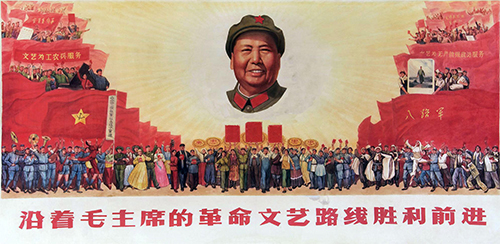
Mao's cult in full force
To Western eyes, the leadership of the Chinese Communist Party (and China itself) is not as clearly defined as the heads of state in our own countries. When teaching Change in the Modern World, Option B: Cultural Revolution to Tiananmen Square 1966-1989 to Modern History students we need to be mindful that they may make certain assumptions based on their own inherent sociocultural biases. Yes, Mao Zedong was Chairman of China from 1945 to 1976, but his most famous successor, Deng Xiaoping, did not occupy this position at all. It would be easy, as a citizen of a country with a Western-styled government, to assume that Deng Xiaoping and Mao Zedong occupied the same positions as overall leaders of China. This is not, however, the case.

The informal term for political leader of the Chinese government is 'Paramount Leader'. It is accurate to say that Communist China had 4 clear paramount leaders between 1966 and 1989, the time period of the study.

They are:

Mao Zedong: Chairman of various posts until 1976.

Hua Guofeng: Chairman of the Central Military Committee until 1981, but only considered leader of the nation until 1978 (when he lost his position as Chairman of the Central Committee).

Deng Xiaoping: Although Deng did not take over directly from any of Hua Guofeng's positions, he did start leading the Consultative Conference National Committee from 1978, signalling his movement into a higher point of influence at that time. He took over from Hua as Chairman of the Central Military Committee in 1981.

Jiang Zemin: Jiang ascended to the role of General Secretary of the Central Committee in 1989, which placed him as the new paramount leader after the Tiananmen Square incident on June 4th.

You'll notice what seem like a few discrepancies in the above information. We all know Mao Zedong as the 'Chairman' of China, however, this is actually a simplification of his full role within the Communist Party of China. At various points, Mao occupied up to 6 positions as Chairman of different branches within the Party and the government. Most of these he rescinded by the end of the 1950s, keeping only the positions of Chairman of the Central Committee and Chairman of the Central Military Committee, which were almost honorary titles by the time of his death (he kept these titles whilst day-to-day power transferred to other roles within the party, which goes some way towards explaining how the most powerful person in the Party could occupy completely different political positions to their predecessors).

"Follow Hua!"
Hua Guofeng was Premier of the State Council, but it was his succession of Mao as the Chairman of the Military Committee (meaning he had control of the People's Liberation Army) that saw him elevated to paramount leader above his peers. This is where things get tricky though, as Deng Xiaoping was undoubtedly the leader of China from 1978 to 1989, despite not occupying any of the key positions of power in the Party of government during that time. Deng was not General Secretary, Premier, or even President of the Party/government. Nor did he become Chairman of the Central Military Committee or Chairman of the Central Committee at any point. Instead, Deng consolidated power through his command of the Central Military Commission, the Consultative Conference Committee, Central Advisor Committee, and as Vice Premier of the State Council.

Deng's successor, Jiang Zemin, held a more traditional bastion of power as General Secretary and Chairman of the Central Military Committee, and this is how the following paramount leaders have established their power since this time.

Pretty dry stuff.

The point for our students to take away from this is that, in the context of a single party political system, the lineage of power does not transfer through a voting system or structured hierarchy. Power is accumulated through the prior paramount leader unofficially 'handing the reigns over' to the new leader through increased association and endorsement, and also by brokering the support of large factions within the Party who hope that the new leader will support their agendas.

Something else to consider is the unofficial designation of 'Party Elders', retired members of the Communist Party who retain a significant degree of influence through largely tokenistic positions (an example is Deng Xiaoping, who still exerted a lot of power well into his 90s despite only occupying a position as Honorary Chairman of the China Bridge Association ['Bridge', as in the card game Bridge]). After Deng's exit, the occupation of leadership became more structured with all three subsequent leaders concurrently occupying the three positions of General Secretary, President, and Chairman of the Central Military Commission.

Other Factors in Understanding Significant Figures
The side story to these four leaders is the narrative of those who also attempted to broker power between 1966 and 1989. The ones that are relevant to the syllabus dot points are:
  • Liu Shaoqi
  • Lin Biao
  • Jiang Qing (AKA 'Madame Mao') and her supporters (together known as the 'Gang of Four').
Liu Shaoqi was designated by Mao as his successor as early as 1960, however, ideological tensions arose between the two figures after the Great Leap Forward, leading Mao to denounce his political protege. A large part of the Cultural Revolution consisted of the resulting power struggle between Mao and Liu, with Liu removed from all political positions and placed under house arrest by 1967. He died in mysterious circumstances in 1969, from alleged pneumonia.

Lin Biao rose in the wake of Liu through his loyal support of Mao's ideology during the Cultural Revolution. In 1969 he was acknowledged as Mao's new successor as the next paramount leader but this favouring was short-lived. Lin's control of the People's Liberation Army grew during the Cultural Revolution to a point that threatened Mao's sense of security. Tensions arrived at a point that saw Lin actively avoid coming to Beijing for Party meetings, and Mao removed him from the Party altogether by 1971. Lin attempted to flee China with his family by plane and died when it crashed in Mongolia. The official line is that Lin attempted to orchestrate an assassination attempt on Mao, had failed, and was now fleeing to the Soviet Union for safety. Another perspective is that the alleged assassination attempt was invented by Mao and his cronies to support the disposal of Lin.

Jiang Qing became the scapegoat of the Cultural Revolution as the de facto head of the 'Gang of Four'. As the most radical faction within the Party, and vehement opponents of China's westernisation and/or modernisation, the Gang of Four were blamed by Hua, Deng, and other Party members for all the ills and crimes of Mao's reign after his death, conveniently allowing for Mao's legacy to remain largely untarnished while Jiang (his wife) became the scapegoat. 

Propaganda depicting children "smashing" the Gang of Four
Two other Chinese political figures of importance to the Option B syllabus are:
  • Zhou Enlai (mentioned in the dot points)
  • Zhao Ziyang (not mentioned in the dot points but instrumental to our understanding of the protests that led into the Tiananmen Square incident of 1989).
Zhou is best understood as the loyal Party member responsible for launching the 'Four Modernisations' that characterised Deng's reign, and for building peaceful ties between China and the rest of the world during a very turbulent time for the nation. He was very popular with the Chinese people, and his struggles against the Gang of Four helped turn public opinion against Jiang Qing, especially after his death at the end of the Cultural Revolution.
Zhao was also a later Party member who was also popular with the Chinese people. In the 1980s, he supported the increased privatisation and westernisation of the Chinese economy, which culminated in his public support of the Tiananmen Square protestors in 1989. Zhao opposed the Party's decision to declare martial law in order to quell the protests in Beijing, on the grounds that making such a decision without an internal vote was constitutionally illegal. Zhao found himself expelled from the Party by Deng and placed under house arrest for the next 15 years.

Students will need to also have tertiary / passing understanding of Soviet leadership as the historical narratives of the USSR and China intersect at several points in relation to the syllabus dot points for Option B. These leaders are:
  • Joseph Stalin
  • Nikita Krushchev
  • Mikhail Gorbachev
Without getting too much into irrelevant information, these three figures relate to China's story in the following ways:

Joseph Stalin: Stalin's Cult of Personality has some clear and relevant parallels to Mao's own cultivation of a godlike status in China, and helps establish some context for the tensions that arose in the 1950s and '60s both between China and Russia, and within the Chinese Communist Party itself. The CCP's amendments to the Chinese constitution took out all references to Mao, mirroring Russia's own process of de-Stalinisation during the mid-1950s, which only served to antagonise This political decision (in both countries) was designed to deconstruct the phenomenon of the 'cult of personality' that had arisen in China and the USSR respectively.

The split in Sino-Soviet relations also has some origins in Stalin's lack of support for China following Mao's establishment of CCP leadership in 1950.

Nikita Krushchev: Krushchev's relaxation of Russia's more Stalinist elements of communism in the 1950s was interpreted by Mao as a threat to the Marxist concept of permanent revolution. This led, in some part, to the increased adherence of the CCP to Maoism as a clear alternative to what Mao interpreted as dangerous revisionism on the Soviet Union's part.

Krushchev's actions during the Cold War were also interpreted as 'soft' and revisionist by the Chinese. 

Mikhail Gorbachev: Gorbachev's part in our story comes much later when he visited China in 1989, prompting, in some part, the Tiananmen Square incident. It will be necessary for students to understand what Gorbachev came to symbolise for those in the Chinese pro-democracy movement. As the Russian leader of the Communist world, Gorbachev was making moves towards the dismantling of socialism (and the Soviet Union) through his introduction of glasnost and perestroika, policies of 'openness' that would lead to the increasing westernisation of the USSR. His visit to China in 1989 was to involve a tour of Tiananmen Square, hence the choice of this location as ground zero for the Chinese protestors.

Resource - Key Figures Timeline

Saturday, June 10, 2017

Sino-Soviet Split and Anti-Revisionism in the 1950s and 1960s

Mao Zedong and Nikita Khrushchev, 1958
In order to gain a full understanding of how Mao Zedong developed his own distinct brand of communism, otherwise known as 'Maoism' or 'Mao Zedong Thought', it will be useful for students to see what led to the split between the world's two largest communist nations. This historical narrative of cause and effect can be traced back to the 1920s, when Lenin consolidated the Bolshevik governance of Russia and established the world's first socialist state. 

A good place to start with orientating students in regards to this is to have them look over the following text and create a mindmap of reasons for the Sino-Soviet split.

Sino-Soviet Split and Anti-Revisionism
From its formation in 1921, the Chinese Communist Party had relied on Soviet political and financial support. Both countries aimed for 'permanent revolution' - an ongoing class struggle that would eventually transform the world into a single, unified communist society without national borders.

The first cracks in the Sino-Soviet alliance began to show in the Chinese Civil War of 1945-1949 when the CCP were battling the Nationalists (the Kuomintang) for control of China. Stalin advised the CCP to stop after taking the north of China as he did not have faith in the their ability to transform all of China into a communist state, and he held back any real support from the CCP during this time because he preferred China to be divided and weakened; a less-threatening neighbour for the USSR to deal with. He even condescendingly referred to the Chinese as 'cabbage communists', viewing them as incapable of true Marxism in comparison to the Soviet Union.

China and the Soviet Union also disputed access and ownership of the Xinjiang region that sat between them, with both wanting its rich mineral resources. Mongolia was similarly disputed, with China only able to claim 'Inner Mongolia'. The rest of Mongolia became a satellite republic under the influence of the Soviet Union. During WWII, when Japan invaded China, the Soviet Union only offered China assistance very late in the war, and even plundered northern Chinese factories for their own gain. 

Towards the end of the 1950s, the Russian leader Nikita Khrushchev gave a speech in which he outlined his wish for a peaceful coexistence between the East and the West. Mao was unimpressed as he saw this as contradicting the theory of permanent revolution, and China had been treated badly by the West in the recent past. Khrushchev's criticism of the previous Soviet leader, Stalin, also threatened Mao's own image (as he had styled himself as a similar kind of leader - worshipped by the masses). In 1957, Mao visited Moscow and encouraged the Soviet Union to assist other countries in their own revolutions, which the Russians ignored. He outlined his own plan to 'liberate' Taiwan, which frightened Khrushchev, who thought such warmongering would lead to worldwide nuclear warfare. The Chinese saw this fear as weakness and a betrayal of the permanent revolution.

In 1958, China began to attack Taiwanese forces. Khrushchev travelled to Beijing to try to intervene, and offered to place Soviet missiles on Chinese soil as a compromise (but would not share atomic technology). Mao refused, offended by the Soviet Union's attempts to dictate what China should do. When Khrushchev visited Russia's Cold War enemy (the United States of America) in 1959, Mao saw it as a further weakening of Soviet supremacy, and began to question Khrushchev's understanding of Marxism. Mao was angered further when Russia sided against Mao over China border disputes with India. 

In 1960, Russia withdrew all diplomats from China and cancelled 300 industrial and economic contracts. The Soviets offered economic aid to India, and China began to characterise the USSR and USA (enemies of each other in the Cold War) as one and the same: hypocrite revisionists and capitalist enemies. Things dropped to an all-time low in 1968, when China and Russia clashed over control of an island in the Ussari River near their border, with up to 200 soldiers killed. Around this time, Mao began to label enemies of the Chinese state as 'revisionists' and 'Chinese Khrushchevs'.

Chinese soldier photographed during the Ussuri River conflict, 1969. This incident lasted for 7 months and is most commonly known as the 'Sino-Soviet border conflict' or, in China, as the Zenbao Island Incident.
Reasons/Evidence
Students should be able to pull the following causes out of the above text:
  1. Stalin discouraged Mao from taking all of China during the Chinese Civil War.
  2. Stalin did not lend any real financial or military support to the Chinese communists during the Civil War.
  3. Both the USSR and China were in dispute over control of the Xinjiang region for its minerals/resources.
  4. The USSR kept hold of Mongolia as a 'buffer zone' between themselves and China.
  5. The USSR lent very little assistance to China when Japan invaded in 1937.
  6. The USSR used WWII as an excuse to plunder Chinese factories in the north.
  7. Nikita Khrushchev criticised Stalin and his 'cult of personality', which did not sit well with Mao, who had his own cult of personality.
  8. Khrushchev also began to build a relationship with the West, which Mao saw as a contradiction of Marxist ideals.
  9. The Soviet Union was disinterested in assisting other smaller nations with their own Marxist revolutions.
  10. The USSR discouraged China from pursuing war with Taiwan, and would not lend atomic technology to Mao.
  11. Khrushchev feared that Mao would provoke nuclear war and tried to directly intervene by visiting Beijing.
  12. Mao saw Khrushchev's visit to the USA as a sign of weakness.
  13. The Soviet Union sent assistance to India when China and India entered into a border dispute.
  14. The USSR withdrew all diplomats and contractors from China in 1960.
  15. The USSR and China battled each other for control of an island in the Ussari River.
Extension/Consolidation:
Tie the above understanding to the ideology dot points in the syllabus by asking students to consider the following essay-style question. Students are encouraged to use the above to establish some apparent key differences in Soviet Marxism and Maoist Marxism.

To what extent is the Sino-Soviet split a result of competing versions of Marxism?