|
| The Pyramid of the Moon, Teotihuacan |
Today is our first day trip in Mexico, and boy am I excited. We are going to see our first pyramids with a pre-booked guide. Duck is still a little apprehensive about Mexico in general but our hotel here in the city has been first class. Well, except for the part of the doorframe that ripped off when I opened door while the security chain was locked. Whoops!
Alejandro drops us off in the Zocalo so we can sightsee a little more before it's time for our trip. The car slows significantly as we approach the square. Protestors have lined the streets, way more intensely than the previous day, holding placards with a politician's face on it. We are naturally curious, and ask Alejandro about it but he is reluctant to answer in specifics. He points out to us that all the protestors are poor, as if this somehow negates their protesting. It's hard to tell just exactly what point he is making though as English is his second language - nonetheless, I find his answering a bit intentionally ambiguous, and I am unable to tell if he is being cynical or sympathetic.
 |
| Protestors lined many streets |
 |
| Note the police presence: they were everywhere |
When we finally get into the Zocalo the place is throbbing with human activity. Hundreds upon hundreds of protestors (possibly thousands) stand around the perimeter in an orderly fashion while someone shouts slogans at them through a megaphone. The police are present as well, both in a regular capacity and also in riot gear, poised to suppress the protestors if things should get ugly. No one seems worried though, touristas and Mexicanos alike pay the protestors and police no mind as they bustle about the square. Kids are still ice skating, and the churches are still open. Tellingly, the Presidential Palace has wisely chosen to close its doors for the day.
 |
| Colonial Architecture in Mexico City |
 |
| More magnificent architecture |
We decide to have a close look at the Basilica, the huge and magnificent cathedral adjacent to the palace.
Outside this cathedral there are glass windows set into the ground. We peer down into them and see the ancient catacombs still preserved underneath. These are the remains of the Aztec temples that once stood here. When Cortez conquered Mexico he (vindictively... piously... it's up for debate really) built the Zocalo and its accompanying church directly over the top of the Aztec capital's centre. The Basilica is literally built on Aztec skulls. You can see them through the glass, half-buried in the walls of the catacombs. It's horrific but also slightly exciting, like I've wandered into an Indiana Jones movie.
 |
| Note the skull set into the wall. |
Inside the Basilica is something else. I'm finding it hard to describe each of the landmarks we see without descending into hyperbole, but let me just say that this is the biggest church I've ever been in. About two to three times larger than the already quite grand one we went into yesterday. The ceilings reach up to the Heavens and curve over to encompass them. Camera-clutching tourists rub shoulders with quiet bow-backed Catholics, admiring the intricate marble architecture and Californian Redwood-like stone columns while locals weep solemnly for their sins and loved ones. Alcoves line the walls, each one depicting a different collection of saints. Some have been opened up for people to pray in. As I gaze up at the towering pillars of stone that hold up the roof - each one thicker than the length of a small car - I wonder; why do we not build stuff like this anymore? Are such architectural feats always dependent on religion or the suffering of a large lower class? Sure, we have our Opera House in Australia, but it's quite minimalist in comparison to Mexico City's egotistical yet impressive opulence - and this is a country where half the population live below the poverty line.
 |
| Outside the Basilica |
 |
| Inside the Basilica |
With half an hour to spare, we decide to grab some more street food for lunch. We spy a busy joint selling tacos for the equivalent of 60 Australian cents each, and we make a beeline for it. After laughing and staring our way through more broken espanol we get shuffled through a lunch line while a mohawked Mexican punk reaches into a large bucket full of soggy, interlocking tacos and plops them onto a plate for us, the halo of oil radiating around them in a vivid shade of orange.
 |
| $1.80 worth of tacos |
I wait until we're almost finished eating them, and remark to the Duck, "Well, if these tacos don't make us sick, then nothing well!" Duck laughs and we wipe our hands on our jeans in lieu of napkins.
Another stray observation about Mexico City... everyone sells cigarettes, even the old beggar woman on the church steps. Her cigarette packets sit propped open in front of her invitingly, the ciggies within available for individual purchase. Amazing.
We meet Itzal, our tour guide for the Teotihuacan pyramids (pronounced Teo-ti-wah-cun), and with her are two other tourists from Australia - a pair of girls from Melbourne who work together in accounting. Itzal tells us that most of the tourists who book tours with Bamba across Mexico are either Australian or from mainland Europe. Make of that what you will.
 |
| Mexico City Metro |
Itzal takes us on the Mexico City Metro, a fairly new subway that connects up roughly half of the city. The crowds are insane, and the doors of the train close against the Duck barely milliseconds after we get on. We swap trains three times until we get to the bus station that will get us to Teotihuacan, which is about 40-50 kilometres outside of the city. The security at the bus station is comparable to the Mexico City Airport, if not even more extreme. We have to show identification and I undergo two separate body pat-downs before they let me onto the bus. There is a large sign outside the queue with the photographs of about forty criminals who are to be watched out for, and we then all pass through a scanner while our bags get checked. I guess this is to prevent bus hijackings and Itzal later confirms that they had a problem with the buses "several months ago" (as if this were the distant past!). One of the accountants exclaims, "Only a few months ago!" and Itzal changes her answer to "a year ago". Later, the bus gets checked mid-route by a security officer who greets each one of us with a "hola" while filming us with a video camera, flashes a torch in my eyes, and looks under all of the seats.
 |
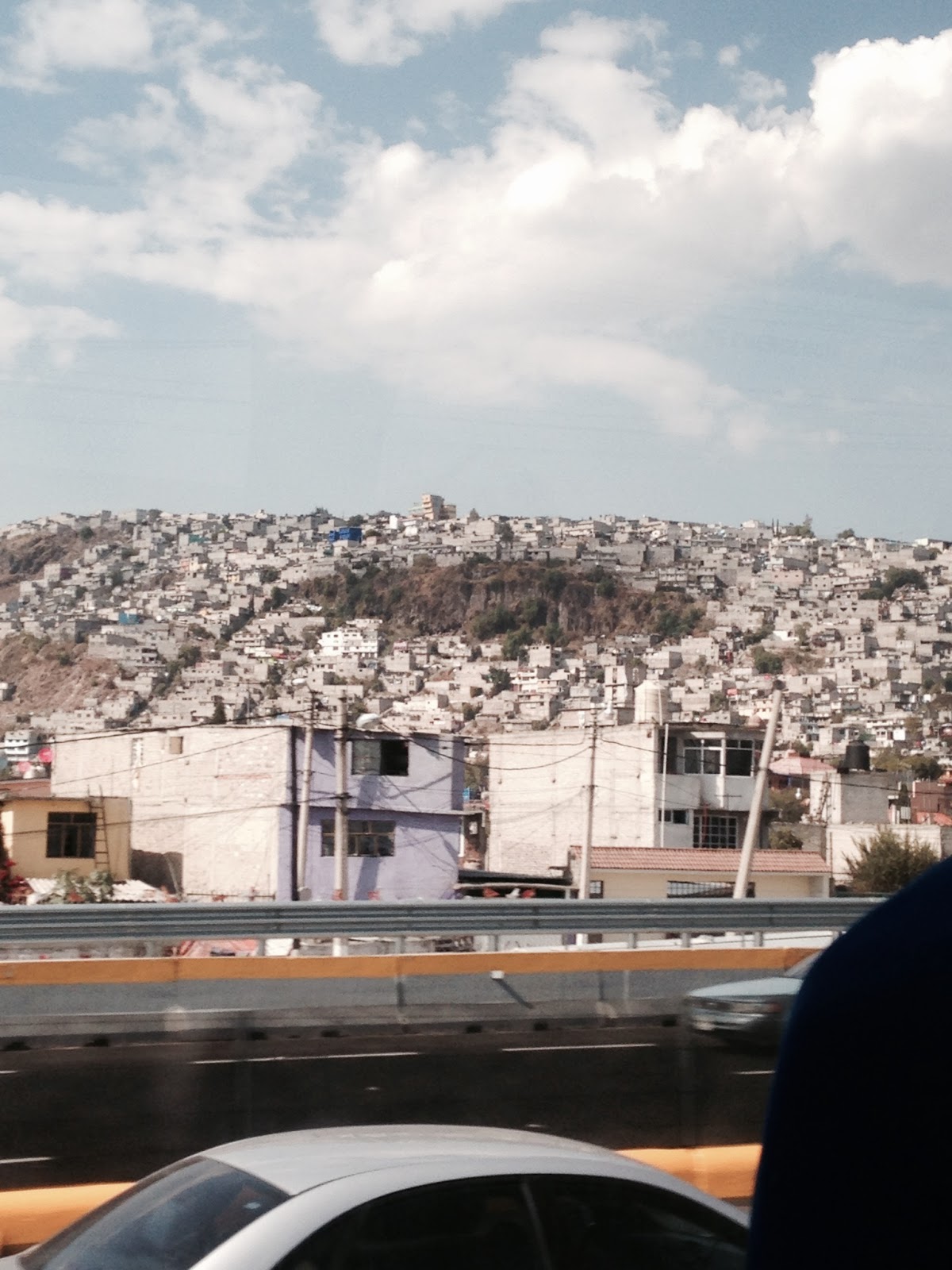
| The favelas (slums) stretch on for miles outside the metropolitan part of Mexico City |
Another funny thing about the bus; it stops to let hawkers on.
A salesman or saleswoman will come on with a big tray full of snacks, a line of coke bottles strapped to their bodies like a bandolero. The bus driver waits for them patiently to walk up and down the bus aisle before leaving, and Itzal explains that they are allowed to sell whatever they want to us but for for no more than $1 American dollar. Good deal.
Teotihuacan is a true wonder but is not heritage-listed yet as it was only discovered around 1910 (these huge pyramids - some of the biggest in Mexico - were previously covered in dirt so they looked like hills and mountains). The ancient city has been partially reconstructed in parts to demonstrate the full scope of the complex built by a Mesoamerican civilisation known only as the Teotihuacanos. Not much is known about this group as they had no written language. Their civilisation flourished between 300 BC and 200 AD, and their buildings were regarded by later civilisations (such as the Mixtecs and the Aztecs) as tombs of the gods. The grand complex has an efficient drainage system, and some of the walls still retain their original red paint and murals depicting jaguars, parrots and pumas.
 |
| Itzal points out the surviving artwork, nearly 2000 years old |
 |
| Teotihuacano jaguar |
After walking through the complex we move past the various smaller structures and come to the Pyramid of the Moon. The steps only take tourists halfway up the structure but that's more than high enough for me. The stairs are narrow and steep, and I resolutely look only two steps ahead as I climb the ascent. Once at the landing I scramble as far from the edge as I can get and turn back to take in the view of the city. It's larger than I thought, and Itzal tells us that the ancient city was home to some 250, 000 Teotihuacans around 2000 years ago. I try to picture the city alive but the structures are too big for my imagination at this point, and I feel breathless from the climb (and my fear of heights doesn't help either). I watch as an American girl poses right on the ledge for a photo, my heart skipping beats as I picture her slipping and tumbling to a stupid, sudden and unavoidable death.
It's at this point that I quickly make my descent, grasping the black rubber rope for comfort as I try not to look down.
At the bottom Itzal explains the nature of Mesoamerican society to us. A person's role in this society was determined by the day they were born on. One of these days was a day of sacrifice, so if you were born on this day it was your lot in life to eventually be sacrificed to the gods. I guess there has to be some kind of payoff... the Teotihuacans couldn't accept the beauty of their pyramids without undergoing some kind of suffering in return, so the streets were awash with blood, and it makes a twisted kind of sense if you're standing at the foot of these giant buildings.
 |
| View of the ancient city |
I struggle to imagine how someone could so willingly lay down their life for an abstract concept like religion, and Itzal tries to explain that it was just a way of life for this society. The 'victim' would have their back cracked over a large rock (a rock that we stand next to as she explains this), and the severing of the spinal column would act as a brutal but effective anesthetic for what was to come. It was required for the sacrificial victim to be conscious until their death so that they could watch their torso being opened up. With the breaking of their back, they could painlessly watch their heart being removed and held in front of their face before they expired.
What a way to go.
And if that wasn't shocking enough, then the heart would be eaten by a high priest in a tamale (a kind of corn-husk burrito). Oh, and did I mention that each corner of the larger pyramids has the remains of babies buried inside them? Cheerful bunch, these Teotihuacanos.
We look to the Pyramid of the Sun, the city's larger pyramid and one of the tallest such structures in all of Mexico. I don't know if I can climb this one. It's three times higher than the Pyramid of the Moon, and I was packing it. As we get closer to it I remain non-commital. Maybe I'll climb it, maybe I won't. Maybe I'll take it one step at a time and see how I go. Maybe I'll just wait at the bottom.
Maybe I just have to do it because this will be the only time I'm ever here and it's a crazy-huge two thousand year old pyramid and if I don't do it I'll hate myself for the rest of my life.
I try not to think about it.
One flight of stairs at a time.
This isn't too bad. These steps aren't as steep.
I'll just take a little peek behind me.
Bad idea.
I lean in towards the stairs and grasp the rubber rope. A six year old boy just within my field of peripheral vision jumps around ahead of me. Where are his goddamn parents? If he falls and comes somersaulting down towards me I will shift out of his way.
I try to pull myself up another flight of stairs. This time I'll look up rather than down.
It's so high.
265 steps later (yes, this is how many there are in total, and no, I didn't count them) I reach the highest landing. From here you can scuttle over rubble up to the apex, which I force myself to do. I stay crouched down, irrationally but irrevocably afraid that if I stand the wind and gravity will take me off the edge all those 65 metres to the ground.
 |
| The smaller structures in ancient Teotihuacan |
The pyramid used to be higher but the top was dynamited during its uncovering. That's what all this rubble is. I sit with the others for a while on the upper most landing and I manage to find some tranquility despite my ever-present fear. People say you can conquer your fears by doing things like this but my phobia remains undiminished alongside my triumph. Coming back down is scary, but at least I get to be on the ground at the end.
Once I'm on the ground again a sudden crowd of locals swarm to us like moths, carrying T-shirts, obsidian jewellery, polished death masks and noisemakers that sound like the harsh growl of a jaguar. I'm pretty okay with just ignoring them, and sometimes say "No" in espanol (which sounds like "No" in English, only you say it with a Mexican accent). The Duck tires of it quickly though, her innate politeness preventing her from simply moving past them silently.
The tour doesn't end after Teotihuacan, Itzal has a few other things to show us. She's very small but also boisterous and mischievous, always ready to slip a well-rehearsed joke into her explanations but also able to chat less formally with us. She finds a taxi who is willing to take five passengers in his four seats (as it's Mexico, this is very easy to organise - all she had to do was ask the first taxi driver that she saw). One of the accountants sits on Itzal's lap in the front seat. There are no seat belts in the back. The taxi wheels around in a slow circle, mounting the makeshift dirt gutters before taking us down some gravel backstreets to the nearby town.
 |
| Obsidian artisan outside of Teotihuacan |
The fences in the town (also named Teotihuacan) are often broken into pieces, and there is no evidence of any kind of town planning - people build their houses right up against each other, or wherever else they like. Dogs are everything, lounging in the streets and even on the roofs of houses. A mangy poodle watches us from a tin awning as we pass. Also, as it's just after Christmas, endless strings of colourful paper flowers hang over the streets like bunting. It's quite a sight - a ramshackle community with its heart on its sleeve.
We pull up at the outskirts of the town where a local (who speaks very good English) demonstrates the many tribal uses of the agave cactus and the way that obsidian is crafted into many kinds of decorative objects. Most importantly, we try three varieties of cacti-based alcohol - pulqua (a traditional Aztec drink, quite tasty and not too potent), tequila (which I've always had issues with, and this local variety is no different) and mescal (yeah, the one with the worm - this one is a bit foul too).
 |
| Pulqua, Tequila, Mescal |
 |
| Cactus-thread |
As the sun goes down, Itzal takes us to a local Mexican family's house where we have a traditional home-cooked meal. Having witnessed the poverty throughout the town, and comparing it to this huge house (which was far bigger than our place back in Australia), I decide that this family is not very reflective of what's average in this part of Mexico. But, that's not to say it isn't a welcome visit, it's a very nice meal and the family are quite interested in what Australia is like, so the time passes pleasantly.
 |
| Home-cooked Mexican |
It's past 9 pm when we get back to the subway in Mexico City, so it's a lot quieter than it was at midday, but no less crazy. Private security soldiers walk past us with their handguns drawn, as if ready to fire on someone like it isn't a big deal. The Duck and the accountants see a guy carrying a giant rifle rather nonchalantly as well but my attention is elsewhere. As far as deterrents go, it seems a fairly effective strategy. The Metro subway feels pretty safe. No one could really say that Mexico isn't trying to do something to clean up its reputation as a hotbed of crime, and when one of these mercenaries smiles at me and says, "Hola", I feel quite safe indeed. But even so, I still can't deny the ambivalence I feel about the whole thing after the fact. As a tourist I might feel quite safe in the presence of such men, but what does the ongoing work of these security forces do to the psyche of the local population?


 With half an hour to spare, we decide to grab some more street food for lunch. We spy a busy joint selling tacos for the equivalent of 60 Australian cents each, and we make a beeline for it. After laughing and staring our way through more broken espanol we get shuffled through a lunch line while a mohawked Mexican punk reaches into a large bucket full of soggy, interlocking tacos and plops them onto a plate for us, the halo of oil radiating around them in a vivid shade of orange.