A Guide to this Blog

Showing posts with label Modern History. Show all posts

Sunday, February 19, 2023

Source Analysis: The Atlantic Slave Trade


One can't roll their sleeves up to work as a History teacher without feeling comfortable with source analysis. Over my years as a teacher I've come across many scaffolds and acronyms designed to help students with this historical skill, and I think it's fair to say there's no hard and fast hierarchy to which one works the best. Whether it's AMOUR, COMBAT, TOMACPRU, OPVL, IOP CAM, TADPOLE or something else, it doesn't really matter which one is used so long as the student understands why it's used and can remember what each letter stands for. 

It's also important for the teacher to feel confident about which one they teach and that they're consistent so students don't get overwhelmed with multiple acronyms. Also, even if they're taught just one acronym, it's important for students to understand that there are other alternatives out there in the pedagogical world. If this isn't mentioned then some students may believe that the one they've been taught must be the best one (or, worse, the only one) and this can cause issues if they later find themselves in front of another teacher or in another school where a different approach is taught. 

Me, personally? I can never remember acronyms and I find them restrictive. I always prefer to try and think about sources in the way that a historian does, which means that not every source offers the same types of information. Acronyms seem a little limited in this sense. 

There's also a question of depth when looking at sources and the need to differentiate for students who may not be able to initially engage with sources at higher levels. What I want is to see students working from identifying basic information up to being able to use a source as evidence in response to a question. So this involves a levelled scaffold. I don't make any claim to inventing this - it's a synthesis of all those who come before me and is essentially just my attempt to reorganise various methods into a common approach that works for me. Anyway, here it is:
  • Level 1: Basics - who wrote the source, what's it about, when was it written, where was the source found, how was the source delivered at the time of publication, and why was it written? 
This is about looking at the source in it's simplest terms and comprehending it. The student needs to locate answers to the who, what, when, where, how, and why of the source, however, it should be made clear to them that not all of the questions are applicable all of the time. These questions (like every other part of this scaffold) are simply a range of prompts to promote engagement.
  • Level 2: Questioning - what's the point of this source? What makes it significant in terms of how we understand the past? That is to say, why might this be an important source for modern people to see?
This part is about 'zooming out' and looking at the source holistically to determine a central thesis or purpose behind it. It also essentially encourages students to think about the historical concept of significance. Again, just responding to one of the prompts above would be enough.
  • Level 3: Closer Analysis - who was the intended audience for this source at the time of writing? Who is the audience for the source now? Do we think this source conveys information about the time authentically and, depending on the answer, why or why not? What sort of biases can be recognised? 
This is where we start looking at the reliability of the source and gauging the level of bias. I think it's important to teach students that all sources are biased in some way or another, it's just a matter of determining what that bias is or why some information has been left out. Politics and postmodernism aside, the practical problem with considering some sources as objective is that it leads to some students simply saying that a source is "biased" or "not biased" and leaving it at that. If we want students to provide detailed analysis about the nature of a source's bias then we may need to take away the option of considering sources from a binary biased/unbiased point of view. 
  • Level 4: Evaluation - how useful is the source in answering a key question? How can it be used to answer a question? How would a historian use this source in the course of their own research?
This final stage is often the hardest for some students to grapple with as it involves historical thinking and some degree of higher order thinking. Students need to consider the usefulness of a source but, if they don't have a historian's purpose established, this can be really difficult. Students therefore need to have a question in mind when they answer this part of the scaffold. In the absence of a teacher-supplied question, more advanced students can be asked to consider how this source is useful in conveying a syllabus dot point, or how a historian might use it in the pursuit of a particular agenda.

Lesson Idea: The Atlantic Slave Trade

I would preface the use of this source by telegraphing the use of racist language reflective of historical context. This helps students maintain historical distance from potentially distressing content and sets the tone for how we look at this sort of language in the classroom.

The previous described scaffold has worked well for me with all stages of high school history - it's just a matter of adjusting how students engage with each level of the scaffold and pitching the language at their age group. The scaffold can be modified to connect to a specific source and students can then work their way through it by examining the source four times, moving up a level each time. 

Here is an example that would work well with examining the Atlantic Slave Trade with a Year 9 or Year 10 class. 

1. Start by giving students a question. Here's the example:

Imagine you are a historian studying the question, "What was life like for slaves in America in the 19th century?"

2. This comes with a scaffold - Source Analysis Activity.

3. Work with students through a PowerPoint that guides their response to the Slave Trade source using the four different levels of questions. This can be found here - Source Analysis PowerPoint.

The source included is a primary source related to the sale of slaves. As teacher, you might want to work through responding to the source first so that you have a good idea of the range of answers that might be possible. Students are to complete their scaffold level by level while you work through the PowerPoint as a class.

As mentioned there are more than a handful of different approaches to source analysis. This is just one that works for me and you're welcome to try it too! 

Disclaimer: The above activity was compiled specifically for this blog. 

Wednesday, January 25, 2023

History and Film

Before I was a teacher, and certainly before I had this blog, I did some work as a film reviewer for a now-defunct online blogging network. It mostly involved getting sent screeners for small-release films that no one cared about but in-between these obligations I still managed to watch and review over a thousand films of my own choice. 

My cinematic self-education is by no means complete, I still have quite a list of 'canon' films that I'm working my way through, but I do have a fairly confident awareness of what the history of cinema looks like. Here are some posts I've previously made about how the history of cinema can be utilised as a resource for the classroom:

Today, however, I want to move away from looking at the history of cinema and look instead at how the medium of film is used to represent history itself. The previous blog posts are intended for use in an English or Film Studies classroom, whereas the following will be more relevant for the subject of History.

It's fair to say that the average History teacher has little curriculum-based used for a discussion on the history of cinema (a subject that focuses as much on storytelling techniques as it does on context) so this blog post will inevitably be focused on content and perspective instead. Here we will look at a few examples of history-focused films that I've specifically liked as a History teacher, and I'll highlight how they fit with our current secondary school History syllabuses in NSW. There are, of course, some things to be aware of:

  • Some of these films are appropriate for students to watch.
  • Some of these films are not appropriate for students to watch.
  • Some of these films may be useful in other KLAs because the content connects to a relevant area of study.

Where a film fits in regard to the above will be up to a teacher's professional and informed judgment. The films that are not appropriate for students to watch have been included for a couple of reasons:

  1. They are useful in broadening or deepening the teacher's understanding of a topic, and this in itself can be a powerful tool as it helps us look in particular directions with our lesson planning or research.
  2. It may be negotiated to watch one of these films with some senior cohorts through the use of principal, head teacher, and parental permission. This can depend on classification and community context.
  3. The teacher might select appropriate scenes for use rather than showing the entire film.

So, with all that out of the way, here are ten great History-based films that I think are useful:

Haxan (directed by Benjamin Christensen, Denmark, 1922)

Haxan is an unusual history of witchcraft that defies our modern view of what a documentary should look like. A 100 minute documentary in 7 parts, Haxan provides a narrative overview of witchcraft through the ages - presenting pagan rituals (with dramatised appearances from the Devil!) alongside more rational sequences that suggest medieval torture and mental illness explain why innocent people would have confessed to being witches in the face of superstition. As such, Haxan exists as a fascinating piece of historiography that charts changing beliefs while blurring the lines between reality and fantasy. The film itself perhaps demonstrates the conflicted beliefs of the 1920s in the way that it confidently places the rational and irrational side by side. The body of critical literature analysing Haxan is perhaps just as valuable as the film itself. 

Would work well for: 

  • History 7-10 - Stage 4 Medieval Europe (Teacher)
  • Year 12 History Extension - Witch Hunts and Witch Trials (Teacher, Students)

Battleship Potemkin (directed by Sergei Eisenstein, Soviet Union, 1925)

This innovative film (the infamous Odessa steps montage remains highly influential for many great directors) is an invaluable historical resource in the sense that it was made under the Soviet regime in its pre-Stalin days. Focusing on the Potemkin mutiny that formed part of the fabric of the 1905 Russian Revolution under Tsar Nicholas Romanov II, Eisenstein's meticulous drama reconstructs historical events in a fairly truthful manner despite its function as 1920s Soviet propaganda. From a teacher's point of view, the film works as either a way of examining developing rebellion against the Romanovs or as an exercise in looking at the film's use as propaganda (the textual history of Battleship Potemkin is just as historically fascinating as the film itself - pre-, during, and post-Stalin versions all serve to demonstrate the changing political landscape of Russia over time).

Would work well for:

  • Year 11 Modern History - The Decline and Fall of the Romanovs (Teacher, Students)
  • Year 12 Modern History - Russia and the Soviet Union (Teacher, Students)

Burn! (directed by Gillo Pontecorvo, Italy, 1969)

At first glance Burn! (or Quemada) might seem a murky choice owing to its generalised nature. Whilst its focus is on a fictional Caribbean island in the 19th century, the themes and main beats of Burn! are still very much in keeping with a common pattern of imperialism, colonialism, slavery, and commercial exploitation. Made at the height of the decolonisation period, the film also stands out (alongside Pontecorvo's more famous film The Battle of Algiers) as one of the more authentic cinematic depictions of modern historical forces. From a curriculum standpoint, it helps to visually illuminate the motivations behind European colonialism and the significance of imperialism and its impact on the modern world.

Would work well for:

  • Year 12 Modern History - The Shaping of the Modern World: The Age of Imperialism (Teacher)

Newsfront (directed by Phillip Noyce, Australia, 1978)

Newsfront is such a broad yet rich text for any History teacher. A classic of Australian cinema, it focuses on the era of 1948-1956, a period in which the advent of television was shaping the way in which news was collected and delivered. Noyce's script mixes archival footage with a wrap-around narrative to insert its newsreel cameramen characters into Australian history. If your knowledge of this period in our history is a little shaky, this film provides a relatively quick overview of the key events (the referendum to ban the Communist Party in Australia, Robert Menzies' big comeback as Prime Minister, postwar migration to Australia, and the arrival of television). For senior students, it provides a chance to examine the role of cinema in representing our history in a certain way.

Would work well for:

  • History 7-10 - Stage 5 The Globalising World: Popular Culture (Teacher)
  • History 7-10 - Stage 5 The Globalising World: Migration Experiences (Teacher)
  • History 7-10 - Stage 5 School Developed Topic: The Cold War (Teacher) 
  • Year 11 Modern History - The Representation and Commemoration of the Past (Teacher, Students)
  • Year 11 Modern History - Case Study: Australia and the Rise of Communism (Teacher)
  • Year 12 History Extension - An Australian Primer Minister: Robert Menzies (Teacher, Students)

Cry Freedom (directed by Richard Attenborough, United Kingdom, 1987)

A politically-charged depiction of Apartheid South Africa made while Apartheid was still happening. As a British film made in the 1980s, it's no surprise that Cry Freedom functions as a perfect example of the 'white saviour' narrative. It's a little disappointing that the focus shifts from Steve Biko around the halfway mark but, that said, it's a fairly accessible and engaging piece of cinema and the Biko half features a fantastic performance from a young Denzel Washington. If you're looking for something that your students will be able to easily follow (perhaps it might even make a few things clearer for them - some students benefit immensely from perceiving history through the lens of a cinematic narrative) then Cry Freedom will definitely do the job.

Would work well for:

  • Year 12 Modern History - Change in the Modern World: Apartheid in South Africa. (Teacher, Students)

Kundun (directed by Martin Scorsese, USA, 1997)

Scorsese's biopic of the Dalai Lama is a high quality production that goes some way towards realistically depicting the Chinese occupation of Tibet in 1950 and the ideological/religious tensions surrounding it. I've personally used this one with a Modern History class but I did cut it down to about half its length so that we could focus on the sections relevant to our topic. Kundun as a film in its own right is probably a little too slow for the average teenager, however, the scenes in which the Dalai Lama meets with Chairman Mao are an essential window into the relations between Communist China and bordering territories. Scorsese's film is generally quite historically accurate - albeit quite toned down in terms of the violence that came alongside the Invasion of Tibet (no doubt owing to Hollywood's sensitivity to potential commercial markets in Asia). 

Would work well for:

  • Year 11 Modern History - Case Study: Tibet in the Modern World. (Teacher, Students)
  • Year 12 Modern History - Change in the Modern World: The Cultural Revolution to Tiananmen Square. (Teacher, Students)

Five Broken Cameras (directed by Emad Burnat and Guy Davidi, Palestine, 2011)

A story of non-violent resistance to the Israeli settlement of the last pockets of Palestinian territory, as recorded by Palestinian documentarian Emad Burnat on five cameras that got destroyed by Israelis one-by-one. In a topic that's so politically fraught and volatile, Burnat is able to provide an irrefutable record that helps to illuminate what's currently happening in Israel and the methods currently being used to eradicate Palestinians from their territory. In terms of the history syllabus, the parameters for the Arab-Israeli Conflict option might be 1948-1996 but the dot point that pertains to the rise and significance of the Israeli settler movement echoes through to the modern day. This documentary does an excellent job of bringing clarity to motivations, actions, and impacts of this movement that don't need to necessarily be tethered directly to any particular time period - the situation remains unresolved and this film still assists in coming to an understanding of the complexities involved.

Would work well for:

  • Year 12 Modern History - Peace and Conflict: The Arab-Israeli Conflict. (Teacher)

The Act of Killing and The Look of Silence (directed by Joshua Oppenheimer, joint international production, 2012 and 2014)

The Act of Killing is an astounding and unusual documentary in which the director asks surviving Indonesian death squad members to re-enact the murders they committed in the 1960s. The Look of Silence is an electrifying and intense companion piece in which the surviving relative of one of the victims confronts his brother's killer. These documentaries unpack and go some way toward explaining why the tragedy of Indonesia's recent history is unlikely to ever find a true sense of closure. When the government allowed and encouraged such widespread civil murder yet also distanced itself officially, thus making it a 'people's issue', what can be done? When thousands killed millions, and the resultant regime remains in power 50 years later, what can be done? It essentially means the killers have no problem speaking openly about the violence they wreaked upon so many because the issue is too widely embedded in Indonesia's society and recent history. Anyway, I would not recommend showing these films to students - the frank discussion of the acts committed by these men is too disturbing. I would, however, recommend them to any teacher looking to teach Indonesia for the National Study in Modern History.

Would work well for:

  • Year 12 Modern History - National Study: Indonesia (Teacher)


Bridge of Spies
(directed by Steven Spielberg, USA, 2015)

There have been lots of films made about the Cold War but most of these were made during the Cold War itself. As such they often fall into the category of spy-fantasies that existed as a pressure valve for the anxieties of the time. In this film, Spielberg gives the Cold War the same grand treatment he gave WWI, WWII and 19th century America in some of his earlier 'serious' films. It struck me while watching Bridge of Spies just how perfectly tailor-made this film was as an entry-point for younger generations with no experience of this unique and protracted conflict. Spielberg crams in as many aspects of the 'war' as possible to create a highly visual narrative, finding success in illuminating a difficult slice of history that often resists direct engagement. 

Would work well for:

  • History 7-10 - Stage 5 School-Developed Topic: The Cold War (Teacher, Students)
  • Year 12 Modern History - Peace and Conflict: The Cold War (Teacher, Students)
 
The Woman King (directed by Gina Prince-Bythewood, USA, 2022)

Contrary to the wave of Americentric online trolls who sought to challenge The Woman King's value, the historical accuracy of this film holds up just as much as most of the other entries on this list. It only takes minimal online searching to find some reliable discussions of how this films deals with an under-represented area of history and, as such, The Woman King will remain highly useful as an educational resource until further directors and writers begin to visit early modern African history from an African perspective. Some elements might push the boundaries of what can be shown in a classroom (it's rated M in Australia but screening it will always be a matter of context and school discretion) but, this said, I think some excerpts could still be used and teachers looking to broaden their personal understanding will find it useful too.

Would work well for:

  • Year 11 Modern History - The Construction of Modern Histories (Teacher)
  • Year 11 Modern History - Case Study: The Trans-Atlantic Slave Trade (Teacher)
  • Year 11 Modern History - The Shaping of the Modern World: The Age of Imperialism (Teacher)

Saturday, November 24, 2018

Incorporating Drafting into Extended Response Assessment Tasks

With the advent of NESA's stipulations for HSC Assessment, in which students may only sit one formal examination per subject (including essays set in this fashion), there is now an increased need to senior students to practise the writing of extended responses in a meaningful fashion. Prior to the new rules, students might have written essays in assessable conditions anywhere up to 3 or 4 times across their final schooling year, but now this is no longer possible.

One way to get around this is to incorporate drafting into an assessable essay. This takes away the formalised examination context and - in the spirit of what NESA is hoping for - allows for a less stressful approach to essay writing in which students can engage with assessment as learning. 

There are two examples here for different subject areas, both of which were written for the older syllabus that ended this year. Regardless of your KLA, it's worth checking out both of them as they represent different approaches to the drafting process.
Both tasks utilise an analytical marking criteria (as opposed to the holistic style rubrics used for HSC marking). It's a different way to mark than what we may be used to, however, it's imperative to use an analytical-styled criteria when undertaking assessment as learning as it allows the students to identify specific skills they can work on to consolidate strengths and address weaknesses. 

The holistic marking grid (in which student ability is represented in bands of grouped criteria) is specifically designed as the absolute end point of the learning process, IE. This style of criteria gets used for HSC marking because the students don't get to see how they're marked at this point. An analytical marking grid (in which specific skills are addressed with their own independent marks) is designed to offer meaningful feedback to the student, and this is often what a lot of Australian universities use for their humanities courses when demonstrating to students what criteria they need to address when submitting assignments.

Anyway! In terms of the resources attached above:

The Advanced English task requires students to submit a draft at some point before the final submission date. In terms of making their drafting visible to the marker, 5 of the 25 marks have been allocated to a reflection statement that they must attach to their final submission. 

The Modern History task strips back the differentiation of skills (it's only a 15 mark response) in order to take the pressure off students who are being asked to do multiple drafts. The drafting process is incorporated here as a non-mandatory due date, which works as thus:
  • Students submit a draft about one week before the final due date. Students can't be penalised if they don't submit at this time - it isn't mandatory and it isn't the final due date.
  • The teacher marks the drafts and gives them back to the students with feedback.
  • Students have an option to re-submit on the final due date for re-marking. If they choose not to do this then they take the mark they've already been given instead.
Roughly half the students in this scenario re-submit a new draft for marking. The other half aren't interested in "doing the assessment task twice" and will take the mark they've been initially given. It turns out to be a remarkably efficient approach as you get to finalise marks for half the students before the final due date.  

I'll write another blog down the track once I've had a chance to develop more assessments in response to the new syllabus.

Thursday, July 27, 2017

Change in the Modern World: China


Option B of the Change in the Modern World module for HSC Modern History offers teachers and students a chance to engage with the volatile and intense recent history of China's Cultural Revolution, as well as the Tiananmen Square incident that threatened to change the lives of more than a billion people.


In the materials below, teachers are shown an overview of how this module can be taught. Each of the resources and ideas will help our Year 12 students to engage with Red China at its height. This new module and option gives us the chance to wrestle with an exciting period of modern history where huge ideas had a very real impact on the lives of both those at the top and the everyday people influenced by them.


Change in the Modern World: Option B overview - PowerPoint Presentation from the HTA NSW Conference 2017

Resources
Political and Social Conditions in China - cause and effect, background dot points.
Building the Field: China 1966-1969 - useful subject-specific vocabulary and historical terminology.
Sino-Soviet Split and Anti-Revisionism in the 1950s and 1960s - cause and effect, ideology, background dot points.
Significant Figures: China 1966-1989 - historical significance, overview of historical figures.
Deng and Mao: Changing Political Standing - significance and timelines in relation to dot points.
Getting to Grips with the Cultural Revolution - cause and effect, research scaffold.
Evaluating the Cultural Revolution - source analysis, historiography, perspectives.
Tiananmen Square: Ideology and Evaluation - source analysis, historiography, perspectives.
Impact of the Tiananmen Square Incident - guided comprehension of historical reading


Additional material can also be found in HTA's Teaching History journal, 2017.

Tuesday, July 25, 2017

Impact of the Democracy Movement on China in 1989

This iconic photo shows an unknown figure who has come to be known as 'Tank Man'. This man stood in front of the advancing CCP tanks during the protests, in his left hand is his grocery shopping.
The last dot point in the China option for Change in the Modern World states that students should give some focus to:
  • the impact of the events of Tiananmen Square in 1989 on China and its standing in the world. 
The protests in Tiananmen Square in 1989 were a distillation of the Democracy Movement that had characterised Chinese dissent throughout the late 1970s and the 1980s up until this point. Chinese artists, intellectuals, and students had gradually increased their demand for political, social, and economic reform under Deng Xiaoping's helming of Chinese leadership, which led to devastating consequences - what many refer to as a historical 'flashpoint'. Through a combination of short and long term causes, tensions built to a point where the opposing ideologies of the CCP and the protestors finally clashed.

This was the point where China 'decided' whether it did want to become a democracy or not. The reverberations of this violent release of pressure would colour the next decade for China both nationally and internationally, and its this examination of the effect that students will need to come to grips with in relation to the last dot point of Option B.

The document attached below offers a summary of the aftermath of the incident, and utilises a scaffolded version of the Cornell note-taking method to guide students in engaging and responding to specific parts of the text. I've found this approach quite effective with mixed ability classes who struggle to read texts of this sort - the note-taking scaffold, with its questions, is helpful because it explicitly focuses students while they read. In essence, it tells them what to look for, and students tend to appreciate this.

Monday, July 24, 2017

Tiananmen Square: Ideology and Evaluation


Picking apart the myriad reasons for what happened at Tiananmen Square in 1989 can be quite a big ask, especially in light of the conflicting information in the historical record. At the time of writing it has now been nearly 30 years since the incident occurred, however, the establishment of a national history in keeping with China's ongoing political ideology means that some degree of historiographical analysis will be required from students looking to get an overall picture of this multidimensional event. 

In other words: the official and the unofficial histories of the Tiananmen Square incident are quite different from one another. 

Before engaging with the opinions of a wide range of historians, students should examine the various causes of the event itself. 

This can be looked at in three main ways:
  1. The reasons for Deng Xiaoping's opposition to the protests.
  2. The reasons for the protestors' opposition to Deng Xiaoping.
  3. The reasons for why the protests could ultimately be interpreted as a failure.  
Here's a sheet with 14 causes that can be sorted into the three above categories. Students can colour-code, cut-and-paste, or copy into a table. Click the link below to download.

Resource: Clash of Ideologies


Following this, students can then begin looking at a variety of evaluations regarding the incident, and consider how each historian has grappled with the above three categories of reasoning. These have been gleamed from various books about 20th Century Chinese history, all of which I would recommend. They are as follows:

Alexander V. Pantsov, author of Deng Xiaoping, 2016
Despite numerous pleas to return home, the rebellious youths did not want to abandon their protests, so the leaders of the nation had to choose between employing force and making concessions. And they made their choice, turning the streets leading to Tiananmen red with blood.
Deng Xiaoping retained his firm conviction about the necessity for dictatorship in the form of the unchallengable rule of the Chinese Communist Party. When confronted by a vision of democracy, he could only see the spectre of chaos. He dug in his heels and would go no further.
Many in the Party saw the market forces of economic reforms to blame, that the modernisation of the economy had opened China up to the 'rotten West' and that this was how bourgeois liberalisation contaminated the minds of the youth. The CCP, now with a new upcoming leader in Jiang, now condemned Deng's planned reforms of the future.
Immanuel C. Y. Hsu, author of China Without Mao, 1990
Elders who enjoyed privileges in the Party wanted to hold onto these privileges at all costs, and felt the need to defend the socialist order that had made their elitism possible. Killing protestors was not a concern as they were 'anti-party counterrevolutionaries' who deserved to be eliminated. Loss of tourism and credit was of small concern compared to the survival of the Communist leadership. Deng declared that he did not fear foreign opinion for this reason.
Accurate figures of the massacre are impossible - Western sources estimated 3000 dead and 10 000 wounded. One report from the New York Times said 400-800. A Chinese government spokesman told an NBC anchorman that there were no casualties - certainly no bloodbath. The Chinese government later admitted to 23 students dying accidentally, and that 150 brave soldiers had died, with a further 5000 wounded.
 Frank Dikotter, author of The Cultural Revolution, 2016
The leaders lived in fear of their own people, constantly having to suppress their political aspirations. Deng personally ordered a military crackdown on pro-democracy demonstrators in Beijing, as tanks rolled into Tiananmen Square. The massacre was a display of brutal force and steely resolve, designed to send a signal that still pulsates to this day: do not query the monopoly of the one-party state.
Ezra F. Vogel, author of Deng Xiaoping and the Transformation of China, 2011
It's estimated that 100 000 protestors were in Tiananmen Square when the army moved in around midnight. Only several thousand were left waiting at 2 AM when the army reached the square. It's estimated that 300-2600 demonstrators were killed. Figures from Beijing hospitals show at least 478 dead and 920 wounded. Nearly 600 vehicles, including PLA trucks and armoured carriers, were damaged.
Maurice Meisner, author of Mao's China and After, 1999
Deng Xiaoping congratulated the police and the army who had crushed the 'counterrevolutionary rebellion'. And he offered condolences to the families of government soldiers who had died. He labelled the civilians as 'the dregs of society'. The government later released a figure of 300 civilian deaths which was mocked by eyewitnesses. It is estimated that 2000-7000 civilian deaths occurred. A nationwide wave of arrests occurred after the event, resulting in the incarceration of at least 1000, and the executions of 100s.
Resource: Assessment of the Tiananmen Square incident by Historians

Sunday, July 23, 2017

Evaluating the Cultural Revolution

After students engage with some of the terrifying history of this period it will be necessary to guide them towards offering their own evaluation of events. This can be modelled through source analysis of what historians say about the Cultural Revolution. Students should read over the following opinions; assess them for their content, and usefulness and reliability, and then arrange them into an order of personal agreement.

Craig Dietrich, author of People's China, 1986
The Great Proletarian Cultural Revolution took the whole world by surprise. Suddenly, China was at war with itself... Nobody could quite understand what was going on or why, partly because systematic reporting was impossible. Millions of students were on the march; entire cities were festooned with wall posters; mighty leaders were wearing dunce caps; thousands of victims were dying in pitched battles; foreign embassies were being mobbed, even burned to the ground. And always words, a Niagara of rhetoric, slogans, accusations, denials, directives, and, above all, Mao Zedong Thought. Clearly, it was a power struggle... Mao Zedong occupied the centre of this maelstrom. It was declared to be his personal revolution. Only gradually did it become clear that he had a rational purpose, albeit an audacious one.
 Richard M. Pfeffer, author of China in Ferment, 1971
The Cultural Revolution was really three things in one: an enigmatic multiple power struggle, wrapped in a crusade, and superimposed on a scattering of more or less spontaneous, more or less politicised student riots, strikes, peasant uprisings, mutinies, and palace coups.
Anne Thurston, author of Enemies of the People, 1987
The Cultural Revolution was an extreme situation characterised by loss - loss of culture, loss of spiritual values and religion, loss of status and honour, loss of career, loss of dignity, and loss of trust.
Maurice Meisner, author of Mao's China and After, 1999
Unity was to prove an elusive goal, and the nature of the victory was hard to define. The Cultural Revolution had begun with a wholesale attack on the Communist Party; it had ended with the resurrection of the Party in its orthodox Leninist form, albeit shorn of Mao's more prominent opponents. In 1966-67 a massive popular movement had flourished on the basis of the principle that 'the masses must liberate themselves'; by 1969 the mass movement had disintegrated, and selected remnants of it had been absorbed by old bureaucratic apparatuses. Much blood had been shed, but what had changed? The Cultural Revolution not only failed to produce permanent institutions of popular self-government but also failed to resolve the more immediate problems of political succession. One of the original aims of the Cultural Revolution was to 'train revolutionary successors'.
Alexander V. Pantsov, author of Deng Xiaoping, 2015
Strange to say, the nightmare that was the Cultural Revolution at least had the positive effect of restraining the potential for self-indulgence of the Chinese ruling elite.
Immanuel C. Y. Hsu, author of China Without Mao, 1990
Mao sought ideological purity through intensified class struggle and the purge of high party and government leaders and intellectuals.
Frank Dikotter, authorof The Cultural Revolution, 2016
The Cultural Revolution was about an old man settling persona scores at the end of his life. Mao had a great capacity for malice and revenge, and had little regard for loss of human life. Mao's ego meant that he saw little distinction between himself and the revolution - he was the revolution. If someone wronged him, they wronged China. Any dissatisfaction with his authority was a direct threat to the dictatorship of the proletariat.
Most of the above information can be found on the downloadable sheet below. As mentioned earlier, students should analyse and engage with the opinions by comparing and contrasting their differences and similarities, and acknowledging possible reasons for bias. It would also be useful to link the content of the sources with the identified causes for the Cultural Revolution. For example, Dikotter's opinion just above links quite neatly with the idea that Mao's personality was a primary factor behind the Cultural Revolution.


I would recommend all of the above texts are great teacher resources for anyone looking to read up on the Cultural Revolution in support of the new Modern History Stage 6 syllabus.

Saturday, July 15, 2017

Getting to Grips with the Cultural Revolution

If I'm honest, History really only comes alive for me when it's challenging. The teaching of History should be a subject area that forces the student (and teacher) to take a long hard look at the 'facts' and question the accepted version of events. If you take a look at the new Stage 6 Modern History NSW Syllabus you'll see that the outcomes are very much geared towards facilitating this kind of historical thinking - the curriculum wants us to analyse sources so that we can better ascertain the nature of bias, the curriculum wants us to contest the 'official' narrative and engage with competing versions of events so that we can make our judgements, the curriculum wants us to gather up as much information as we can so that we can offer individualistic evaluations in response to essay questions.

Modern History isn't dry, it's something that should be passionately argued with.

The Cultural Revolution is one of two key focal points for the Change in the Modern World China option (Option B) and, as such, it's perfect fodder in regards to the aforementioned mutable nature of the syllabus outcomes. The Cultural Revolution is a notoriously tricky area of historical debate and therefore forces the student (and teacher) to create their own historical narrative in response to the available (and unavailable) information.

The first port of call is 'building the field', where students increase their knowledge of the historical period through increased engagement with appropriate vocabulary and, also, gathering an impression of the causes that could be attributed to the Cultural Revolution. Potential causes could be best summarised as the following:
  • The Sino-Soviet split: a clash of ideologies leading to China's increasing independence.
  • Tensions arising from Party Politics: Party members removing all references to Maoism from constitution in order to diminish Mao Zedong's power. Mao's role as 'honorary' Chairman led to ambiguity over leadership.
  • The Great Leap Forward: failure of this attempt to modernise China in one quick go had disastrous consequences for Chinese society, leading to widespread death, famine and corruption.
  • Permanent Revolution: the ongoing nature of class struggle in a Marxist society meant that elitism and revisionism needed to be prevented.
  • Mao's Personality: Mao sought to maintain the Cult of Personality that kept him in power, and would often test the loyalty of his comrades. Different factions arose in the Party in response to desires to be identified as Mao's potential successor.
  • Educational Reform: Mao saw the importance in harnessing the next generation as the future of Chinese communism, and aimed to control this through education and ideology.
The next step in teaching the Cultural Revolution is in getting students to dive headfirst into the narrative of events. This is incredibly difficult with the Cultural Revolution for a number of reasons:
  1. It's near impossible to know exactly why Mao started the Revolution.
  2. The Cultural Revolution happened on a huge scale, with millions of students ('Red Guards') spearheading the revolution in hundreds of independent movements that did not co-ordinate with one another.
  3. The Party fractured in ways that are hard to understand - those who feared ideological attack from Mao sought to influence the Red Guards to act in a certain way, deflecting blame towards their enemies. This resulted in civil disputes between different groups of Red Guards acting under the influence of different Party members.
  4. Mao remained largely aloof from the Revolution - once he had set the chain of events in motion he stepped back from direct involvement. It could be argued that he was keeping his own hands clean of any wrongdoing, however, the very nature of socialist revolution also demanded action from the proletariat (the students and workers) so it would not have made sense for Mao to have directly led them as this ran contrary to Marxist ideology.
  5. In the simplest of terms, China was plunged into chaos between 1966 and 1976.
It is therefore best to have students shape their own understanding by gathering information through independent research. The depth and breadth of information on the Cultural Revolution is so multitudinous, so contradictory, and so endlessly fascinating, that it would be a great disservice to prescribe a single narrative for students to follow.

The solution is to set students up with scaffolded research. Here is a guide that will assist students with assembling some key information alongside their own research.


Just for your awareness, here are some things that may come up in student research (or key words that you may find useful in directing them):

Bian Zhongyun: The first death of the Cultural Revolution. Bian was a vice principal of a school where the Red Guards rose up. Her mouth was filled with soil and her face splashed with black ink, and she was paraded around while wearing a dunce's cap before being beaten to death with nail-spiked clubs, and dumped into a garbage cart.

Other Teachers: Many authority figures in schools were the first targets for the new revolutionaries. The principal at the Third Girls Middle School was beaten to death, and the Dean there hung herself before she could face a similar fate. A Biology teacher at Beijing Teacher's School was dragged along the ground until she died, and then other teachers were forced to beat her dead body if they did not want to face a similar fate. Party member Liu Shaoqi set a quota (of 1%) for Red Guards in their targeting of teachers, which equated to 300 000 victims.

The Little Red Book: The level of fanaticism amongst the Red Guards was so intense that Mao's quotations (originally published in the Liberation Army Daily) were assembled as a little red book for all citizens to carry.

Massacres: In regional areas such as Daxing, local leaders (those that Mao had initially intended to target) murdered all the landlords and their families. 300 in total were killed in a co-ordinated night-time attack that utilised methods of stabbing, strangling, and electrocution to prevent what the leaders claimed was a chance of 'bourgeois uprising'. Even the children were included to ensure that no revenge could be taken in the future.

Rallies: There were huge gatherings in Tiananmen Square where Red Guards could catch a glimpse of Chairman Mao. The last of these took place in November 1966, and saw two and a half million teenagers gather in one day to see their great helmsman.

Destruction of the Four Olds: Many graveyards and temples were defaced and destroyed, especially in regional areas such as Tibet. Bodies of dead women were dug up in Confucian cemeteries and hung from trees, and over 10 000 graves in Shanghai alone were desecrated. In Zhengdang, ancient monuments were destroyed. Entire libraries, such as one in Zikawai, were also burned down as symbols of bourgeois culture, leading to the loss of thousands of 19th century books.

Shanghai: As one of China's most modern cities, Shanghai saw the eruption of some strange displays of Maoist outrage. At least 30 flower shops were destroyed as flowers were considered a waste of farmland. Cats were also targeted as they were considered symbols of Western decadence. Furthermore, many Red Guards saw the Revolution as an opportunity for looting, and some 30 000 'bad families' were forced to hand over property deeds - leaving nearly half a million people homeless. 704 people in Shanghai committed suicide in September 1966 alone.

The Vietnam War: The in-fighting between separate factions of Red Guards got so bad that weapons China meant to send to the Viet Cong were seized by various Chinese groups. The People's Liberation Army had to be mobilised away from the Chinese-Vietnamese border in order to help restore order in some provinces of China.

Guangxi Province: Rival Party members Lin Biao and Zhou Enlai waged war against each other in Guangxi in 1968 through the use of proxy forces of Red Guards. At least 80 000 were killed in several massacres.

Cannibalism: Rebels in Wuxuan began to practice cannibalism as a strange fusion of ritual and Marxist ideology, with at least 70 'capitalist' landlords publicly butchered and eaten alive. Mao ordered an end to this practice once he got word of it but, instead of punishing the cannibals, he sent a new statue of himself as a congratulatory present for those who had assisted with the Cultural Revolution.

Impact on the Arts: Intellectuals were the most badly scarred by the Cultural Revolution. Mao disliked intellectualism and saw it as useless in contrast to the practicality of his own view of socialism, which meant that artists and philosophers and the like were targeted by Red Guards. 1966-1976 became 'ten lost years' with no art, no music, no painting, no writing, no academic or scientific journals in China. It was a huge waste of an entire decade's worth of talent.

Ethnic Minorities: Also amongst the most persecuted were those who did not ethnically conform with the socialist Chinese majority. 800 000 Mongolians in the Chinese province of Inner Mongolia were tortured - there was widespread sexual abuse of women, removal of tongues and teeth, and many burned alive. Only 10% of the population in Inner Mongolia were actually Mongol, yet 75% of those persecuted in the area were of this ethnicity, which made it look like genocide. Mao ordered a stop to this persecution but did not punish those responsible.

The End of the Red Guard: Unable to manage the independent actions of the Red Guard groups who had radically changed China's urban society, Mao ordered for all those who had driven the Cultural Revolution to be sent to the countryside for re-education through labour. Between 1969 and 1972 some 17 million of these youths were sent to live in villages, leading to mass suicide, poverty, and depression.

Wednesday, June 28, 2017

Deng and Mao: Changing Political Standing

This cover from a 1983 Time magazine demonstrates the challenging relationship between two of modern China's most influential figures.
The middle section of Option B for Change in the Modern World in the new Modern History HSC syllabus deals with the transition stage between the two big key events that form the basis of the study. In the 1960s we have the Cultural Revolution, and in 1989 we have the Tiananmen Square Incident, but between these flashpoints of great social upheaval there is a changeover of guard that helped to shape the course of Chinese history in the latter half of the 20th Century. The early 1970s saw Mao Zedong go into physical decline as he began to outwardly show signs of Parkinson's Disease, leading to his disappearance from the public eye before his death in 1976. By 1979 he would be succeeded as paramount leader by his co-revolutionary and long-time colleague Deng Xiaoping.

The details of China's political development in terms of key political figures can be seen here.

You'll note, however, that 1976 and 1979 are three years apart. It wasn't a smooth rise for Deng to become China's new helmsman, and Mao's own 'fall' from power isn't as clear cut as one might imagine. The involvement of Hua Guofeng as Mao's immediate successor, and the prosecution/scapegoating of the Gang of Four, are the two major factors that would eventually allow Deng to complete his 'rehabilitation' from persecuted enemy of the state in the Cultural Revolution to powerful and respected Party member in the wake of Mao's death.

Here's a resource that details the rises and falls of Mao and Deng in greater detail -Resource: Deng and Mao

In order to get students thinking about the impact of significant events on the way each of these men were perceived by the public and Chinese Communist Party, it will beneficial to encourage some degree of independent evaluation. Students can do this by looking at each dot point in the resource and assigning a score out of 10 indicating how popular and/or powerful they think Mao or Deng would have been in relation to said event. The results can then be plotted on a graph depicting their respective political standing, allowing for visual comparison of data created through direct engagement of the student with the historical detail.

It's numeracy in History!

The graph may look something like this. Be mindful that this is just based on the scores that I gave to each dot point - it isn't factual, it's a graphic representation of my opinion as an amateur historian. Each student should have different results as it will be based on their own evaluation of the events.

It's not an exact science as the data is evaluative rather than quantitative, however, it does help students represent their understand in a concrete and visible fashion.
You could do a couple of things after this, such as:
  • Compare and contrast results, encouraging debate around the nature of subjective evaluation when judging the merits of significant historical figures. 
  • Create an aggregated version of the graph  by taking averages of the class's combined scores and making one overall graph.
  • Have students write a paragraph response assessing the syllabus dot point on the changing political standing of Mao Zedong and Deng Xiaoping, using their newly created graph as evidence to draw upon.

Sunday, June 18, 2017

Significant Figures: China 1966-1989

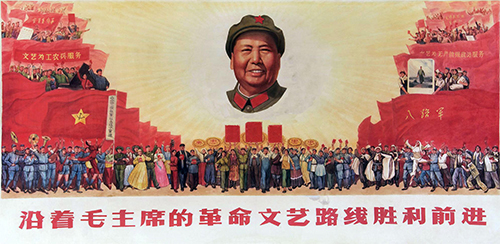
Mao's cult in full force
To Western eyes, the leadership of the Chinese Communist Party (and China itself) is not as clearly defined as the heads of state in our own countries. When teaching Change in the Modern World, Option B: Cultural Revolution to Tiananmen Square 1966-1989 to Modern History students we need to be mindful that they may make certain assumptions based on their own inherent sociocultural biases. Yes, Mao Zedong was Chairman of China from 1945 to 1976, but his most famous successor, Deng Xiaoping, did not occupy this position at all. It would be easy, as a citizen of a country with a Western-styled government, to assume that Deng Xiaoping and Mao Zedong occupied the same positions as overall leaders of China. This is not, however, the case.

The informal term for political leader of the Chinese government is 'Paramount Leader'. It is accurate to say that Communist China had 4 clear paramount leaders between 1966 and 1989, the time period of the study.

They are:

Mao Zedong: Chairman of various posts until 1976.

Hua Guofeng: Chairman of the Central Military Committee until 1981, but only considered leader of the nation until 1978 (when he lost his position as Chairman of the Central Committee).

Deng Xiaoping: Although Deng did not take over directly from any of Hua Guofeng's positions, he did start leading the Consultative Conference National Committee from 1978, signalling his movement into a higher point of influence at that time. He took over from Hua as Chairman of the Central Military Committee in 1981.

Jiang Zemin: Jiang ascended to the role of General Secretary of the Central Committee in 1989, which placed him as the new paramount leader after the Tiananmen Square incident on June 4th.

You'll notice what seem like a few discrepancies in the above information. We all know Mao Zedong as the 'Chairman' of China, however, this is actually a simplification of his full role within the Communist Party of China. At various points, Mao occupied up to 6 positions as Chairman of different branches within the Party and the government. Most of these he rescinded by the end of the 1950s, keeping only the positions of Chairman of the Central Committee and Chairman of the Central Military Committee, which were almost honorary titles by the time of his death (he kept these titles whilst day-to-day power transferred to other roles within the party, which goes some way towards explaining how the most powerful person in the Party could occupy completely different political positions to their predecessors).

"Follow Hua!"
Hua Guofeng was Premier of the State Council, but it was his succession of Mao as the Chairman of the Military Committee (meaning he had control of the People's Liberation Army) that saw him elevated to paramount leader above his peers. This is where things get tricky though, as Deng Xiaoping was undoubtedly the leader of China from 1978 to 1989, despite not occupying any of the key positions of power in the Party of government during that time. Deng was not General Secretary, Premier, or even President of the Party/government. Nor did he become Chairman of the Central Military Committee or Chairman of the Central Committee at any point. Instead, Deng consolidated power through his command of the Central Military Commission, the Consultative Conference Committee, Central Advisor Committee, and as Vice Premier of the State Council.

Deng's successor, Jiang Zemin, held a more traditional bastion of power as General Secretary and Chairman of the Central Military Committee, and this is how the following paramount leaders have established their power since this time.

Pretty dry stuff.

The point for our students to take away from this is that, in the context of a single party political system, the lineage of power does not transfer through a voting system or structured hierarchy. Power is accumulated through the prior paramount leader unofficially 'handing the reigns over' to the new leader through increased association and endorsement, and also by brokering the support of large factions within the Party who hope that the new leader will support their agendas.

Something else to consider is the unofficial designation of 'Party Elders', retired members of the Communist Party who retain a significant degree of influence through largely tokenistic positions (an example is Deng Xiaoping, who still exerted a lot of power well into his 90s despite only occupying a position as Honorary Chairman of the China Bridge Association ['Bridge', as in the card game Bridge]). After Deng's exit, the occupation of leadership became more structured with all three subsequent leaders concurrently occupying the three positions of General Secretary, President, and Chairman of the Central Military Commission.

Other Factors in Understanding Significant Figures
The side story to these four leaders is the narrative of those who also attempted to broker power between 1966 and 1989. The ones that are relevant to the syllabus dot points are:
  • Liu Shaoqi
  • Lin Biao
  • Jiang Qing (AKA 'Madame Mao') and her supporters (together known as the 'Gang of Four').
Liu Shaoqi was designated by Mao as his successor as early as 1960, however, ideological tensions arose between the two figures after the Great Leap Forward, leading Mao to denounce his political protege. A large part of the Cultural Revolution consisted of the resulting power struggle between Mao and Liu, with Liu removed from all political positions and placed under house arrest by 1967. He died in mysterious circumstances in 1969, from alleged pneumonia.

Lin Biao rose in the wake of Liu through his loyal support of Mao's ideology during the Cultural Revolution. In 1969 he was acknowledged as Mao's new successor as the next paramount leader but this favouring was short-lived. Lin's control of the People's Liberation Army grew during the Cultural Revolution to a point that threatened Mao's sense of security. Tensions arrived at a point that saw Lin actively avoid coming to Beijing for Party meetings, and Mao removed him from the Party altogether by 1971. Lin attempted to flee China with his family by plane and died when it crashed in Mongolia. The official line is that Lin attempted to orchestrate an assassination attempt on Mao, had failed, and was now fleeing to the Soviet Union for safety. Another perspective is that the alleged assassination attempt was invented by Mao and his cronies to support the disposal of Lin.

Jiang Qing became the scapegoat of the Cultural Revolution as the de facto head of the 'Gang of Four'. As the most radical faction within the Party, and vehement opponents of China's westernisation and/or modernisation, the Gang of Four were blamed by Hua, Deng, and other Party members for all the ills and crimes of Mao's reign after his death, conveniently allowing for Mao's legacy to remain largely untarnished while Jiang (his wife) became the scapegoat. 

Propaganda depicting children "smashing" the Gang of Four
Two other Chinese political figures of importance to the Option B syllabus are:
  • Zhou Enlai (mentioned in the dot points)
  • Zhao Ziyang (not mentioned in the dot points but instrumental to our understanding of the protests that led into the Tiananmen Square incident of 1989).
Zhou is best understood as the loyal Party member responsible for launching the 'Four Modernisations' that characterised Deng's reign, and for building peaceful ties between China and the rest of the world during a very turbulent time for the nation. He was very popular with the Chinese people, and his struggles against the Gang of Four helped turn public opinion against Jiang Qing, especially after his death at the end of the Cultural Revolution.
Zhao was also a later Party member who was also popular with the Chinese people. In the 1980s, he supported the increased privatisation and westernisation of the Chinese economy, which culminated in his public support of the Tiananmen Square protestors in 1989. Zhao opposed the Party's decision to declare martial law in order to quell the protests in Beijing, on the grounds that making such a decision without an internal vote was constitutionally illegal. Zhao found himself expelled from the Party by Deng and placed under house arrest for the next 15 years.

Students will need to also have tertiary / passing understanding of Soviet leadership as the historical narratives of the USSR and China intersect at several points in relation to the syllabus dot points for Option B. These leaders are:
  • Joseph Stalin
  • Nikita Krushchev
  • Mikhail Gorbachev
Without getting too much into irrelevant information, these three figures relate to China's story in the following ways:

Joseph Stalin: Stalin's Cult of Personality has some clear and relevant parallels to Mao's own cultivation of a godlike status in China, and helps establish some context for the tensions that arose in the 1950s and '60s both between China and Russia, and within the Chinese Communist Party itself. The CCP's amendments to the Chinese constitution took out all references to Mao, mirroring Russia's own process of de-Stalinisation during the mid-1950s, which only served to antagonise This political decision (in both countries) was designed to deconstruct the phenomenon of the 'cult of personality' that had arisen in China and the USSR respectively.

The split in Sino-Soviet relations also has some origins in Stalin's lack of support for China following Mao's establishment of CCP leadership in 1950.

Nikita Krushchev: Krushchev's relaxation of Russia's more Stalinist elements of communism in the 1950s was interpreted by Mao as a threat to the Marxist concept of permanent revolution. This led, in some part, to the increased adherence of the CCP to Maoism as a clear alternative to what Mao interpreted as dangerous revisionism on the Soviet Union's part.

Krushchev's actions during the Cold War were also interpreted as 'soft' and revisionist by the Chinese. 

Mikhail Gorbachev: Gorbachev's part in our story comes much later when he visited China in 1989, prompting, in some part, the Tiananmen Square incident. It will be necessary for students to understand what Gorbachev came to symbolise for those in the Chinese pro-democracy movement. As the Russian leader of the Communist world, Gorbachev was making moves towards the dismantling of socialism (and the Soviet Union) through his introduction of glasnost and perestroika, policies of 'openness' that would lead to the increasing westernisation of the USSR. His visit to China in 1989 was to involve a tour of Tiananmen Square, hence the choice of this location as ground zero for the Chinese protestors.

Resource - Key Figures Timeline

Saturday, June 10, 2017

Sino-Soviet Split and Anti-Revisionism in the 1950s and 1960s

Mao Zedong and Nikita Khrushchev, 1958
In order to gain a full understanding of how Mao Zedong developed his own distinct brand of communism, otherwise known as 'Maoism' or 'Mao Zedong Thought', it will be useful for students to see what led to the split between the world's two largest communist nations. This historical narrative of cause and effect can be traced back to the 1920s, when Lenin consolidated the Bolshevik governance of Russia and established the world's first socialist state. 

A good place to start with orientating students in regards to this is to have them look over the following text and create a mindmap of reasons for the Sino-Soviet split.

Sino-Soviet Split and Anti-Revisionism
From its formation in 1921, the Chinese Communist Party had relied on Soviet political and financial support. Both countries aimed for 'permanent revolution' - an ongoing class struggle that would eventually transform the world into a single, unified communist society without national borders.

The first cracks in the Sino-Soviet alliance began to show in the Chinese Civil War of 1945-1949 when the CCP were battling the Nationalists (the Kuomintang) for control of China. Stalin advised the CCP to stop after taking the north of China as he did not have faith in the their ability to transform all of China into a communist state, and he held back any real support from the CCP during this time because he preferred China to be divided and weakened; a less-threatening neighbour for the USSR to deal with. He even condescendingly referred to the Chinese as 'cabbage communists', viewing them as incapable of true Marxism in comparison to the Soviet Union.

China and the Soviet Union also disputed access and ownership of the Xinjiang region that sat between them, with both wanting its rich mineral resources. Mongolia was similarly disputed, with China only able to claim 'Inner Mongolia'. The rest of Mongolia became a satellite republic under the influence of the Soviet Union. During WWII, when Japan invaded China, the Soviet Union only offered China assistance very late in the war, and even plundered northern Chinese factories for their own gain. 

Towards the end of the 1950s, the Russian leader Nikita Khrushchev gave a speech in which he outlined his wish for a peaceful coexistence between the East and the West. Mao was unimpressed as he saw this as contradicting the theory of permanent revolution, and China had been treated badly by the West in the recent past. Khrushchev's criticism of the previous Soviet leader, Stalin, also threatened Mao's own image (as he had styled himself as a similar kind of leader - worshipped by the masses). In 1957, Mao visited Moscow and encouraged the Soviet Union to assist other countries in their own revolutions, which the Russians ignored. He outlined his own plan to 'liberate' Taiwan, which frightened Khrushchev, who thought such warmongering would lead to worldwide nuclear warfare. The Chinese saw this fear as weakness and a betrayal of the permanent revolution.

In 1958, China began to attack Taiwanese forces. Khrushchev travelled to Beijing to try to intervene, and offered to place Soviet missiles on Chinese soil as a compromise (but would not share atomic technology). Mao refused, offended by the Soviet Union's attempts to dictate what China should do. When Khrushchev visited Russia's Cold War enemy (the United States of America) in 1959, Mao saw it as a further weakening of Soviet supremacy, and began to question Khrushchev's understanding of Marxism. Mao was angered further when Russia sided against Mao over China border disputes with India. 

In 1960, Russia withdrew all diplomats from China and cancelled 300 industrial and economic contracts. The Soviets offered economic aid to India, and China began to characterise the USSR and USA (enemies of each other in the Cold War) as one and the same: hypocrite revisionists and capitalist enemies. Things dropped to an all-time low in 1968, when China and Russia clashed over control of an island in the Ussari River near their border, with up to 200 soldiers killed. Around this time, Mao began to label enemies of the Chinese state as 'revisionists' and 'Chinese Khrushchevs'.

Chinese soldier photographed during the Ussuri River conflict, 1969. This incident lasted for 7 months and is most commonly known as the 'Sino-Soviet border conflict' or, in China, as the Zenbao Island Incident.
Reasons/Evidence
Students should be able to pull the following causes out of the above text:
  1. Stalin discouraged Mao from taking all of China during the Chinese Civil War.
  2. Stalin did not lend any real financial or military support to the Chinese communists during the Civil War.
  3. Both the USSR and China were in dispute over control of the Xinjiang region for its minerals/resources.
  4. The USSR kept hold of Mongolia as a 'buffer zone' between themselves and China.
  5. The USSR lent very little assistance to China when Japan invaded in 1937.
  6. The USSR used WWII as an excuse to plunder Chinese factories in the north.
  7. Nikita Khrushchev criticised Stalin and his 'cult of personality', which did not sit well with Mao, who had his own cult of personality.
  8. Khrushchev also began to build a relationship with the West, which Mao saw as a contradiction of Marxist ideals.
  9. The Soviet Union was disinterested in assisting other smaller nations with their own Marxist revolutions.
  10. The USSR discouraged China from pursuing war with Taiwan, and would not lend atomic technology to Mao.
  11. Khrushchev feared that Mao would provoke nuclear war and tried to directly intervene by visiting Beijing.
  12. Mao saw Khrushchev's visit to the USA as a sign of weakness.
  13. The Soviet Union sent assistance to India when China and India entered into a border dispute.
  14. The USSR withdrew all diplomats and contractors from China in 1960.
  15. The USSR and China battled each other for control of an island in the Ussari River.
Extension/Consolidation:
Tie the above understanding to the ideology dot points in the syllabus by asking students to consider the following essay-style question. Students are encouraged to use the above to establish some apparent key differences in Soviet Marxism and Maoist Marxism.

To what extent is the Sino-Soviet split a result of competing versions of Marxism?