A Guide to this Blog

Showing posts with label China. Show all posts

Thursday, July 27, 2017

Change in the Modern World: China


Option B of the Change in the Modern World module for HSC Modern History offers teachers and students a chance to engage with the volatile and intense recent history of China's Cultural Revolution, as well as the Tiananmen Square incident that threatened to change the lives of more than a billion people.


In the materials below, teachers are shown an overview of how this module can be taught. Each of the resources and ideas will help our Year 12 students to engage with Red China at its height. This new module and option gives us the chance to wrestle with an exciting period of modern history where huge ideas had a very real impact on the lives of both those at the top and the everyday people influenced by them.


Change in the Modern World: Option B overview - PowerPoint Presentation from the HTA NSW Conference 2017

Resources
Political and Social Conditions in China - cause and effect, background dot points.
Building the Field: China 1966-1969 - useful subject-specific vocabulary and historical terminology.
Sino-Soviet Split and Anti-Revisionism in the 1950s and 1960s - cause and effect, ideology, background dot points.
Significant Figures: China 1966-1989 - historical significance, overview of historical figures.
Deng and Mao: Changing Political Standing - significance and timelines in relation to dot points.
Getting to Grips with the Cultural Revolution - cause and effect, research scaffold.
Evaluating the Cultural Revolution - source analysis, historiography, perspectives.
Tiananmen Square: Ideology and Evaluation - source analysis, historiography, perspectives.
Impact of the Tiananmen Square Incident - guided comprehension of historical reading


Additional material can also be found in HTA's Teaching History journal, 2017.

Tuesday, July 25, 2017

Impact of the Democracy Movement on China in 1989

This iconic photo shows an unknown figure who has come to be known as 'Tank Man'. This man stood in front of the advancing CCP tanks during the protests, in his left hand is his grocery shopping.
The last dot point in the China option for Change in the Modern World states that students should give some focus to:
  • the impact of the events of Tiananmen Square in 1989 on China and its standing in the world. 
The protests in Tiananmen Square in 1989 were a distillation of the Democracy Movement that had characterised Chinese dissent throughout the late 1970s and the 1980s up until this point. Chinese artists, intellectuals, and students had gradually increased their demand for political, social, and economic reform under Deng Xiaoping's helming of Chinese leadership, which led to devastating consequences - what many refer to as a historical 'flashpoint'. Through a combination of short and long term causes, tensions built to a point where the opposing ideologies of the CCP and the protestors finally clashed.

This was the point where China 'decided' whether it did want to become a democracy or not. The reverberations of this violent release of pressure would colour the next decade for China both nationally and internationally, and its this examination of the effect that students will need to come to grips with in relation to the last dot point of Option B.

The document attached below offers a summary of the aftermath of the incident, and utilises a scaffolded version of the Cornell note-taking method to guide students in engaging and responding to specific parts of the text. I've found this approach quite effective with mixed ability classes who struggle to read texts of this sort - the note-taking scaffold, with its questions, is helpful because it explicitly focuses students while they read. In essence, it tells them what to look for, and students tend to appreciate this.

Monday, July 24, 2017

Tiananmen Square: Ideology and Evaluation


Picking apart the myriad reasons for what happened at Tiananmen Square in 1989 can be quite a big ask, especially in light of the conflicting information in the historical record. At the time of writing it has now been nearly 30 years since the incident occurred, however, the establishment of a national history in keeping with China's ongoing political ideology means that some degree of historiographical analysis will be required from students looking to get an overall picture of this multidimensional event. 

In other words: the official and the unofficial histories of the Tiananmen Square incident are quite different from one another. 

Before engaging with the opinions of a wide range of historians, students should examine the various causes of the event itself. 

This can be looked at in three main ways:
  1. The reasons for Deng Xiaoping's opposition to the protests.
  2. The reasons for the protestors' opposition to Deng Xiaoping.
  3. The reasons for why the protests could ultimately be interpreted as a failure.  
Here's a sheet with 14 causes that can be sorted into the three above categories. Students can colour-code, cut-and-paste, or copy into a table. Click the link below to download.

Resource: Clash of Ideologies


Following this, students can then begin looking at a variety of evaluations regarding the incident, and consider how each historian has grappled with the above three categories of reasoning. These have been gleamed from various books about 20th Century Chinese history, all of which I would recommend. They are as follows:

Alexander V. Pantsov, author of Deng Xiaoping, 2016
Despite numerous pleas to return home, the rebellious youths did not want to abandon their protests, so the leaders of the nation had to choose between employing force and making concessions. And they made their choice, turning the streets leading to Tiananmen red with blood.
Deng Xiaoping retained his firm conviction about the necessity for dictatorship in the form of the unchallengable rule of the Chinese Communist Party. When confronted by a vision of democracy, he could only see the spectre of chaos. He dug in his heels and would go no further.
Many in the Party saw the market forces of economic reforms to blame, that the modernisation of the economy had opened China up to the 'rotten West' and that this was how bourgeois liberalisation contaminated the minds of the youth. The CCP, now with a new upcoming leader in Jiang, now condemned Deng's planned reforms of the future.
Immanuel C. Y. Hsu, author of China Without Mao, 1990
Elders who enjoyed privileges in the Party wanted to hold onto these privileges at all costs, and felt the need to defend the socialist order that had made their elitism possible. Killing protestors was not a concern as they were 'anti-party counterrevolutionaries' who deserved to be eliminated. Loss of tourism and credit was of small concern compared to the survival of the Communist leadership. Deng declared that he did not fear foreign opinion for this reason.
Accurate figures of the massacre are impossible - Western sources estimated 3000 dead and 10 000 wounded. One report from the New York Times said 400-800. A Chinese government spokesman told an NBC anchorman that there were no casualties - certainly no bloodbath. The Chinese government later admitted to 23 students dying accidentally, and that 150 brave soldiers had died, with a further 5000 wounded.
 Frank Dikotter, author of The Cultural Revolution, 2016
The leaders lived in fear of their own people, constantly having to suppress their political aspirations. Deng personally ordered a military crackdown on pro-democracy demonstrators in Beijing, as tanks rolled into Tiananmen Square. The massacre was a display of brutal force and steely resolve, designed to send a signal that still pulsates to this day: do not query the monopoly of the one-party state.
Ezra F. Vogel, author of Deng Xiaoping and the Transformation of China, 2011
It's estimated that 100 000 protestors were in Tiananmen Square when the army moved in around midnight. Only several thousand were left waiting at 2 AM when the army reached the square. It's estimated that 300-2600 demonstrators were killed. Figures from Beijing hospitals show at least 478 dead and 920 wounded. Nearly 600 vehicles, including PLA trucks and armoured carriers, were damaged.
Maurice Meisner, author of Mao's China and After, 1999
Deng Xiaoping congratulated the police and the army who had crushed the 'counterrevolutionary rebellion'. And he offered condolences to the families of government soldiers who had died. He labelled the civilians as 'the dregs of society'. The government later released a figure of 300 civilian deaths which was mocked by eyewitnesses. It is estimated that 2000-7000 civilian deaths occurred. A nationwide wave of arrests occurred after the event, resulting in the incarceration of at least 1000, and the executions of 100s.
Resource: Assessment of the Tiananmen Square incident by Historians

Sunday, July 23, 2017

Evaluating the Cultural Revolution

After students engage with some of the terrifying history of this period it will be necessary to guide them towards offering their own evaluation of events. This can be modelled through source analysis of what historians say about the Cultural Revolution. Students should read over the following opinions; assess them for their content, and usefulness and reliability, and then arrange them into an order of personal agreement.

Craig Dietrich, author of People's China, 1986
The Great Proletarian Cultural Revolution took the whole world by surprise. Suddenly, China was at war with itself... Nobody could quite understand what was going on or why, partly because systematic reporting was impossible. Millions of students were on the march; entire cities were festooned with wall posters; mighty leaders were wearing dunce caps; thousands of victims were dying in pitched battles; foreign embassies were being mobbed, even burned to the ground. And always words, a Niagara of rhetoric, slogans, accusations, denials, directives, and, above all, Mao Zedong Thought. Clearly, it was a power struggle... Mao Zedong occupied the centre of this maelstrom. It was declared to be his personal revolution. Only gradually did it become clear that he had a rational purpose, albeit an audacious one.
 Richard M. Pfeffer, author of China in Ferment, 1971
The Cultural Revolution was really three things in one: an enigmatic multiple power struggle, wrapped in a crusade, and superimposed on a scattering of more or less spontaneous, more or less politicised student riots, strikes, peasant uprisings, mutinies, and palace coups.
Anne Thurston, author of Enemies of the People, 1987
The Cultural Revolution was an extreme situation characterised by loss - loss of culture, loss of spiritual values and religion, loss of status and honour, loss of career, loss of dignity, and loss of trust.
Maurice Meisner, author of Mao's China and After, 1999
Unity was to prove an elusive goal, and the nature of the victory was hard to define. The Cultural Revolution had begun with a wholesale attack on the Communist Party; it had ended with the resurrection of the Party in its orthodox Leninist form, albeit shorn of Mao's more prominent opponents. In 1966-67 a massive popular movement had flourished on the basis of the principle that 'the masses must liberate themselves'; by 1969 the mass movement had disintegrated, and selected remnants of it had been absorbed by old bureaucratic apparatuses. Much blood had been shed, but what had changed? The Cultural Revolution not only failed to produce permanent institutions of popular self-government but also failed to resolve the more immediate problems of political succession. One of the original aims of the Cultural Revolution was to 'train revolutionary successors'.
Alexander V. Pantsov, author of Deng Xiaoping, 2015
Strange to say, the nightmare that was the Cultural Revolution at least had the positive effect of restraining the potential for self-indulgence of the Chinese ruling elite.
Immanuel C. Y. Hsu, author of China Without Mao, 1990
Mao sought ideological purity through intensified class struggle and the purge of high party and government leaders and intellectuals.
Frank Dikotter, authorof The Cultural Revolution, 2016
The Cultural Revolution was about an old man settling persona scores at the end of his life. Mao had a great capacity for malice and revenge, and had little regard for loss of human life. Mao's ego meant that he saw little distinction between himself and the revolution - he was the revolution. If someone wronged him, they wronged China. Any dissatisfaction with his authority was a direct threat to the dictatorship of the proletariat.
Most of the above information can be found on the downloadable sheet below. As mentioned earlier, students should analyse and engage with the opinions by comparing and contrasting their differences and similarities, and acknowledging possible reasons for bias. It would also be useful to link the content of the sources with the identified causes for the Cultural Revolution. For example, Dikotter's opinion just above links quite neatly with the idea that Mao's personality was a primary factor behind the Cultural Revolution.


I would recommend all of the above texts are great teacher resources for anyone looking to read up on the Cultural Revolution in support of the new Modern History Stage 6 syllabus.

Saturday, July 15, 2017

Getting to Grips with the Cultural Revolution

If I'm honest, History really only comes alive for me when it's challenging. The teaching of History should be a subject area that forces the student (and teacher) to take a long hard look at the 'facts' and question the accepted version of events. If you take a look at the new Stage 6 Modern History NSW Syllabus you'll see that the outcomes are very much geared towards facilitating this kind of historical thinking - the curriculum wants us to analyse sources so that we can better ascertain the nature of bias, the curriculum wants us to contest the 'official' narrative and engage with competing versions of events so that we can make our judgements, the curriculum wants us to gather up as much information as we can so that we can offer individualistic evaluations in response to essay questions.

Modern History isn't dry, it's something that should be passionately argued with.

The Cultural Revolution is one of two key focal points for the Change in the Modern World China option (Option B) and, as such, it's perfect fodder in regards to the aforementioned mutable nature of the syllabus outcomes. The Cultural Revolution is a notoriously tricky area of historical debate and therefore forces the student (and teacher) to create their own historical narrative in response to the available (and unavailable) information.

The first port of call is 'building the field', where students increase their knowledge of the historical period through increased engagement with appropriate vocabulary and, also, gathering an impression of the causes that could be attributed to the Cultural Revolution. Potential causes could be best summarised as the following:
  • The Sino-Soviet split: a clash of ideologies leading to China's increasing independence.
  • Tensions arising from Party Politics: Party members removing all references to Maoism from constitution in order to diminish Mao Zedong's power. Mao's role as 'honorary' Chairman led to ambiguity over leadership.
  • The Great Leap Forward: failure of this attempt to modernise China in one quick go had disastrous consequences for Chinese society, leading to widespread death, famine and corruption.
  • Permanent Revolution: the ongoing nature of class struggle in a Marxist society meant that elitism and revisionism needed to be prevented.
  • Mao's Personality: Mao sought to maintain the Cult of Personality that kept him in power, and would often test the loyalty of his comrades. Different factions arose in the Party in response to desires to be identified as Mao's potential successor.
  • Educational Reform: Mao saw the importance in harnessing the next generation as the future of Chinese communism, and aimed to control this through education and ideology.
The next step in teaching the Cultural Revolution is in getting students to dive headfirst into the narrative of events. This is incredibly difficult with the Cultural Revolution for a number of reasons:
  1. It's near impossible to know exactly why Mao started the Revolution.
  2. The Cultural Revolution happened on a huge scale, with millions of students ('Red Guards') spearheading the revolution in hundreds of independent movements that did not co-ordinate with one another.
  3. The Party fractured in ways that are hard to understand - those who feared ideological attack from Mao sought to influence the Red Guards to act in a certain way, deflecting blame towards their enemies. This resulted in civil disputes between different groups of Red Guards acting under the influence of different Party members.
  4. Mao remained largely aloof from the Revolution - once he had set the chain of events in motion he stepped back from direct involvement. It could be argued that he was keeping his own hands clean of any wrongdoing, however, the very nature of socialist revolution also demanded action from the proletariat (the students and workers) so it would not have made sense for Mao to have directly led them as this ran contrary to Marxist ideology.
  5. In the simplest of terms, China was plunged into chaos between 1966 and 1976.
It is therefore best to have students shape their own understanding by gathering information through independent research. The depth and breadth of information on the Cultural Revolution is so multitudinous, so contradictory, and so endlessly fascinating, that it would be a great disservice to prescribe a single narrative for students to follow.

The solution is to set students up with scaffolded research. Here is a guide that will assist students with assembling some key information alongside their own research.


Just for your awareness, here are some things that may come up in student research (or key words that you may find useful in directing them):

Bian Zhongyun: The first death of the Cultural Revolution. Bian was a vice principal of a school where the Red Guards rose up. Her mouth was filled with soil and her face splashed with black ink, and she was paraded around while wearing a dunce's cap before being beaten to death with nail-spiked clubs, and dumped into a garbage cart.

Other Teachers: Many authority figures in schools were the first targets for the new revolutionaries. The principal at the Third Girls Middle School was beaten to death, and the Dean there hung herself before she could face a similar fate. A Biology teacher at Beijing Teacher's School was dragged along the ground until she died, and then other teachers were forced to beat her dead body if they did not want to face a similar fate. Party member Liu Shaoqi set a quota (of 1%) for Red Guards in their targeting of teachers, which equated to 300 000 victims.

The Little Red Book: The level of fanaticism amongst the Red Guards was so intense that Mao's quotations (originally published in the Liberation Army Daily) were assembled as a little red book for all citizens to carry.

Massacres: In regional areas such as Daxing, local leaders (those that Mao had initially intended to target) murdered all the landlords and their families. 300 in total were killed in a co-ordinated night-time attack that utilised methods of stabbing, strangling, and electrocution to prevent what the leaders claimed was a chance of 'bourgeois uprising'. Even the children were included to ensure that no revenge could be taken in the future.

Rallies: There were huge gatherings in Tiananmen Square where Red Guards could catch a glimpse of Chairman Mao. The last of these took place in November 1966, and saw two and a half million teenagers gather in one day to see their great helmsman.

Destruction of the Four Olds: Many graveyards and temples were defaced and destroyed, especially in regional areas such as Tibet. Bodies of dead women were dug up in Confucian cemeteries and hung from trees, and over 10 000 graves in Shanghai alone were desecrated. In Zhengdang, ancient monuments were destroyed. Entire libraries, such as one in Zikawai, were also burned down as symbols of bourgeois culture, leading to the loss of thousands of 19th century books.

Shanghai: As one of China's most modern cities, Shanghai saw the eruption of some strange displays of Maoist outrage. At least 30 flower shops were destroyed as flowers were considered a waste of farmland. Cats were also targeted as they were considered symbols of Western decadence. Furthermore, many Red Guards saw the Revolution as an opportunity for looting, and some 30 000 'bad families' were forced to hand over property deeds - leaving nearly half a million people homeless. 704 people in Shanghai committed suicide in September 1966 alone.

The Vietnam War: The in-fighting between separate factions of Red Guards got so bad that weapons China meant to send to the Viet Cong were seized by various Chinese groups. The People's Liberation Army had to be mobilised away from the Chinese-Vietnamese border in order to help restore order in some provinces of China.

Guangxi Province: Rival Party members Lin Biao and Zhou Enlai waged war against each other in Guangxi in 1968 through the use of proxy forces of Red Guards. At least 80 000 were killed in several massacres.

Cannibalism: Rebels in Wuxuan began to practice cannibalism as a strange fusion of ritual and Marxist ideology, with at least 70 'capitalist' landlords publicly butchered and eaten alive. Mao ordered an end to this practice once he got word of it but, instead of punishing the cannibals, he sent a new statue of himself as a congratulatory present for those who had assisted with the Cultural Revolution.

Impact on the Arts: Intellectuals were the most badly scarred by the Cultural Revolution. Mao disliked intellectualism and saw it as useless in contrast to the practicality of his own view of socialism, which meant that artists and philosophers and the like were targeted by Red Guards. 1966-1976 became 'ten lost years' with no art, no music, no painting, no writing, no academic or scientific journals in China. It was a huge waste of an entire decade's worth of talent.

Ethnic Minorities: Also amongst the most persecuted were those who did not ethnically conform with the socialist Chinese majority. 800 000 Mongolians in the Chinese province of Inner Mongolia were tortured - there was widespread sexual abuse of women, removal of tongues and teeth, and many burned alive. Only 10% of the population in Inner Mongolia were actually Mongol, yet 75% of those persecuted in the area were of this ethnicity, which made it look like genocide. Mao ordered a stop to this persecution but did not punish those responsible.

The End of the Red Guard: Unable to manage the independent actions of the Red Guard groups who had radically changed China's urban society, Mao ordered for all those who had driven the Cultural Revolution to be sent to the countryside for re-education through labour. Between 1969 and 1972 some 17 million of these youths were sent to live in villages, leading to mass suicide, poverty, and depression.

Wednesday, June 28, 2017

Deng and Mao: Changing Political Standing

This cover from a 1983 Time magazine demonstrates the challenging relationship between two of modern China's most influential figures.
The middle section of Option B for Change in the Modern World in the new Modern History HSC syllabus deals with the transition stage between the two big key events that form the basis of the study. In the 1960s we have the Cultural Revolution, and in 1989 we have the Tiananmen Square Incident, but between these flashpoints of great social upheaval there is a changeover of guard that helped to shape the course of Chinese history in the latter half of the 20th Century. The early 1970s saw Mao Zedong go into physical decline as he began to outwardly show signs of Parkinson's Disease, leading to his disappearance from the public eye before his death in 1976. By 1979 he would be succeeded as paramount leader by his co-revolutionary and long-time colleague Deng Xiaoping.

The details of China's political development in terms of key political figures can be seen here.

You'll note, however, that 1976 and 1979 are three years apart. It wasn't a smooth rise for Deng to become China's new helmsman, and Mao's own 'fall' from power isn't as clear cut as one might imagine. The involvement of Hua Guofeng as Mao's immediate successor, and the prosecution/scapegoating of the Gang of Four, are the two major factors that would eventually allow Deng to complete his 'rehabilitation' from persecuted enemy of the state in the Cultural Revolution to powerful and respected Party member in the wake of Mao's death.

Here's a resource that details the rises and falls of Mao and Deng in greater detail -Resource: Deng and Mao

In order to get students thinking about the impact of significant events on the way each of these men were perceived by the public and Chinese Communist Party, it will beneficial to encourage some degree of independent evaluation. Students can do this by looking at each dot point in the resource and assigning a score out of 10 indicating how popular and/or powerful they think Mao or Deng would have been in relation to said event. The results can then be plotted on a graph depicting their respective political standing, allowing for visual comparison of data created through direct engagement of the student with the historical detail.

It's numeracy in History!

The graph may look something like this. Be mindful that this is just based on the scores that I gave to each dot point - it isn't factual, it's a graphic representation of my opinion as an amateur historian. Each student should have different results as it will be based on their own evaluation of the events.

It's not an exact science as the data is evaluative rather than quantitative, however, it does help students represent their understand in a concrete and visible fashion.
You could do a couple of things after this, such as:
  • Compare and contrast results, encouraging debate around the nature of subjective evaluation when judging the merits of significant historical figures. 
  • Create an aggregated version of the graph  by taking averages of the class's combined scores and making one overall graph.
  • Have students write a paragraph response assessing the syllabus dot point on the changing political standing of Mao Zedong and Deng Xiaoping, using their newly created graph as evidence to draw upon.

Sunday, June 18, 2017

Significant Figures: China 1966-1989

Mao's cult in full force
To Western eyes, the leadership of the Chinese Communist Party (and China itself) is not as clearly defined as the heads of state in our own countries. When teaching Change in the Modern World, Option B: Cultural Revolution to Tiananmen Square 1966-1989 to Modern History students we need to be mindful that they may make certain assumptions based on their own inherent sociocultural biases. Yes, Mao Zedong was Chairman of China from 1945 to 1976, but his most famous successor, Deng Xiaoping, did not occupy this position at all. It would be easy, as a citizen of a country with a Western-styled government, to assume that Deng Xiaoping and Mao Zedong occupied the same positions as overall leaders of China. This is not, however, the case.

The informal term for political leader of the Chinese government is 'Paramount Leader'. It is accurate to say that Communist China had 4 clear paramount leaders between 1966 and 1989, the time period of the study.

They are:

Mao Zedong: Chairman of various posts until 1976.

Hua Guofeng: Chairman of the Central Military Committee until 1981, but only considered leader of the nation until 1978 (when he lost his position as Chairman of the Central Committee).

Deng Xiaoping: Although Deng did not take over directly from any of Hua Guofeng's positions, he did start leading the Consultative Conference National Committee from 1978, signalling his movement into a higher point of influence at that time. He took over from Hua as Chairman of the Central Military Committee in 1981.

Jiang Zemin: Jiang ascended to the role of General Secretary of the Central Committee in 1989, which placed him as the new paramount leader after the Tiananmen Square incident on June 4th.

You'll notice what seem like a few discrepancies in the above information. We all know Mao Zedong as the 'Chairman' of China, however, this is actually a simplification of his full role within the Communist Party of China. At various points, Mao occupied up to 6 positions as Chairman of different branches within the Party and the government. Most of these he rescinded by the end of the 1950s, keeping only the positions of Chairman of the Central Committee and Chairman of the Central Military Committee, which were almost honorary titles by the time of his death (he kept these titles whilst day-to-day power transferred to other roles within the party, which goes some way towards explaining how the most powerful person in the Party could occupy completely different political positions to their predecessors).

"Follow Hua!"
Hua Guofeng was Premier of the State Council, but it was his succession of Mao as the Chairman of the Military Committee (meaning he had control of the People's Liberation Army) that saw him elevated to paramount leader above his peers. This is where things get tricky though, as Deng Xiaoping was undoubtedly the leader of China from 1978 to 1989, despite not occupying any of the key positions of power in the Party of government during that time. Deng was not General Secretary, Premier, or even President of the Party/government. Nor did he become Chairman of the Central Military Committee or Chairman of the Central Committee at any point. Instead, Deng consolidated power through his command of the Central Military Commission, the Consultative Conference Committee, Central Advisor Committee, and as Vice Premier of the State Council.

Deng's successor, Jiang Zemin, held a more traditional bastion of power as General Secretary and Chairman of the Central Military Committee, and this is how the following paramount leaders have established their power since this time.

Pretty dry stuff.

The point for our students to take away from this is that, in the context of a single party political system, the lineage of power does not transfer through a voting system or structured hierarchy. Power is accumulated through the prior paramount leader unofficially 'handing the reigns over' to the new leader through increased association and endorsement, and also by brokering the support of large factions within the Party who hope that the new leader will support their agendas.

Something else to consider is the unofficial designation of 'Party Elders', retired members of the Communist Party who retain a significant degree of influence through largely tokenistic positions (an example is Deng Xiaoping, who still exerted a lot of power well into his 90s despite only occupying a position as Honorary Chairman of the China Bridge Association ['Bridge', as in the card game Bridge]). After Deng's exit, the occupation of leadership became more structured with all three subsequent leaders concurrently occupying the three positions of General Secretary, President, and Chairman of the Central Military Commission.

Other Factors in Understanding Significant Figures
The side story to these four leaders is the narrative of those who also attempted to broker power between 1966 and 1989. The ones that are relevant to the syllabus dot points are:
  • Liu Shaoqi
  • Lin Biao
  • Jiang Qing (AKA 'Madame Mao') and her supporters (together known as the 'Gang of Four').
Liu Shaoqi was designated by Mao as his successor as early as 1960, however, ideological tensions arose between the two figures after the Great Leap Forward, leading Mao to denounce his political protege. A large part of the Cultural Revolution consisted of the resulting power struggle between Mao and Liu, with Liu removed from all political positions and placed under house arrest by 1967. He died in mysterious circumstances in 1969, from alleged pneumonia.

Lin Biao rose in the wake of Liu through his loyal support of Mao's ideology during the Cultural Revolution. In 1969 he was acknowledged as Mao's new successor as the next paramount leader but this favouring was short-lived. Lin's control of the People's Liberation Army grew during the Cultural Revolution to a point that threatened Mao's sense of security. Tensions arrived at a point that saw Lin actively avoid coming to Beijing for Party meetings, and Mao removed him from the Party altogether by 1971. Lin attempted to flee China with his family by plane and died when it crashed in Mongolia. The official line is that Lin attempted to orchestrate an assassination attempt on Mao, had failed, and was now fleeing to the Soviet Union for safety. Another perspective is that the alleged assassination attempt was invented by Mao and his cronies to support the disposal of Lin.

Jiang Qing became the scapegoat of the Cultural Revolution as the de facto head of the 'Gang of Four'. As the most radical faction within the Party, and vehement opponents of China's westernisation and/or modernisation, the Gang of Four were blamed by Hua, Deng, and other Party members for all the ills and crimes of Mao's reign after his death, conveniently allowing for Mao's legacy to remain largely untarnished while Jiang (his wife) became the scapegoat. 

Propaganda depicting children "smashing" the Gang of Four
Two other Chinese political figures of importance to the Option B syllabus are:
  • Zhou Enlai (mentioned in the dot points)
  • Zhao Ziyang (not mentioned in the dot points but instrumental to our understanding of the protests that led into the Tiananmen Square incident of 1989).
Zhou is best understood as the loyal Party member responsible for launching the 'Four Modernisations' that characterised Deng's reign, and for building peaceful ties between China and the rest of the world during a very turbulent time for the nation. He was very popular with the Chinese people, and his struggles against the Gang of Four helped turn public opinion against Jiang Qing, especially after his death at the end of the Cultural Revolution.
Zhao was also a later Party member who was also popular with the Chinese people. In the 1980s, he supported the increased privatisation and westernisation of the Chinese economy, which culminated in his public support of the Tiananmen Square protestors in 1989. Zhao opposed the Party's decision to declare martial law in order to quell the protests in Beijing, on the grounds that making such a decision without an internal vote was constitutionally illegal. Zhao found himself expelled from the Party by Deng and placed under house arrest for the next 15 years.

Students will need to also have tertiary / passing understanding of Soviet leadership as the historical narratives of the USSR and China intersect at several points in relation to the syllabus dot points for Option B. These leaders are:
  • Joseph Stalin
  • Nikita Krushchev
  • Mikhail Gorbachev
Without getting too much into irrelevant information, these three figures relate to China's story in the following ways:

Joseph Stalin: Stalin's Cult of Personality has some clear and relevant parallels to Mao's own cultivation of a godlike status in China, and helps establish some context for the tensions that arose in the 1950s and '60s both between China and Russia, and within the Chinese Communist Party itself. The CCP's amendments to the Chinese constitution took out all references to Mao, mirroring Russia's own process of de-Stalinisation during the mid-1950s, which only served to antagonise This political decision (in both countries) was designed to deconstruct the phenomenon of the 'cult of personality' that had arisen in China and the USSR respectively.

The split in Sino-Soviet relations also has some origins in Stalin's lack of support for China following Mao's establishment of CCP leadership in 1950.

Nikita Krushchev: Krushchev's relaxation of Russia's more Stalinist elements of communism in the 1950s was interpreted by Mao as a threat to the Marxist concept of permanent revolution. This led, in some part, to the increased adherence of the CCP to Maoism as a clear alternative to what Mao interpreted as dangerous revisionism on the Soviet Union's part.

Krushchev's actions during the Cold War were also interpreted as 'soft' and revisionist by the Chinese. 

Mikhail Gorbachev: Gorbachev's part in our story comes much later when he visited China in 1989, prompting, in some part, the Tiananmen Square incident. It will be necessary for students to understand what Gorbachev came to symbolise for those in the Chinese pro-democracy movement. As the Russian leader of the Communist world, Gorbachev was making moves towards the dismantling of socialism (and the Soviet Union) through his introduction of glasnost and perestroika, policies of 'openness' that would lead to the increasing westernisation of the USSR. His visit to China in 1989 was to involve a tour of Tiananmen Square, hence the choice of this location as ground zero for the Chinese protestors.

Resource - Key Figures Timeline

Saturday, June 10, 2017

Sino-Soviet Split and Anti-Revisionism in the 1950s and 1960s

Mao Zedong and Nikita Khrushchev, 1958
In order to gain a full understanding of how Mao Zedong developed his own distinct brand of communism, otherwise known as 'Maoism' or 'Mao Zedong Thought', it will be useful for students to see what led to the split between the world's two largest communist nations. This historical narrative of cause and effect can be traced back to the 1920s, when Lenin consolidated the Bolshevik governance of Russia and established the world's first socialist state. 

A good place to start with orientating students in regards to this is to have them look over the following text and create a mindmap of reasons for the Sino-Soviet split.

Sino-Soviet Split and Anti-Revisionism
From its formation in 1921, the Chinese Communist Party had relied on Soviet political and financial support. Both countries aimed for 'permanent revolution' - an ongoing class struggle that would eventually transform the world into a single, unified communist society without national borders.

The first cracks in the Sino-Soviet alliance began to show in the Chinese Civil War of 1945-1949 when the CCP were battling the Nationalists (the Kuomintang) for control of China. Stalin advised the CCP to stop after taking the north of China as he did not have faith in the their ability to transform all of China into a communist state, and he held back any real support from the CCP during this time because he preferred China to be divided and weakened; a less-threatening neighbour for the USSR to deal with. He even condescendingly referred to the Chinese as 'cabbage communists', viewing them as incapable of true Marxism in comparison to the Soviet Union.

China and the Soviet Union also disputed access and ownership of the Xinjiang region that sat between them, with both wanting its rich mineral resources. Mongolia was similarly disputed, with China only able to claim 'Inner Mongolia'. The rest of Mongolia became a satellite republic under the influence of the Soviet Union. During WWII, when Japan invaded China, the Soviet Union only offered China assistance very late in the war, and even plundered northern Chinese factories for their own gain. 

Towards the end of the 1950s, the Russian leader Nikita Khrushchev gave a speech in which he outlined his wish for a peaceful coexistence between the East and the West. Mao was unimpressed as he saw this as contradicting the theory of permanent revolution, and China had been treated badly by the West in the recent past. Khrushchev's criticism of the previous Soviet leader, Stalin, also threatened Mao's own image (as he had styled himself as a similar kind of leader - worshipped by the masses). In 1957, Mao visited Moscow and encouraged the Soviet Union to assist other countries in their own revolutions, which the Russians ignored. He outlined his own plan to 'liberate' Taiwan, which frightened Khrushchev, who thought such warmongering would lead to worldwide nuclear warfare. The Chinese saw this fear as weakness and a betrayal of the permanent revolution.

In 1958, China began to attack Taiwanese forces. Khrushchev travelled to Beijing to try to intervene, and offered to place Soviet missiles on Chinese soil as a compromise (but would not share atomic technology). Mao refused, offended by the Soviet Union's attempts to dictate what China should do. When Khrushchev visited Russia's Cold War enemy (the United States of America) in 1959, Mao saw it as a further weakening of Soviet supremacy, and began to question Khrushchev's understanding of Marxism. Mao was angered further when Russia sided against Mao over China border disputes with India. 

In 1960, Russia withdrew all diplomats from China and cancelled 300 industrial and economic contracts. The Soviets offered economic aid to India, and China began to characterise the USSR and USA (enemies of each other in the Cold War) as one and the same: hypocrite revisionists and capitalist enemies. Things dropped to an all-time low in 1968, when China and Russia clashed over control of an island in the Ussari River near their border, with up to 200 soldiers killed. Around this time, Mao began to label enemies of the Chinese state as 'revisionists' and 'Chinese Khrushchevs'.

Chinese soldier photographed during the Ussuri River conflict, 1969. This incident lasted for 7 months and is most commonly known as the 'Sino-Soviet border conflict' or, in China, as the Zenbao Island Incident.
Reasons/Evidence
Students should be able to pull the following causes out of the above text:
  1. Stalin discouraged Mao from taking all of China during the Chinese Civil War.
  2. Stalin did not lend any real financial or military support to the Chinese communists during the Civil War.
  3. Both the USSR and China were in dispute over control of the Xinjiang region for its minerals/resources.
  4. The USSR kept hold of Mongolia as a 'buffer zone' between themselves and China.
  5. The USSR lent very little assistance to China when Japan invaded in 1937.
  6. The USSR used WWII as an excuse to plunder Chinese factories in the north.
  7. Nikita Khrushchev criticised Stalin and his 'cult of personality', which did not sit well with Mao, who had his own cult of personality.
  8. Khrushchev also began to build a relationship with the West, which Mao saw as a contradiction of Marxist ideals.
  9. The Soviet Union was disinterested in assisting other smaller nations with their own Marxist revolutions.
  10. The USSR discouraged China from pursuing war with Taiwan, and would not lend atomic technology to Mao.
  11. Khrushchev feared that Mao would provoke nuclear war and tried to directly intervene by visiting Beijing.
  12. Mao saw Khrushchev's visit to the USA as a sign of weakness.
  13. The Soviet Union sent assistance to India when China and India entered into a border dispute.
  14. The USSR withdrew all diplomats and contractors from China in 1960.
  15. The USSR and China battled each other for control of an island in the Ussari River.
Extension/Consolidation:
Tie the above understanding to the ideology dot points in the syllabus by asking students to consider the following essay-style question. Students are encouraged to use the above to establish some apparent key differences in Soviet Marxism and Maoist Marxism.

To what extent is the Sino-Soviet split a result of competing versions of Marxism?

Saturday, May 20, 2017

Building the Field: China 1966-1989

Red Guards read from Mao's 'Little Red Book' during the Cultural Revolution

A key aspect of increased capacity for engaging with knowledge is better literacy. If we want to be able to express our thoughts on a specific subject then we need to be equipped with the vocabulary that will allow for full interaction with the topic at hand. In other words, in order to find the nuance in meaning that permits for increasingly sophisticated discussion of an idea the responder needs to have advanced literacy skills.

It's easy to think of grammar as commas, full stops, and capital letters, but grammar goes well beyond this in terms of structuring our understanding of language. Our command and understanding of grammar is a significant building block for our cognitive ability; it's our ability to organise information into a taxonomy of terms demonstrating relationships between words and concepts that increases the individual's capability for dealing with new concepts and content. 

Getting more specific, there are three extralinguistic features that contribute to our understanding of a context surrounding a new text when we read it. These are:
  • Field: What is being talked about or written about (the content)
  • Mode: The nature of the text and the role language plays within it (how the content is being delivered - spontaneously? planned? written? televised?).
  • Tenor: The relationship between the speaker/listener or reader/writer (does the composer treat the reader as a novice, an equal or an expert? What kind of language is being used to achieve this?)
When we have students engaging with a previously unfamiliar area of knowledge, such as the new Modern History HSC syllabus China option for Change in the Modern World, the students will need to 'build the field'. Arriving at a point where students can communicate sophisticated historical ideas is dependent on their understanding of the history in question. They will need to build a specialised lexicon that includes all the new terms that they will be coming into contact with, and creating this new vocabulary bank will be the base from which they can draw upon when formulating their responses.

There are several ways that the field can be built. One tried-and-true way is a glossary, which I've included below, but reading new words and their definitions isn't a particularly effective way to learn something. The research tends to suggest that students will have a better time with new terms if they put them into practice immediately. This means that new words should be introduced gradually, with students trying them out in sentences of their own construction. 

Another effective method is giving the reader a piece of text that includes several unfamiliar terms and having them monitor the piece with the highlighter. Students locate and highlight the new terms and decode them one by one, with the teacher's assistance, in order to increase their knowledge of the context around the text.

Anyway, here's an overview of the vocabulary a student should become familiar with during the course of their study of Change in the Modern World, Option B. As mentioned, it's best to introduce these gradually and in context.

Anti-Revisionism: The maintenance of communist ideals in China. Those who sought to compromise Marxist ideology were accused of 'revisionism', and anti-revisionism referred to the need for Chinese communists to fight against this.

Bourgeoisie: The middle class. In Marxist theory, the 'bourgeoisie' are the capitalist class who seek to get rich off the labour of the workers. Marxists aimed to remove the bourgeoisie element from society.

Capitalism: A system of government, or society, in which the goal of the individual is to accumulate wealth for themselves. Trade is controlled by the private sector, rather than by the government.

Capitalist Roader: A synonym for 'revisionist'. Those in communist Chinese society seen as taking the easy 'capitalist road' were derogatorily labelled 'capitalist roaders'.

Cold War: The international tension (1947-1991) between the communist East (led by the Soviet Union) and the capitalist West (headed by the United States of America). Although communist, China did not fit neatly into the Soviet Union's side of the conflict as the two neighbouring Marxist countries had their own unresolved tensions during this time.

Counterrevolutionary: Internal enemies of the Chinese communist state were labelled as 'counterrevolutionary' as their actions were interpreted as running contrary to the spirit of the Chinese communist revolution.

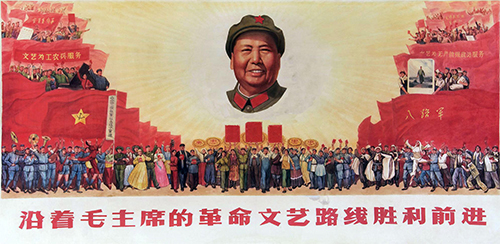
This propaganda poster literally depicts Chairman Mao as the sun that lights all of China
Cult of Personality: This occurs when a person in a position of authority (such as Mao Zedong) creates a political atmosphere in which they are worshipped as a godlike figure by the general population. See any of the many artworks produced between 1950 and 1976 that depict Chairman Mao as a benevolent father-figure to the Chinese people (such as that above).

Cultural Revolution: A movement that occurred between 1966 and 1976, in which Mao Zedong encouraged students and workers to rise up and rid China of revisionist and counterrevolutionary elements.

Dazibao: Chinese for 'Big Character Poster'. These are large handwritten posters used to protest, communicate propaganda, and express ideas. These were popular during both the Cultural Revolution and in the late 1970s Democracy Movement.

De-Stalinisation: In 1956 the new Russian Chairman, Nikita Khrushchev, began a process of deconstructing the cult of personality that had surrounded the previous Chairman, Joseph Stalin.

Feudalism: A medieval form of government in which landowners controlled the state, with peasants or serfs working the land in exchange for being allowed to live on said land. Much of China was still a feudal state by the mid-20th century.

Four Olds: Mao Zedong ordered the Red Guards of the Cultural Revolution to destroy the 'four olds' so that China could be rebuilt anew. These were: old thought, old culture, old customs, old habits. This resulted in much of China's ancient heritage being destroyed to make way for a new and modern communist China.

Four Modernisations: A program launched by Zhou Enlai in 1975 to assist with China's progress towards increased industrialisation. These modernisations were: Agriculture, Industry, National Defense, and Science/Technology.

Fifth Modernisation: A dazibao in 1978 that called upon the Chinese Communist Party to add 'Democracy' as a fifth aspect of the Four Modernisations.

The Gang of Four were blamed for all the horrors of the Cultural Revolution
Gang of Four: A radical faction within the Chinese Communist Party headed by Jiang Qing (Mao Zedong's wife). The Gang of Four opposed efforts to modernise China as they saw it as the 'poisonous road to capitalist restoration'. After Mao's death, the Gang of Four attempted to seize power but instead found themselves denounced and arrested as enemies of the state. 

Gerontocracy: A government ruled by the elderly. Protestors against the Chinese government in the 1980s derogatorily labelled Deng Xiaoping and other senior members of the Chinese Communist Party as a 'gerontocracy'.
Glasnost: A policy promoted by the Soviet Chairman, Mikhail Gorbachev, in the 1980s. This policy loosely translates as 'openness' and was characterised by the loosening of strictness in communist Russian society. 

Industrialisation: Widespread development of modern industries in a country.

Leftism: Political views or policies of the 'left' (those who identify with communism, Marxism, and socialism).

Liberalisation: The process of allowing increased freedom in Chinese society. Many members of the Chinese Communist Party in the 1980s feared that liberalisation would interfere with socialist progress.

Liberalism: The idea of a society founded on freedom, particular in regards to equality, free trade, and freedom to pursue personal wealth.

Marxism: A political system based on the teachings of Karl Marx, the philosopher who invented the theory of communism.

Maoism / Mao Zedong Thought: Chairman Mao's own interpretation of Marxism could be found in his Little Red Book, and featured several key differences in comparison to the Soviet/Marxist version of communism. One main difference was that Maoism focused on role of the peasants in the maintenance of a communist society.

Modernisation: The process in which countries develop from a traditional or feudal state into something industrialised and up-to-date.

People's Liberation Army: The Chinese army, who assisted Mao in winning the Civil War that led to the creation of communist China in 1949.

Perestroika: Translates as 'restructuring'. Perestroika were the reforms that the Soviet Union underwent in the 1980s before transitioning away from communism.

Permanent Revolution: The idea that communist revolution was an ongoing struggle between the social classes, and would continue until the entire world had become communist. Also links to the idea that Marxist societies, such as China, had to continue revisiting Marxist ideals in order to ensure that they stayed true to the spirit of communism.

Plenum: A political meeting in which all controlling members of the Chinese Communist Party had to be present.

Proletariat: The working / peasant class of a society.

Millions of Red Guards made the pilgrimage to Beijing to see Chairman Mao during the Cultural Revolution

Red Guards: The students encouraged by Chairman Mao to spearhead the Cultural Revolution were dubbed the 'Red Guards'. These students numbered in the millions and became fanatical devotees of Chairman Mao and his Little Red Book, vowing to fight those who wanted to bring capitalism to China. 

Rehabilitation: Enemies of the Cultural Revolution were sentenced to 'rehabilitation'. This often consisted of several years of forced labour that would teach capitalist roaders and revisionists how to be communist again.

Revisionism: Those who wanted to 'revise' communist society in China and allow increased freedom, or accumulation of personal power. These elements of Chinese society were criticised as 'revisionists'.

Rightist: Political views or policies of the 'right' (those who identify with nationalist and conservative ideologies).

Stalinism: The ideology of Marxism as practised by Joseph Stalin in the Soviet Union. Stalinism was extremely totalitarian in its control of Russian society.

Struggle Session: Those identified as enemies of the Cultural Revolution was made to undertake 'struggle sessions', in which they had to denounce and criticise themselves for hours at a time so that they could start afresh as true communists. These sessions also meant humiliation and torture at the hands of the Red Guards and, sometimes, death.

Westernisation: The increased adoption of Western (American/European) and capitalist culture in China.

Monday, April 3, 2017

Reading Roll: January-March 2017

Killing and Dying by Adrian Tomine
The title of this collection of stories by New Yorker artist Adrian Tomine is a reference to the last entry of the anthology in which an awkward teenage girl takes a stab at stand-up comedy (in comedian parlance 'killing' refers to the jokes that hit their mark, and 'dying' to the ones that don't). Tomine stretches the definition of a graphic novel here by experimenting with story length to essay his way through the lives of the mediocre and not-quite-marginalised, presenting the reader with six separate tales of unfulfilled dreams and painful pathos. The result is something profound and almost undefinable; with finely observed illustration adding depth where dialogue simply cannot.

Southern Bastards Volumes 1-3 by Jason Aaron and Jason Latour
I don't claim to be an aficionado of the admittedly obscure genre of 'rural noir' but what I know of it (Winter's Bone, No Country for Old Men, Deliverance, Frailty) I like. Southern Bastards is a relatively new series from Image comics that continues Image's incredible track record for pushing the envelope in the medium in terms of genre and narrative. Spanning two generations of small-town life, Southern Bastards revolves around Euless Boss, a very successful high school football coach who rules the southern town of Craw County, Alabama, with a BBQ-rib-sauce-stained fist. A perfect example of a story where setting is key, Southern Bastards seems deep-fried in all the worst that southern Americana has to offer. Absolutely mesmerising.


The Sellout by Paul Beatty
I can't think of the last time I read a book so self-aware, so accusatory yet confident, and so relentlessly sharp. The Sellout is a modern satire on race relations in America that deftly explores the following scenario: if segregation has been outlawed in America then why does it still exist in all but name? From the central conceit of a young black man bringing black slavery back, to the carefully-constructed setting and hilariously droll and exaggerated characters that simultaneously manage to both exploit and subvert a whole slew of ripe stereotypes, The Sellout is (so far) the book of the century. A must-read.

Bagombo Snuff Box by Kurt Vonnegut
As you may or may not have noticed from the name of this blog, Kurt Vonnegut is my favourite author. Bagombo Snuff Box was the last short story collection published by Vonnegut while he was still alive, and collects together the majority of his remaining unpublished work (mostly short stories from the 1950s that were published in a variety of magazines and newspapers). If this were a lesser author then you would say that this was the 'scraping the bottom of the barrel' volume but as it's Vonnegut even his worst is still better than most. Highlights include: '2 B R 0 2 B' (a vision of the future in which ageing has been cured) and 'A Present for Big Saint Nick' (a darkly hilarious mash-up of Chicago gangsters and Santa Claus-wannabes).
People's China by Craig Dietrich
You're going to see a few Chinese history titles here as I went on a bit of China-binge during the recent summer break. This particular title gives a great overview of the Cultural Revolution and the events leading into and out of it, and I would recommend it as a strong entry point for anyone wanting to know more about these events - especially considering that People's China was written in 1986, making it an invaluable pre-Tiananmen Square Incident text.

Deng Xiaoping by Alexander V. Pantsov and Steven I. Levine
This recent biography of Deng Xiaoping promises to present the most objective depiction of Chairman Mao's most influential successor, eschewing both right wing and left wing interpretations of the 'great reformer' in order to present a more centrist and multi-faceted view. Most interestingly, the author asks the reader not to view Deng as the antithesis of Mao in any way. Deng did take a less despotic approach to leadership than his predecessor, however, there are also examples of Mao actually reigning in Deng's more murderous actions back in the 1950s - belying the idea that Deng Xiaoping was automatically the antidote to all the insanity that Mao had wreaked on China during the Great Leap Forward and Cultural Revolution.

China Without Mao by Immanuel C. Y. Hsu
Of all the books I read on China, China Without Mao was the only one written by a Chinese historian (albeit one who was an ex-patriot). Having been written less than 10 years after Mao's death, this history is one that defines itself somewhat immediately in terms of how communist-China has developed in Mao's absence - covering the fallout of the Cultural Revolution, the murmurings of democratic rebellion among intellectuals in the late 1970s, and conservative Deng Xiaoping's often contradictory drive to modernise China. The edition I read also has (a much-needed) postscript in which Hsu dissects the 1989 Tiananmen Square Incident and what it means to China.

The Cultural Revolution by Frank Dikotter
Frank Dikotter reconstructs China's most problematic area of history through the stories of the people who lived it, providing a balanced and up-to-date account of the chaotic politics that fueled an astonishing series of events. I found this particular history book quite invaluable in my researching of modern Chinese history, being as it zeroes in on Mao's revolution quite definitively whilst also providing some much needed context on the contributing factors and wide-reaching consequences.

Mao's China and After by Maurice Meisner
Meisner's history was written in 1977. This means, from a historian's perspective, it's a useful view of what people were thinking about the Cultural Revolution right as it had gasped its dying breath. Meisner has the view of a Westerner but nonetheless includes more than sufficient levels of detail and research to give his text the ring of authenticity.

Outliers by Malcolm Gladwell
This book blew my mind. Gladwell launches a paradigm-shifting study of success and how we understand it (or, more accurately, don't understand it). Of most significance is Gladwell's belief that success is all about opportunity rather than inherent greatness, something that he exhaustively sets about proving with a wide-ranging study of everything from hockey teams and Asian mathematicians to game show winners and feuding hillbillies. Gladwell is so comprehensive and illuminating in his writing and research that I think just about anyone who read this would be hard-pressed to not believe in his vision of success. It also helps that Gladwell's thesis is supported by the essential idea that the key to success is simply hard work (he writes extensively on the 10 000 hour rule here), which eschews all the quick fixes and god-given perspectives of effectiveness that most people would prefer to believe in.

Fight Like a Girl by Clementine Ford
It's hard for me to offer a critique of Clementine Ford's feminist call-to-arms without feeling like I'm somehow slipping into a criticism that reflects the inherently patriarchal nature of our society. I know that, in light of the 2010s resurgence in feminism and anti-feminism, talk of patriarchal structures can come off as sounding satirical but, honestly, Ford does such a great job of exploring the language and inherent biases purveyed by Australian and online communities that it's hard not to feel convinced. And even if you're put off by the idea of someone angrily tearing apart misogynist ideologies, there's still a lot of other stuff in Fight Like a Girl worth recommending. It's easy to latch onto the more controversial aspects of Ford's essays at the expense of recognising how genuinely funny she is, and how closely she shears to the bones of her own story in the most personal of ways. 

Swallow Me Whole by Nate Powell
Nate Powell has grown in stature of late as one of the pre-eminent names in graphic novel auteurship, and Swallow Me Whole is worth checking out as one of his earlier standout pieces. Part coming-of-age, part exploration of serious mental illness; Powell's exploration of a young woman's descent into schizophrenia is symbolically unsettling and somewhat bittersweet. It's also a masterclass in the use of the unique nature of the graphic novel to convey a narrative, with Powell ditching the use of dialogue at key points to profoundly immerse the reader in his protagonist's world.


Paper Girls Volumes 1-2 by Brian K. Vaughan
Paper Girls does for comics what Super 8 did for film and Stranger Things did for TV: revisit the zeitgeist of Spielbergian pre-teen adventure in order to effectively mine the collective nostalgia of so many genre fans who grew up in the 1980s. Brian K. Vaughan is already known for two massive sci-fi comic hits - Y The Last Man and Saga - and with Paper Girls he confidently goes three-for-three. It's probably safe to say that Paper Girls somehow trumps the weirdness of those other two series whilst paradoxically remaining more grounded through the use of a specific time period. It also helps that the effortlessly engaging narrative and well-drawn characters are perfectly complimented by the luridly apt blue-and-pink colour palette.

East of West Volumes 1-2 by Jonathan Hickman
What have I been doing without this comic series? It took a little while for me to warm to the blatantly mythic elements that scream 'epic showdown' right from the opening panels but I learned that in order to come to grips with Hickman's ambitious alternative-history I just had to go with it. This fantasy/sci-fi dystopia is almost overwhelming in its inventiveness. Native American shape-shifters that stalk the wastelands of a westernpunk America would be enough to fuel an exciting and original series all on its own, however, when teamed up with a futuristic and blood-soaked Maoist San Francisco, the Four Horsemen of the Apocalypse, and numerous other bold additions to a version of America that never quite broke free of the 19th century, the result is startling and hard to shake from the imagination. A great title that shows what a gifted storyteller can do with the medium of the comic.
The Secret River by Kate Grenville
Kate Grenville's bestselling historical novel is wonderfully evocative and carefully constructed, piecing together convict and settler histories of Sydney and the defiant remnants of an Indigenous culture that may never recover from the wrongs visited upon them in the last 220 years. The Secret River is the story of the Hawksbury River, and the uneasy meeting between emancipated convicts and the Dharug people that took place in the early years of Australia's settlement by the British. Grenville employs a a style of prose at once both immediate and distant, suggesting a certain sense of empathy but also reminding the reader that what they're 'witnessing' is a representation of actual history. I got a lot out of this book - it's incredibly well-written and rings true.
Embroideries by Marjane Satrapi
This anecdotal collection of memoirs explores the sexual politics of being a woman in Iran during the Islamic Revolution, and is set 'within' the main narrative of Satrapi's more famous work Persepolis. It's a rather brisk graphic novella that uses a traditional female-centric social gathering as a jumping off point for a range of interesting stories that subvert the way the West stereotypically sees Muslim women. Fans of Persepolis will enjoy Satrapi's patented combination of the hidden history of Iran and irreverent humour.

Criminal: Coward by Ed Brubaker and Sean Phillips
Leo is a professional criminal who has made his name for two very specific reasons: he's an excellent thief, and his strict adherence to a code of 'cowardice' ensures that he always lives to steal another day. This excellent, stand-alone noir comic has all the familiar tropes and hallmarks of the crime genre without feeling tired or cliched. Brubaker and Philips deftly control their exploration of generic conventions in a way that allows Leo's story to feel simultaneously pulpish, hard-boiled, and authentic. I was hooked from beginning to end.  
 

The Salty River by Jan Bauer
This graphic novel memoir tells the story of a German backpacker's journey of love and self-discovery in the Australian outback. The content feels a bit slim at times but Bauer's artwork is often beautiful and well-observed, and he does a good job of capturing the emptiness and yearning of Australia's often haunting environment. 


DMZ Volumes 5-12 by Brian Wood
Brian Wood's dystopian opus of an imagined Second American Civil War was something I previously touched on here. In the rest of the series, Wood explores his ideas with the kind of political depth usually reserved for academic journals and classics of literature, yet he manages to do it in the comic book form with almost casual aplomb. Essaying a complex cast of characters with a similarly deft quality that made TV's The Wire such an endurable intellectual classic of corruption, DMZ charts the journey of journalist Matty Roth as he lives, breathes, and kills his way through the disturbing no man's land of Manhattan that sits between the military complex of the United States of America and the insurgent Free States who have risen up as a domestic response to post-9/11 interference in the affairs of the rest of the world. A true 21st century literary classic.

Concrete Island by J. G. Ballard
There was something delightfully dotty and twisted that appealed to my sensibilities when I read the high concept blurb on the back of this J.G. Ballard novel. Concerning a modern-day Robinson Crusoe who finds himself stranded on the 'concrete island' between highways after a car accident, this novella mixes satire, the speculative nature of dystopian fiction, and survivalist adventure. In other terms, Concrete Island concerns itself with a high flying company executive who must come to terms with facing the rest of his life trapped in the worst corner one could ever hope to inhabit in the primordial urban sprawl of the increasingly emergent capitalist world of 1970s London. This is the second Ballard I've read but it's already clear to me that he has his whole own thing going on in speculative fiction, and I'll definitely be reading more of his stuff in the near future. 

The No. 1 Ladies' Detective Agency by Alexander McCall Smith
Alexander McCall Smith is so prolific that, despite only being published in the last 20 years, he has already written 100 novels. It's safe to say that his most famous creation is Mme Precious Ramotswe, the owner of the one-woman Batswana detective agency of the title. This episodic novel eschews the kind of intricate and highly involved plot that one might expect from the crime genre in favour of focusing instead of Mme Ramotswe herself as she charmingly finger-wags her way through a series adventures amidst a variety of colourful characters in post-colonial Southern Africa. McCall Smith's transportation of Agatha Christie-like tropes into an exotic locale breeds a hybrid that stands so confidently on its own two African feet that it's very easy indeed to see how Mme Ramotswe went on to star in at least 16 more novels. 

1599: A Year in the Life of William Shakespeare by James Shapiro
Shakespearean scholar James Shapiro meticulously and miraculously constructs Elizabethan England in reference to the Bard's life, creating a tour de force of historical context behind perhaps the most significant year of Shakespeare's life. In the year of 1599, Shakespeare's creative talents exploded with four of his most famous plays - Henry V, Julius Caesar, As You Like It, and Hamlet - and Shapiro does an astounding job of exploring the conditions that could have birthed such an unprecedented imaginative output. An absolute must for anyone teaching Hamlet, and a text that is grist as much for the History student's mill as it is for those who study English.


The Man in the High Castle by Philip K. Dick
This was my first Philip K. Dick and I really did not enjoy it at all. I appreciate the concept of an alternate history where 1960s America has been divided up between the Nazis and the Japanese, and there are some interesting parallels between this alternate history with our own history and a third history posited by the book-within-a-book authored by the eponymous high castle guy. What I could not get past, however, was how mindnumbingly pedestrian the plot was, the way the book jumped between several characters who existed solely to show different aspects of Dick's vision (whilst fulfiling no actual function in terms of plot advancement), and the misguided suggestion that the Japanese Empire of WWII was inherently more humane than the Nazis. I know the Nazis were responsible for Some Very Bad Things, but Japan's own atrocity-laden history in the 1930s and 1940s is arguably just as horrific, and the way Dick positions a Japanese-American government as the last line of defence between peaceful co-existence and the insane plans of a 1960s Nazi regime is just offensive. I honestly do not get what all the fuss is about with this famed novel.


Talking to My Country by Stan Grant
This memoir examines the concepts of Aboriginality, cultural identity in a hybrid-society, and the inherent inequalities that continue to fuel the gap between the Indigenous and non-Indigenous in Australia. Stan Grant explores this confronting division in our country via his own personal experiences, and does so with astonishing frankness and unabashed emotion. The candid nature of his storytelling had me turning pages quite rapidly, and I was moved at several points by his anger, sadness, frustration, and dwindling sense of hope for a potentially brighter future.

Ghost World by Daniel Clowes
I watched the film Ghost World back when it first came out, some 17 years ago, and I liked it a lot. It was funny and wistful and bittersweet, and had a quirky listless quality that exemplified the apotheosis of indie filmmaking in the early '00s. These days I'm firmly ensconced in exploring the canon of graphic novels and finally got around to reading Daniel Clowes' serialised exploration of post-school disaffection. I was surprised by how different the graphic novel was to the film. Although the essence and tone was basically the same, the plot and characters are vastly different - like, almost completely different texts. Anyway! Comparisons aside, Ghost World-the-graphic-novel is a darkly hilarious and sometimes disturbing look at the crossroads of life as experienced by two teenage girls after they finish high school. Enid and Rebecca are two of the great indie-comic creations of the 1990s, and exist in a pop culture bubble that represents a time and place as much as they do more universal themes of coming-of-age.

Hamlet by William Shakespeare
Ah, Hamlet. What can be said that hasn't been said before? This is my third time reading what is arguably the Bard's most famous play, and the first time I've read it in my 30s. The previous times were when I was about 27, and again before that when I was 17 and in Year 12. This year I'll be 37 so I guess that means I've read it approximately once every ten years. Maybe I'll make a habit of it. Anyway, reading Hamlet in my 30s was a completely different experience to my prior readings... I'm now convinced that there isn't a shred of madness to the Danish prince and that every decision he makes in his course of revenge is justifiably cautious. I guess my impression comes with the realisation that the Ghost may not be intended by Shakespeare to be Hamlet's dead father at all but an agent of the Devil. Maybe I'll change my mind again. I'll let you know in 2027. 


Blake and Mortimer: The Yellow 'M' by Edgar P. Jacobs
Taking its cues from Tintin, the Blake and Mortimer series of the 1950s is a pulp comic title of the ligne claire style, depicting all the espionage and derring-do of Tintin's adventures without any of the inventiveness or finesse. I guess my disappointment stems from hoping that I would dip into this series and find a whole new serial of Tintin-like excitement but, eh... it was just really naff. I love the artwork, and I love the pulp tropes that power it along, but man, the dialogue is so lame and exposition-heavy, and the characterisation is ridiculously paper-thin. I'm not sure if I'll read any more of this series.